
Sku: WP7100

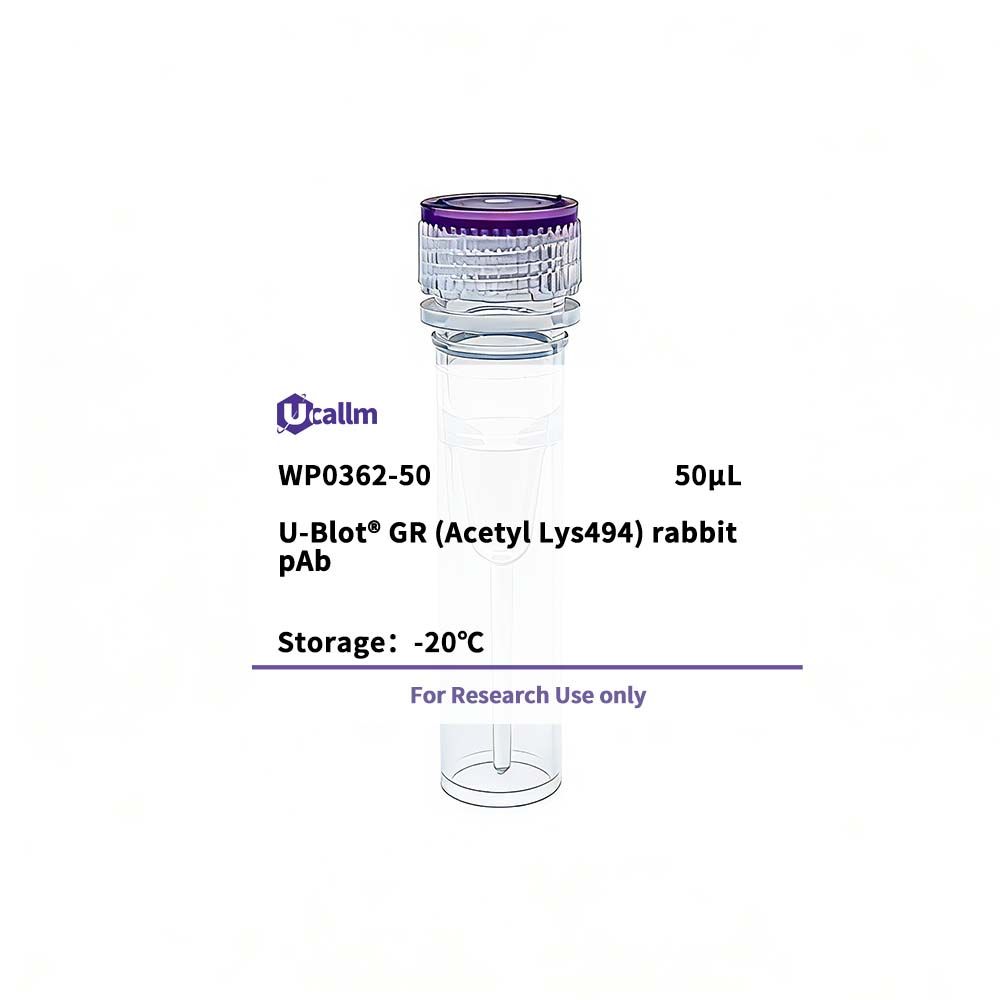
Catalog No.: WP0362
Specification: 50μL/100μL
Stock: In stock
U-Blot® GR (Acetyl Lys494) rabbit pAb Learn more
Background:alternative products:At least 4 isoforms, Alpha (shown here), Alpha-B, Beta and Beta-B, are produced by alternative initiation at Met-1 and Met-27. The existence of isoform Alpha and isoform Alpha-B has been proved by mutagenesis. As the sequence environment of the 2 potential ATG initiator codons is the same for the other altrnatively spliced isoforms, alternative initiation of translation could also occur on these transcripts. Additional isoforms seem to exist,disease:Defects in NR3C1 are a cause of glucocorticoid resistance [MIM:138040]; also known as cortisol resistance. It is a hypertensive, hyperandrogenic disorder characterized by increased serum cortisol concentrations. Inheritance is autosomal dominant.,domain:Composed of three domains: a modulating N-terminal domain, a DNA-binding domain and a C-terminal steroid-binding domain.,function:Receptor for glucocorticoids (GC). Has a dual mode of action: as a transcription factor that binds to glucocorticoid response elements (GRE) and as a modulator of other transcription factors. Affects inflammatory responses, cellular proliferation and differentiation in target tissues. Could act as a coactivator for STAT5-dependent transcription upon growth hormone (GH) stimulation and could reveal an essential role of hepatic GR in the control of body growth. Involved in chromatin remodeling. Plays a significant role in transactivation. Involved in nuclear translocation.,miscellaneous:Can up- or down-modulate aggregation and nuclear localization of expanded polyglutamine polypeptides derived from AR and HD through specific regulation of gene expression. Aggregation and nuclear localization of expanded polyglutamine proteins are regulated cellular processes that can be modulated by this receptor, a well-characterized transcriptional regulator.,miscellaneous:High constitutive expression of isoform beta by neutrophils may provide a mechanism by which these cells escape glucocorticoid-induced cell death. Up-regulation by proinflammatory cytokines such as IL8 further enhances their survival in the presence of glucocorticoids during inflammation.,online information:Glucocorticoid receptor entry,polymorphism:Carriers of the 22-Glu-Lys-23 allele are relatively more resistant to the effects of GCs with respect to the sensitivity of the adrenal feedback mechanism than non-carriers, resulting in a better metabolic health profile. Carriers have a better survival than non-carriers, as well as lower serum CRP levels. The 22-Glu-Lys-23 polymorphism is associated with a sex-specific, beneficial body composition at young-adult age, as well as greater muscle strength in males.,PTM:Increased proteasome-mediated degradation in response to glucocorticoids.,PTM:Phosphorylated in the absence of hormone; becomes hyperphosphorylated in the presence of glucocorticoid. The Ser-203-phosphorylated form is mainly cytoplasmic, and the Ser-211-phosphorylated form is nuclear. Transcriptional activity correlates with the amount of phosphorylation at Ser-211.,PTM:Sumoylated; this reduces transcription transactivation.,PTM:Ubiquitinated; restricts glucocorticoid-mediated transcriptional signaling.,similarity:Belongs to the nuclear hormone receptor family. NR3 subfamily.,similarity:Contains 1 nuclear receptor DNA-binding domain.,subcellular location:Cytoplasmic in the absence of ligand, nuclear after ligand-binding.,subunit:Heteromultimeric cytoplasmic complex with HSP90, HSP70, and FKBP5 or another immunophilin, or the immunophilin homolog PPP5C. Directly interacts with UNC45A. Upon ligand binding FKBP5 dissociates from the complex and FKBP4 takes its place, thereby linking the complex to dynein and mediating transport to the nucleus, where the complex dissociates (By similarity). Binds to DNA as a homodimer, and as a heterodimer with NR3C2 or the retinoid X receptor. Binds STAT5A and STAT5B homodimers and heterodimers. Interacts with NRIP1, POU2F1, POU2F2 and TRIM28. Interacts with NCOA1, NCOA3, SMARCA4, SMARCC1, SMARCD1, and SMARCE1 (By similarity). Interacts with several coactivator complexes, including the SMARCA4 complex, CREBBP/EP300, TADA2L and p160 coactivators such as NCOA2 and NCOA6. Interaction with BAG1 inhibits transactivation. Interacts with HEXIM1, PELP1 and TGFB1I1.,tissue specificity:Widely expressed. In the heart, detected in left and right atria, left and right ventricles, aorta, apex, intraventricular septum, and atrioventricular node as well as whole adult and fetal heart.,
ucallm
Datasheet, COA, SDS, and protocol files can be requested from technical support.
Emailinfo@ucallmlabs.com
Phone+(1)-866-986-9598
WeChat / IMUcallm-Tech
HoursMonday-Friday 09:00-18:00 CST
Sku: WP7100

Sku: WP6801
Sku: WP9999

Sku: WP9998
Sku: WP9997