
Sku: WP7100

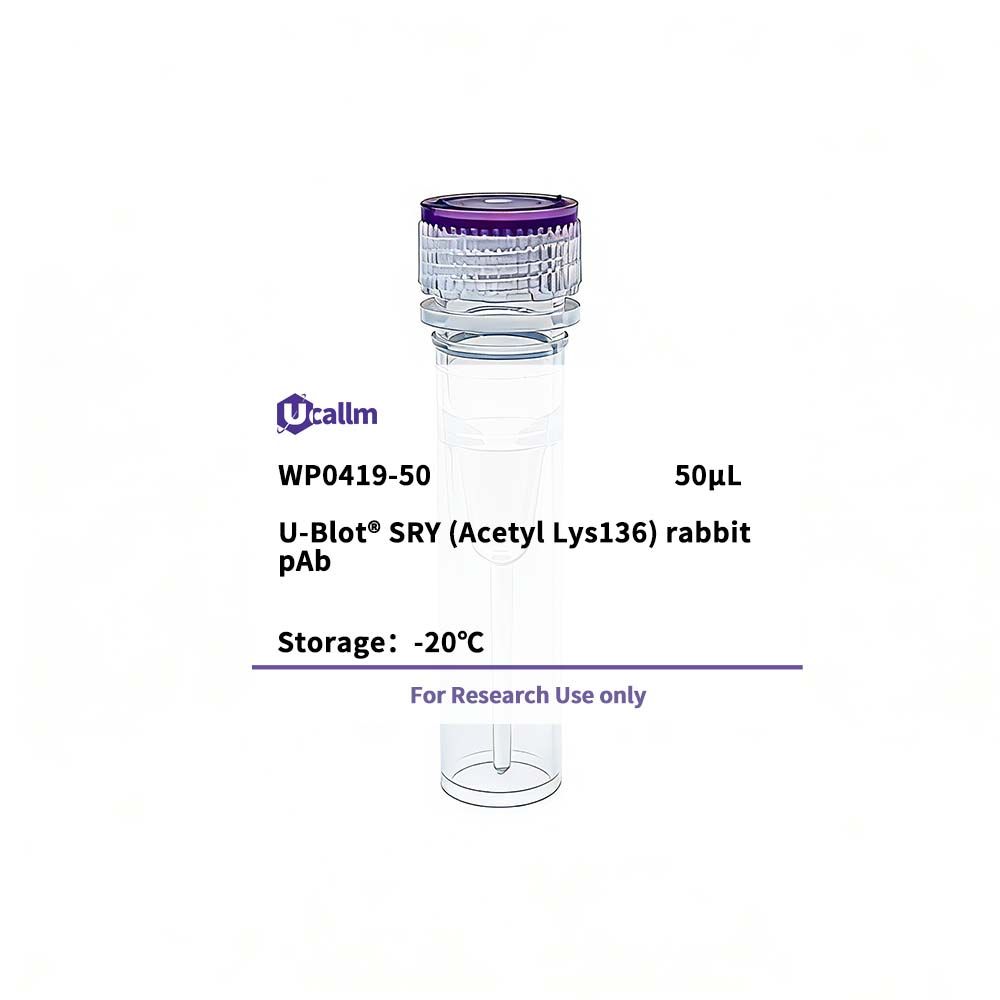
Catalog No.: WP0419
Specification: 50μL/100μL
Stock: In stock
U-Blot® SRY (Acetyl Lys136) rabbit pAb Learn more
Background:disease:Defects in SRY are a cause of gonadal dysgenesis XY female type (GDXY) [MIM:306100]; also known as 'XY females' or Swyer syndrome. Patients are found to have a 46,XY karyotype. They suffer rapid and early degeneration of their gonads, which are present in the adult as 'streak gonads', consisting mainly of fibrous tissue and variable amounts of ovarian stroma. As a result these patients do not develop secondary sexual characteristics at puberty. The external genitalia in these subjects are completely female, and Muellerian structures are normal. In contrast, subjects with 46,XY partial gonadal dysgenesis have ambiguous genitalia, a mix of Muellerian and Wolffian structures, and dysgenic gonads.,disease:Defects in SRY are a cause of true hermaphroditism [MIM:235600]. A true hermaphrodite must have both mature ovarian and mature testicular tissue with histologic evidence of follicles and tubules, respectively. It is a genetically heterogeneous condition. The genotype of most affected individuals is 46,XX, but many have 46,XY or a mosaic of 46,XX/46,XY. True hermaphroditism can be caused also by chromosomal translocation.,disease:Defects in SRY are found in Turner syndrome, a disease characterized by gonadal dysgenesis with short stature, "streak gonads", variable abnormalities such as webbing of the neck, cubitus valgus, cardiac defects, low posterior hair line. The phenotype is female. Turner syndrome has its basis in a 45,X chromosomal aberration.,function:Transcriptional regulator which control a genetic switch in male development. It is necessary and sufficient for initiating male sex determination by directing the development of supporting cell precursors (pre-Sertoli cells) as Sertoli rather than granulosa cells (By similarity). In male adult brain involved in the maintenance of motor functions of dopaminergic neurons (By similarity). Involved in different aspects of gene regulation including promoter activation or repression (By similarity). Facilitates DNA bending. SRY HMG box recognizes DNA by partial intercalation in the minor groove. Also involved in pre-mRNA splicing. Binds to the DNA consensus sequence 5'-[AT]AACAA[AT]-3'.,miscellaneous:DNA binding and bending properties of the HMG domains of human and mouse SRY differ form each other. Human SRY shows more extensive minor groove contacts with DNA and a lower specificity of sequence recognition than mouse SRY.,online information:SRY entry,online information:The tenuous nature of sex - Issue 80 of March 2007,PTM:Phosphorylated on serine residues by PKA. Phosphorylation by PKA enhances its DNA-binding activity and stimulates transcription repression. Acetylation of Lys-136 contributes to its nuclear localization and enhances its interaction with KPNB1. Deacetylated by HDAC3. Poly-ADP-ribosylated by PARP1. ADP-ribosylation reduces its DNA-binding activity.,similarity:Belongs to the SRY family.,similarity:Contains 1 HMG box DNA-binding domain.,subcellular location:Colocalizes with SOX6 in speckles. Colocalizes with CAML in the nucleus. Colocalizes in the nucleus with ZNF208 isoform KRAB-O and tyrosine hydroxylase (TH).,subunit:Interacts with CALM, EP300, HDAC3, KPNB1, ZNF208 isoform KRAB-O, PARP1, SLC9A3R2 and WT1. The interaction with EP300 modulates its DNA-binding activity. The interaction with KPNB1 is sensitive to dissociation by Ran in the GTP-bound form (By similarity). Interaction with PARP1 impaired its DNA-binding activity.,
ucallm
Datasheet, COA, SDS, and protocol files can be requested from technical support.
Emailinfo@ucallmlabs.com
Phone+(1)-866-986-9598
WeChat / IMUcallm-Tech
HoursMonday-Friday 09:00-18:00 CST
Sku: WP7100

Sku: WP6801
Sku: WP9999

Sku: WP9998
Sku: WP9997