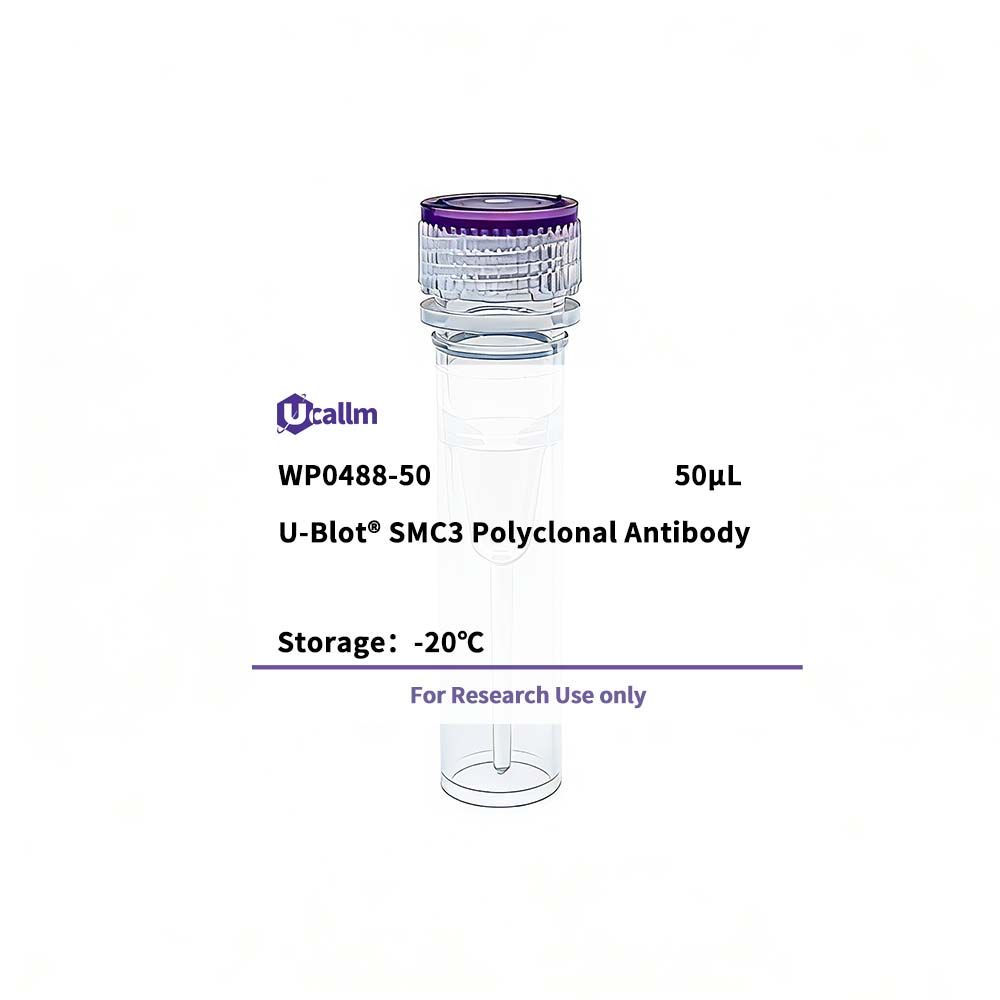
- Target
- SMC3
- Reactivity
- Human,Mouse,Rat
- Application
- WB,ELISA
- MW(Calculated)
- --
- MW(Observed)
- 133kD
- Host Species
- Rabbit
- Isotype
- IgG
- Conjugate/Modification
- Unmodified
- Modification site
- --
- Recommended Dilution Ratio
- WB 1:500-2000;ELISA 1:5000-20000
- Form
- PBS, 50% glycerol, 0.05% Proclin 300, 0.05%BSA
- Source
- --
- Purification
- The antibody was affinity-purified from rabbit antiserum by affinity-chromatography using epitope-specific immunogen.
- Purity
- --
- storageCondition
- -15°C to -25°C/1 year(Do not lower than -25°C)
- Concentration
- 1 mg/ml
- Clonality
- Polyclonal
- Clone No.
- --
- Immunogen
- Synthesized peptide derived from human protein . at AA range: 1010-1090
- Sequence
- --
- Specificity
- SMC3 Polyclonal Antibody detects endogenous levels of protein.
- Gene Name
- SMC3 BAM BMH CSPG6 SMC3L1
- Protein Name
- Structural maintenance of chromosomes protein 3 (SMC protein 3) (SMC-3) (Basement membrane-associated chondroitin proteoglycan) (Bamacan) (Chondroitin sulfate proteoglycan 6) (Chromosome-associated polypeptide) (hCAP)
- Other Name
- Structural maintenance of chromosomes protein 3;SMC protein 3;SMC-3;Basement membrane-associated chondroitin proteoglycan;Bamacan;Chondroitin sulfate proteoglycan 6;Chromosome-associated polypeptide;hCAP;
- Organism-1
- Human
- Gene ID-1
- 9126
- SwissProt-1
- Q9UQE7
- Organism-2
- Mouse
- Gene ID-2
- --
- SwissProt-2
- Q9CW03
- Organism-3
- Rat
- Gene ID-3
- --
- SwissProt-3
- P97690
- Organism-4
- --
- gene ID-4
- --
- SwissProt-4
- --
- Cellular Localization
- Nucleus . Chromosome . Chromosome, centromere . Associates with chromatin. Before prophase it is scattered along chromosome arms. During prophase, most of cohesin complexes dissociate from chromatin probably because of phosphorylation by PLK, except at centromeres, where cohesin complexes remain. At anaphase, the RAD21 subunit of the cohesin complex is cleaved, leading to the dissociation of the complex from chromosomes, allowing chromosome separation. The phosphorylated form at Ser-1083 is preferentially associated with unsynapsed chromosomal regions (By similarity). .