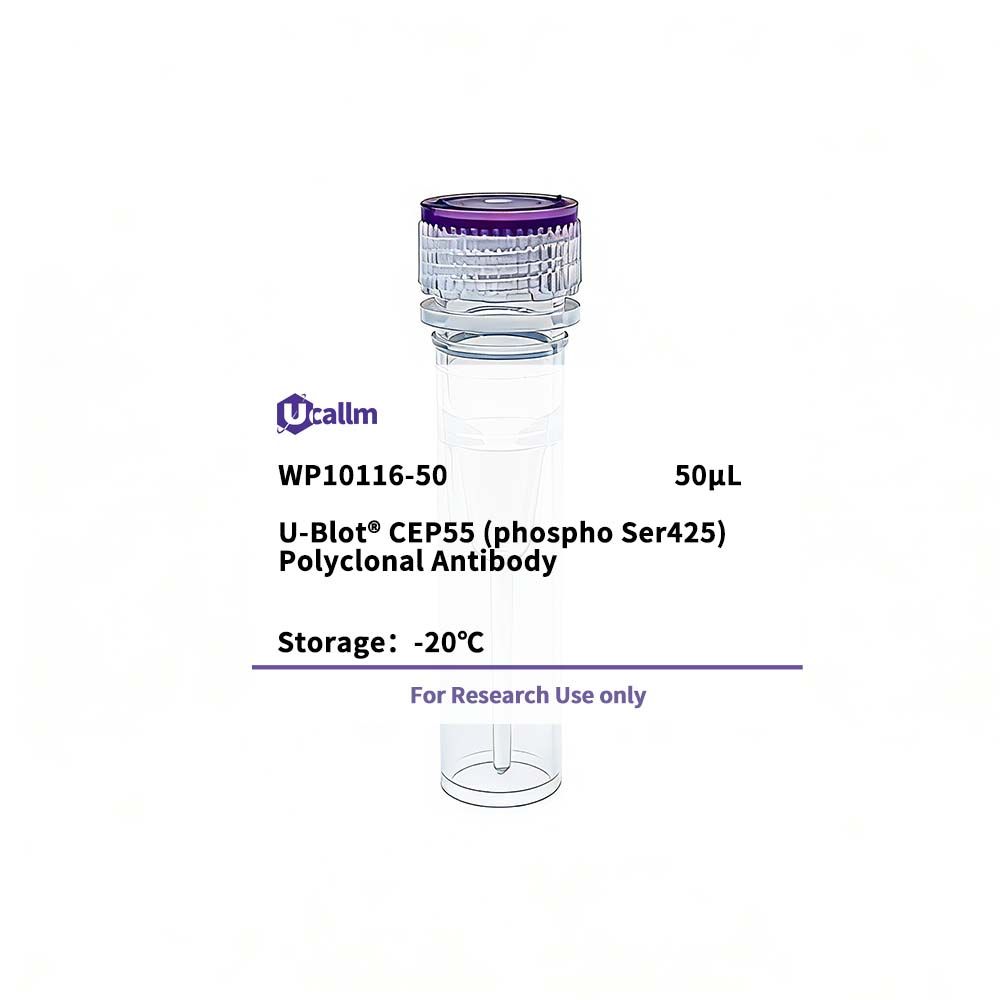
U-Blot® CEP55 (phospho Ser425) Polyclonal Antibody

U-Blot® CEP55 (phospho Ser425) Polyclonal Antibody
$288.00
Size:50μL
SKU: WP10116-50

Catalog No.: WP10116

Specification: 50μL/100μL

Stock: In stock

U-Blot® CEP55 (phospho Ser425) Polyclonal Antibody Learn more

Product information

Background:function:Plays a role in mitotic exit and cytokinesis. Not required for microtubule nucleation. Recruits PDCD6IP and TSG101 to midbody during cytokinesis.,PTM:There is a hierachy of phosphorylation, where both Ser-425 and Ser-428 are phosphorylated at the onset of mitosis, prior to Ser-436. Phosphorylation at Ser-425 and Ser-428 is required for dissociation from the centrosome at the G2/M boundary. Phosphorylation at the 3 sites, Ser-425, Ser-428 and Ser-436, is required for protein function at the final stages of cell division to complete cytokinesis successfully.,subcellular location:Present at the centrosomes at interphase. A small portion is associated preferentially with the mother centriole, whereas the majority localizes to the pericentriolar material. During mitosis, loss of affinity for the centrosome at the onset of prophase and diffusion throughout the cell. This dissociation from the centrosome is phosphorylation-dependent. May remain localized at the centrosome during mitosis in certain cell types. Appears at the cleavage furrow in late anaphase and in the midbody in cytokinesis.,subunit:Homodimer. Interacts (phosphorylated on Ser-425 and Ser-428) with PLK1. Interacts with AKAP9; the interaction occurs in interphase and is lost upon mitotic entry. Interacts with PCNT; the interaction occurs in interphase and is lost upon mitotic entry. Interacts with PDCD6IP; the interaction is direct; CEP55 binds PDCD6IP in a 2:1 stoechiometry; PDCD6IP competes with TSG101 for the same binding site. Interacts with TSG101; TSG101 competes with PDCD6IP for the same binding site; interaction is required for cytokinesis but not for viral budding. Interacts with FAM125A, VPS37B, VPS37C and VPS28.,tissue specificity:Widely expressed, mostly in proliferative tissues. Highly expressed in testis. Intermediate levels in adult and fetal thymus, as well as in various cancer cell lines. Low levels in different parts of the digestive tract, bone marrow, lymph nodes, placenta, fetal heart and fetal spleen. Hardly detected in brain.,

Product Overview

Catalog No.
WP10116
SKU
WP10116-50
Category
Polyclonal antibodies
Product Type
Other
Size
50μL/100μL
Stock Status
In stock
Available Stock
20
Minimum Order Quantity
1

Storage & Compliance

Storage
-15°C to -25°C/1 year(Do not lower than -25°C)
Research Use Only
Yes

Additional Specifications

Target
CEP55
Reactivity
Human,Rat,Mouse,
Application
IHC,IF,WB,ELISA
MW(Calculated)
54kD
MW(Observed)
--
Host Species
Rabbit
Isotype
IgG
Conjugate/Modification
Phospho
Modification site
--
Recommended Dilution Ratio
WB 1:500-2000;IHC 1:100-1:300;ELISA 1:20000;IF 1:50-200
Form
Liquid in PBS containing 50% glycerol, 0.5% BSA and 0.02% sodium azide.
Source
--
Purification
The antibody was affinity-purified from rabbit antiserum by affinity-chromatography using epitope-specific immunogen.
Purity
--
storageCondition
-15°C to -25°C/1 year(Do not lower than -25°C)
Concentration
1 mg/ml
Clonality
Polyclonal
Clone No.
--
Immunogen
Synthesized phospho-peptide around the phosphorylation site of human CEP55 (phospho Ser425)
Sequence
--
Specificity
Phospho-CEP55 (S425) Polyclonal Antibody detects endogenous levels of CEP55 protein only when phosphorylated at S425.
Gene Name
CEP55
Protein Name
Centrosomal protein of 55 kDa
Other Name
CEP55;C10orf3;URCC6;Centrosomal protein of 55 kDa;Cep55;Up-regulated in colon cancer 6
Organism-1
Human
Gene ID-1
55165
SwissProt-1
Q53EZ4
Organism-2
Mouse
Gene ID-2
--
SwissProt-2
Q8BT07
Organism-3
--
Gene ID-3
--
SwissProt-3
--
Organism-4
--
gene ID-4
--
SwissProt-4
--
Cellular Localization
Cytoplasm . Cytoplasm, cytoskeleton, microtubule organizing center, centrosome, centriole . Cytoplasm, cytoskeleton, microtubule organizing center, centrosome . Cleavage furrow . Midbody, Midbody ring . Present at the centrosomes at interphase. A small portion is associated preferentially with the mother centriole, whereas the majority localizes to the pericentriolar material. During mitosis, loses affinity for the centrosome at the onset of prophase and diffuses throughout the cell. This dissociation from the centrosome is phosphorylation-dependent. May remain localized at the centrosome during mitosis in certain cell types. Appears at the cleavage furrow in late anaphase and in the midbody in cytokinesis. .

Tech Support

ucallm

01

Documents

Datasheet, COA, SDS, and protocol files can be requested from technical support.

02

Storage & Handling

Storage
-15°C to -25°C/1 year(Do not lower than -25°C)
06

Contact Support

Emailinfo@ucallmlabs.com

Phone+(1)-866-986-9598

WeChat / IMUcallm-Tech

HoursMonday-Friday 09:00-18:00 CST

Request Technical Support
Keywords:Polyclonal antibodies