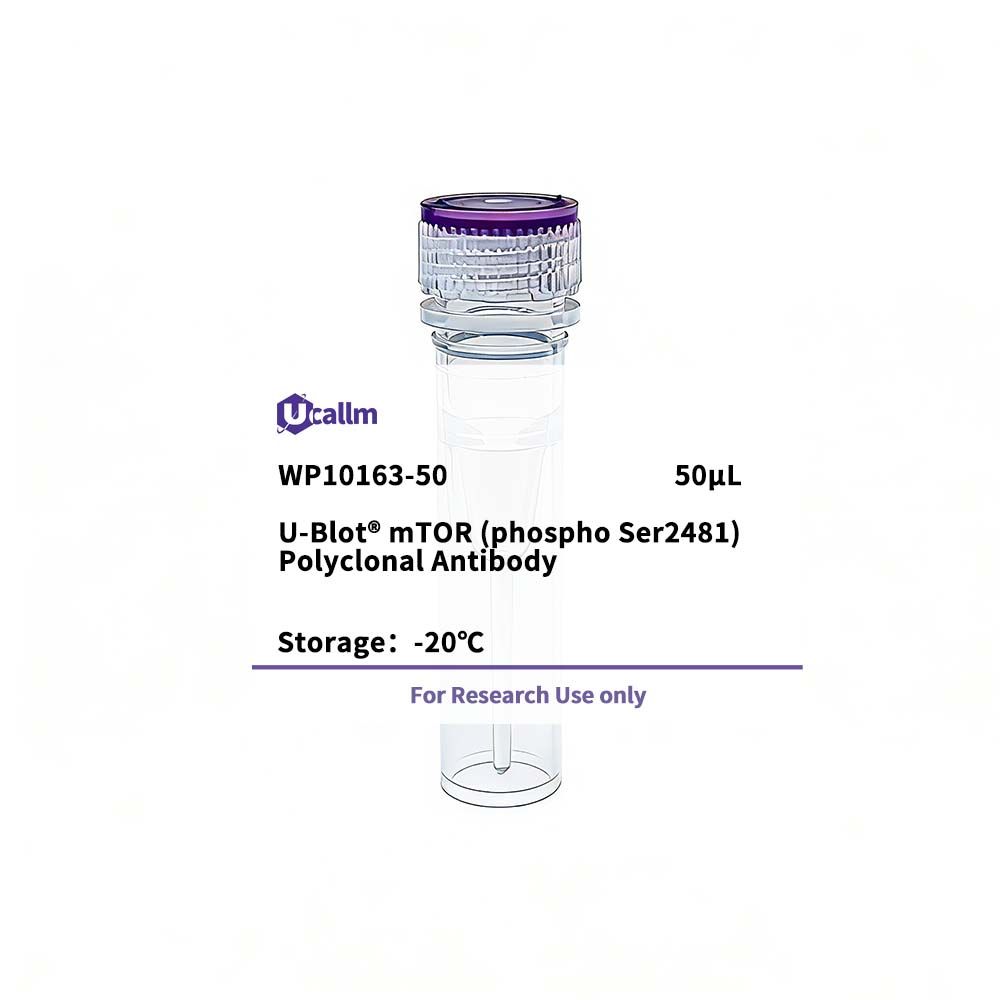
- Target
- mTOR
- Reactivity
- Human,Mouse,Rat,Bovine
- Application
- WB,IHC,IF,ELISA
- MW(Calculated)
- 289kD
- MW(Observed)
- --
- Host Species
- Rabbit
- Isotype
- IgG
- Conjugate/Modification
- Phospho
- Modification site
- --
- Recommended Dilution Ratio
- IHC 1:100-1:300;IF 1:200-1:1000;ELISA 1:20000;WB 1:500-2000
- Form
- Liquid in PBS containing 50% glycerol, 0.5% BSA and 0.02% sodium azide.
- Source
- --
- Purification
- The antibody was affinity-purified from rabbit antiserum by affinity-chromatography using epitope-specific immunogen.
- Purity
- --
- storageCondition
- -15°C to -25°C/1 year(Do not lower than -25°C)
- Concentration
- 1 mg/ml
- Clonality
- Polyclonal
- Clone No.
- --
- Immunogen
- The antiserum was produced against synthesized peptide derived from human mTOR around the phosphorylation site of Ser2481. AA range:2447-2496
- Sequence
- --
- Specificity
- Phospho-mTOR (S2481) Polyclonal Antibody detects endogenous levels of mTOR protein only when phosphorylated at S2481.
- Gene Name
- MTOR
- Protein Name
- Serine/threonine-protein kinase mTOR
- Other Name
- MTOR;FRAP;FRAP1;FRAP2;RAFT1;RAPT1;Serine/threonine-protein kinase mTOR;FK506-binding protein 12-rapamycin complex-associated protein 1;FKBP12-rapamycin complex-associated protein;Mammalian target of rapamycin;mTOR;Mechanistic tar
- Organism-1
- Human
- Gene ID-1
- 2475
- SwissProt-1
- P42345
- Organism-2
- Mouse
- Gene ID-2
- 56717
- SwissProt-2
- Q9JLN9
- Organism-3
- Rat
- Gene ID-3
- 56718
- SwissProt-3
- P42346
- Organism-4
- --
- gene ID-4
- --
- SwissProt-4
- --
- Cellular Localization
- Endoplasmic reticulum membrane ; Peripheral membrane protein ; Cytoplasmic side . Golgi apparatus membrane ; Peripheral membrane protein ; Cytoplasmic side . Mitochondrion outer membrane ; Peripheral membrane protein ; Cytoplasmic side . Lysosome . Cytoplasm . Nucleus, PML body . Microsome membrane . Lysosome membrane . Cytoplasmic vesicle, phagosome . Shuttles between cytoplasm and nucleus. Accumulates in the nucleus in response to hypoxia (By similarity). Targeting to lysosomes depends on amino acid availability and RRAGA and RRAGB (PubMed:18497260, PubMed:20381137). Lysosome targeting also depends on interaction with MEAK7. Translocates to the lysosome membrane in the presence of TM4SF5 (PubMed:30956113). .