- Target
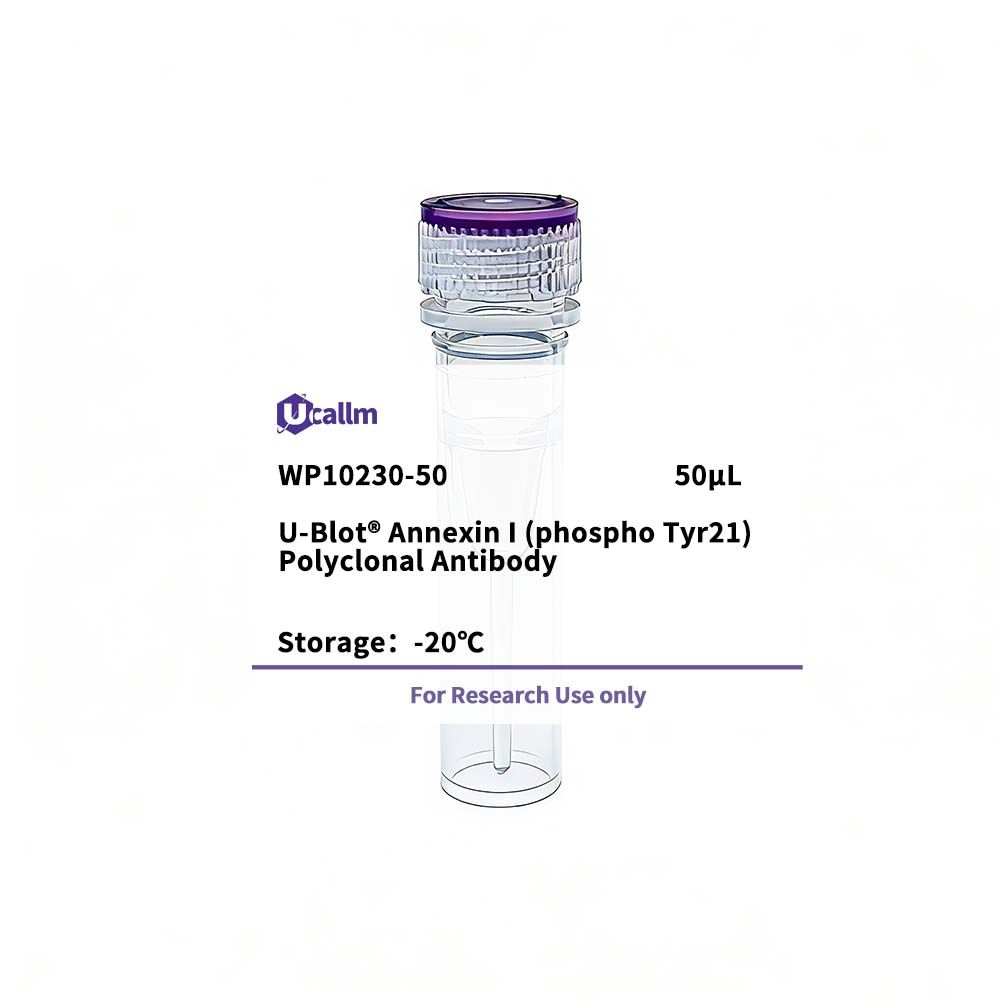
- Annexin I
- Reactivity
- Human,Rat,Mouse,
- Application
- WB,ELISA
- MW(Calculated)
- 39kD
- MW(Observed)
- --
- Host Species
- Rabbit
- Isotype
- IgG
- Conjugate/Modification
- Phospho
- Modification site
- --
- Recommended Dilution Ratio
- WB 1:500-1:2000;ELISA 1:20000;Not yet tested in other applications.
- Form
- Liquid in PBS containing 50% glycerol, 0.5% BSA and 0.02% sodium azide.
- Source
- --
- Purification
- The antibody was affinity-purified from rabbit antiserum by affinity-chromatography using epitope-specific immunogen.
- Purity
- --
- storageCondition
- -15°C to -25°C/1 year(Do not lower than -25°C)
- Concentration
- 1 mg/ml
- Clonality
- Polyclonal
- Clone No.
- --
- Immunogen
- Synthesized phospho-peptide around the phosphorylation site of human Annexin I (phospho Tyr21)
- Sequence
- --
- Specificity
- Phospho-Annexin I (Y21) Polyclonal Antibody detects endogenous levels of Annexin I protein only when phosphorylated at Y21.
- Gene Name
- ANXA1
- Protein Name
- Annexin A1
- Other Name
- ANXA1;ANX1;LPC1;Annexin A1;Annexin I;Annexin-1;Calpactin II;Calpactin-2;Chromobindin-9;Lipocortin I;Phospholipase A2 inhibitory protein;p35
- Organism-1
- Human
- Gene ID-1
- 301
- SwissProt-1
- P04083
- Organism-2
- Mouse
- Gene ID-2
- --
- SwissProt-2
- P10107
- Organism-3
- --
- Gene ID-3
- --
- SwissProt-3
- --
- Organism-4
- --
- gene ID-4
- --
- SwissProt-4
- --
- Cellular Localization
- Nucleus . Cytoplasm . Cell projection, cilium . Cell membrane . Membrane ; Peripheral membrane protein . Endosome membrane ; Peripheral membrane protein . Basolateral cell membrane . Apical cell membrane . Lateral cell membrane . Secreted . Secreted, extracellular space . Cell membrane ; Peripheral membrane protein ; Extracellular side . Secreted, extracellular exosome . Cytoplasmic vesicle, secretory vesicle lumen . Cell projection, phagocytic cup . Early endosome . Cytoplasmic vesicle membrane ; Peripheral membrane protein . Secreted, at least in part via exosomes and other secretory vesicles. Detected in exosomes and other extracellular vesicles (PubMed:25664854). Alternatively, the secretion is dependent on protein unfolding and facilitated by the cargo receptor TMED10; it results in the protein translocation from the cytoplasm into ERGIC (endoplasmic reticulum-Golgi intermediate compartment) followed by vesicle entry and secretion (PubMed:32272059). Detected in gelatinase granules in resting neutrophils (PubMed:10772777). Secretion is increased in response to wounding and inflammation (PubMed:25664854). Secretion is increased upon T-cell activation (PubMed:17008549). Neutrophil adhesion to endothelial cells stimulates secretion via gelatinase granules, but foreign particle phagocytosis has no effect (PubMed:10772777). Colocalizes with actin fibers at phagocytic cups (By similarity). Displays calcium-dependent binding to phospholipid membranes (PubMed:2532504, PubMed:8557678). .