

Assay Development
2-12 weeks depending on assay format and validation design
Optimized protocol, validation result summary, reagent recommendations, and optional testing data.
Target, sample type, desired assay format, sensitivity requirements, controls, and acceptance criteria.
## 1.Overview The Escherichia coli (E.coli) protein expression system is the most widely used prokaryotic expression platform for recombinant protein production. As an essential tool in molecular biology research and biotechnological industrialization, this system offers clear genetic background, high-level target gene expression, short culture cycles, and strong contamination resistance. The system typically utilizes plasmid vectors carrying the gene of interest, leveraging the host's efficient transcription and translation machinery to achieve high-level recombinant protein production. After decades of research and development, E. coli has become one of the preferred hosts for recombinant protein expression, with recombinant proteins accounting for up to 50% of the total cellular protein under optimized conditions. The system is widely applied in basic research, industrial enzyme production, diagnostic reagent development, and therapeutic protein manufacturing.
## 2.Core Advantages (1)Well-characterized genetic background: One of the best-studied model organisms, facilitating genetic manipulation and expression optimization (2)Rapid growth and short cycle: ~20 minutes doubling time enables large quantities of recombinant protein in a short period (3)High expression levels: For some proteins under optimized fermentation conditions, yields can reach several grams per liter. (4)Low cost: Simple culture conditions requiring only basic nutrients and standard equipment (5)Ease of manipulation: High transformation efficiency and extensive molecular biology toolkits (6)Scalability: Easily scalable from small laboratory cultures to large-scale industrial fermentation
## 3.System Limitations (1)Lack of native PTM machinery: Lacks most eukaryotic post-translational modifications (PTMs), including glycosylation and many phosphorylation events. (2)Limited disulfide bond formation in the cytoplasm: The reducing cytoplasmic environment is not conducive to proper disulfide bond formation(requires specialized strains or periplasmic translocation) (3)Inclusion body formation: Overexpression often leads to insoluble protein aggregates (inclusion bodies) (4)Codon bias: The codon bias of E. coli may affect the expression of eukaryotic genes (5)Protein degradation: Exogenous proteins are susceptible to host proteases (6)Limited extracellular secretion: Has limited protein secretion capability; recombinant proteins are typically accumulated in the cytoplasm or periplasm. (7)Endotoxin risk: Lipopolysaccharide (endotoxin) in the cell wall may contaminate final products
## 4. Key Application Areas (1)Basic research: Production of recombinant proteins for structural/functional studies, e.g., histones for chromatin remodeling studies, luciferase for bioluminescence imaging. (2)Industrial enzyme production: Proteases, lipases, amylases, etc., e.g., phytase for animal feed additives, chymosin for cheese production. (3)Therapeutic proteins: Insulin, human growth hormone (hGH), etc., e.g., recombinant human insulin and interferons. (4)Diagnostic Reagents: Antigens, antibodies, and enzyme labels, e.g., C-reactive protein antigen for CRP testing. (5)Vaccine development: Recombinant subunit vaccines, e.g., hepatitis B surface antigen (HBsAg) for hepatitis B prevention
## 5. Classification of Expression Vectors ### 5.1 By promoter type 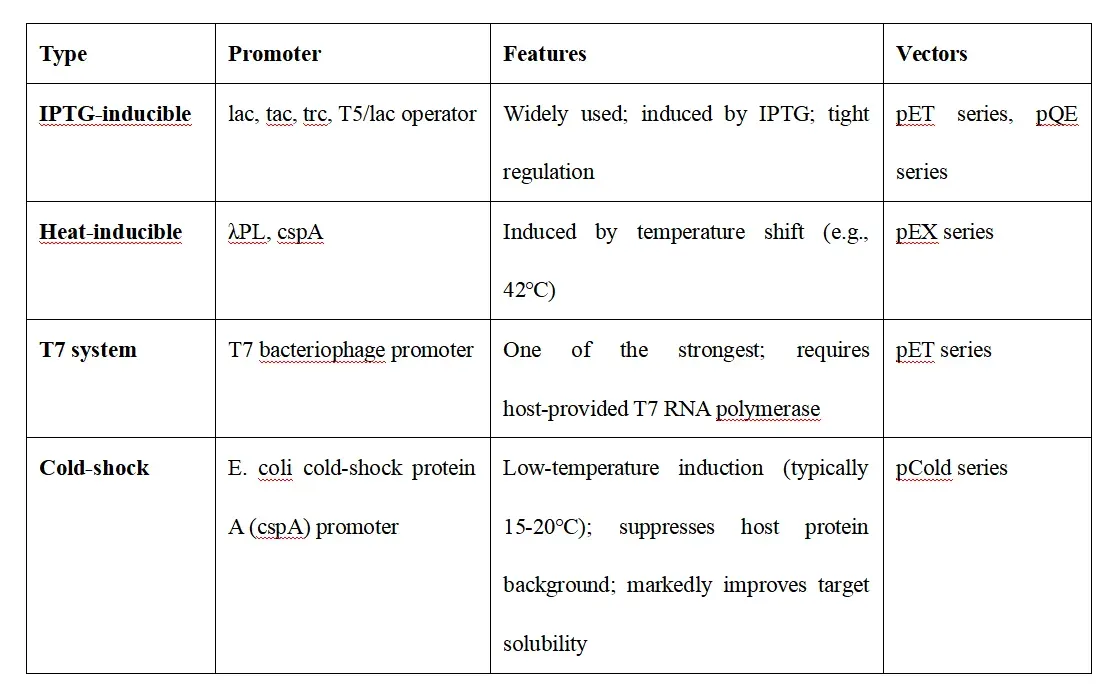 ### 5.2 By expression product format 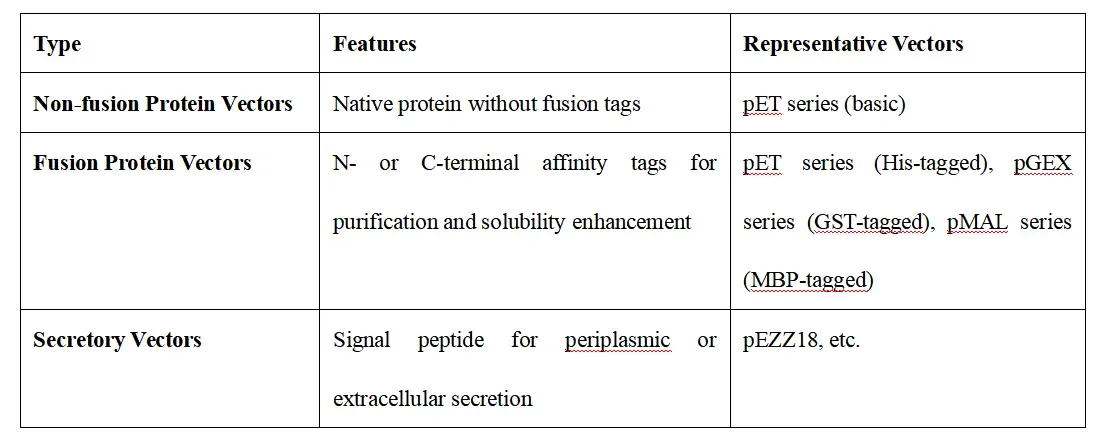 ### 5.3 Common Fusion Tags 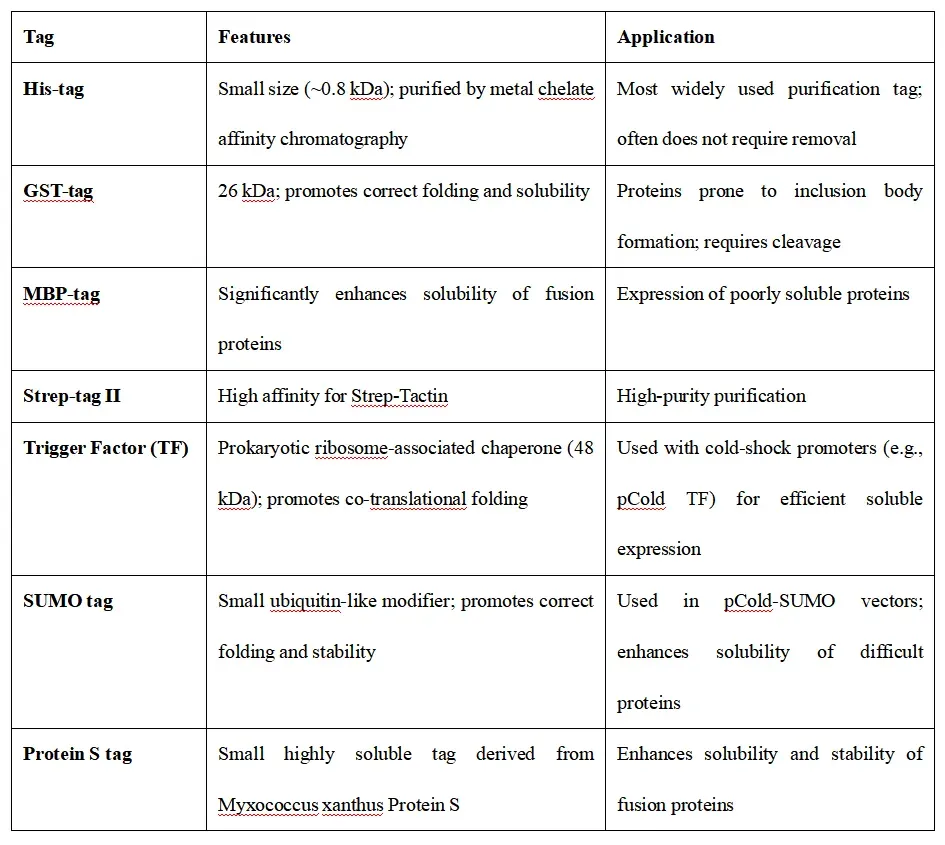 ### 6.Common Expression Host Strains 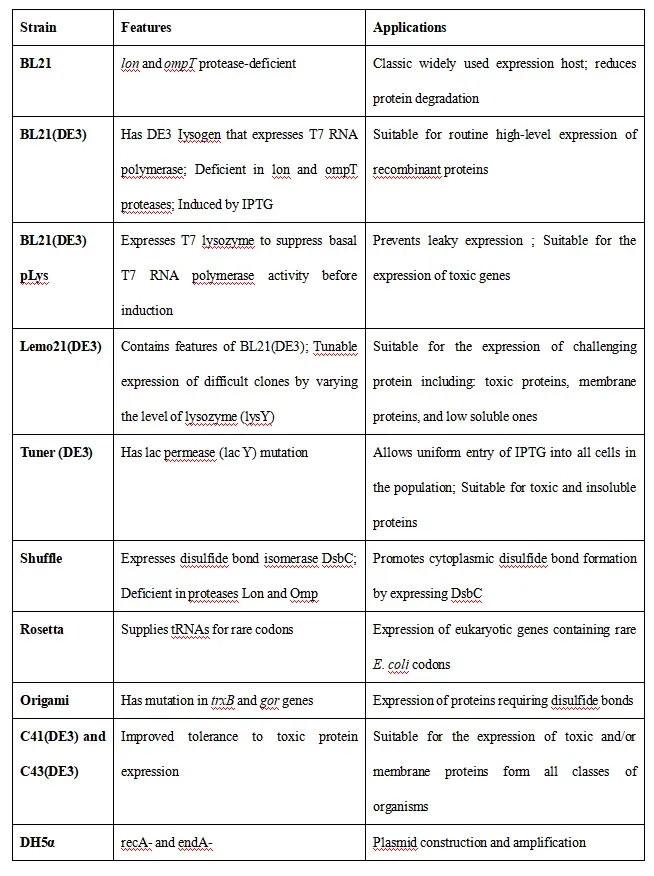 ### 7.Selection Guide 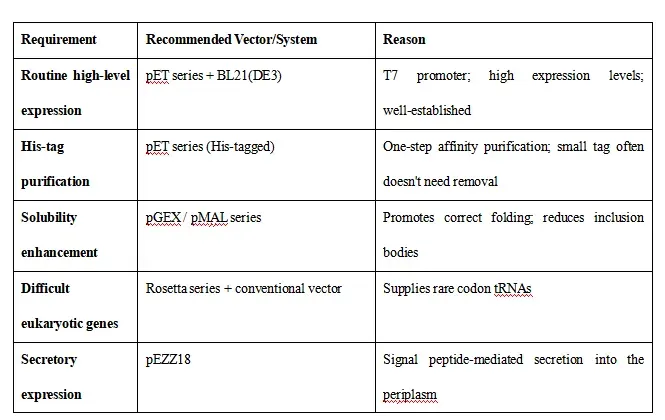 Selection Recommendations: BL21(DE3) for routine expression; Rosetta for eukaryotic genes with rare codons; Origami for proteins requiring disulfide bonds; DH5α for plasmid construction and amplification.
## 8.Service Highlights - High-Yield Guarantee: Leveraging our extensive E. coli experience, we have successfully achieved gram-scale purified protein production for selected targets - Multiple Host Options: BL21(DE3), Rosetta, Origami, etc., to meet diverse expression needs. - Versatile Vector Systems: pET, pGEX, pMAL, etc., supporting fusion tags, non-fusion, and secretion. - Inclusion Body Refolding: We offer professional refolding services to obtain bioactive soluble protein from inclusion bodies.
## 9.Service Procedure 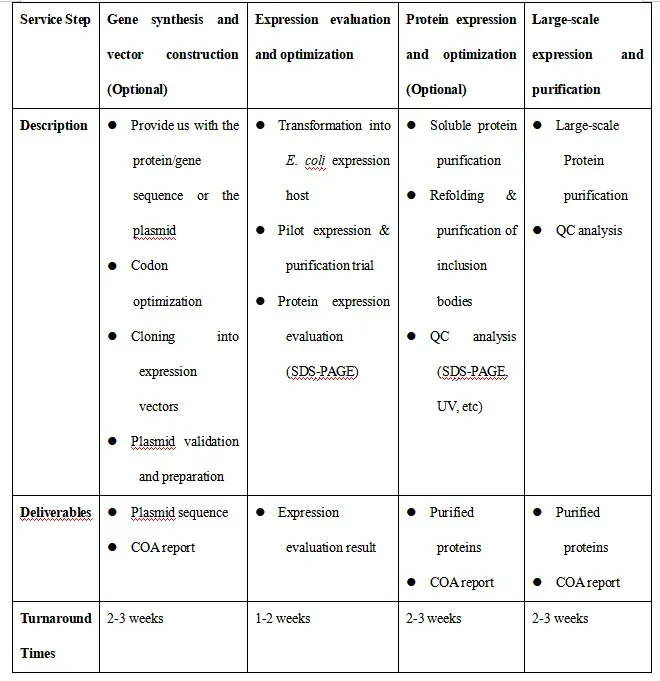 ## 10.requently Asked Questions (FAQs) Q1: My protein always forms inclusion bodies in E. coli. What should I do? A: Try lowering induction temperature and IPTG concentration, using solubility-enhancing tags, choosing strains like Origami for disulfide bond formation, or performing inclusion body refolding. We offer comprehensive refolding services. Q2: How do I choose a fusion tag? A: For purification only, use His-tag. For solubility enhancement, try GST or MBP. For functional studies, consider the tag's impact on activity and include a protease cleavage site for removal. Q3: My protein is toxic to E. coli. What should I do? A: Use a tightly regulated promoter (e.g., T7 lac promoter in pET series) or specialized strains like Tuner or C41(DE3), and optimize induction conditions.