
info@ucallmlabs.com
The intestine is an essential digestive organ and is recognized as one of the most structurally complex organs in the human body. It participates in nutrient metabolism, immune regulation, and mucosal barrier maintenance to sustain physiological homeostasis. Intestinal epithelial injury, immune activation, and gut microbiota dysbiosis collectively promote the occurrence and progression of intestinal diseases.
Traditional studies on intestinal diseases mainly rely on cell lines and animal models, both of which have obvious limitations. Conventional cell lines lack cell–cell and cell–matrix interactions in the intestinal microenvironment and cannot faithfully recapitulate the genetic characteristics of patients. Animal experiments are limited by high costs, long experimental cycles, and unavoidable species differences between humans and rodents.
In 2009, the Hans Clevers team first established intestinal organoids using mouse Lgr5-positive intestinal stem cells. Organoid technology was selected as one of the top ten breakthrough technologies by Science in 2013 and was named the Method of the Year by Nature in 2017. Characterized by human origin and high physiological similarity, organoids can faithfully recapitulate multiple organ-specific disease phenotypes in vitro, including tumors, primary sclerosing cholangitis, and inflammatory bowel disease (IBD). Organoid-based mechanistic exploration, therapeutic evaluation, and off-target effect detection effectively reduce the failure rate of clinical drug development. Meanwhile, organoids exhibit great application potential and commercial value for precision medicine and individualized clinical medication guidance.
Intestinal organoids are derived from Lgr5-enriched stem cells located at the crypt base and exhibit typical three-dimensional structures with inward lumens and apical surfaces facing the extracellular matrix. Intestinal organoids contain all major differentiated intestinal cell types, including Paneth cells, absorptive enterocytes, colonocytes, goblet cells, and enteroendocrine cells. They recapitulate the cellular composition and biological characteristics of the intestinal epithelium, possess self-renewal capacity, and maintain physiological functions such as water and ion absorption and substance transport. Furthermore, intestinal organoids retain the individual genetic background of donors, showing unique advantages over conventional cell lines and animal models.
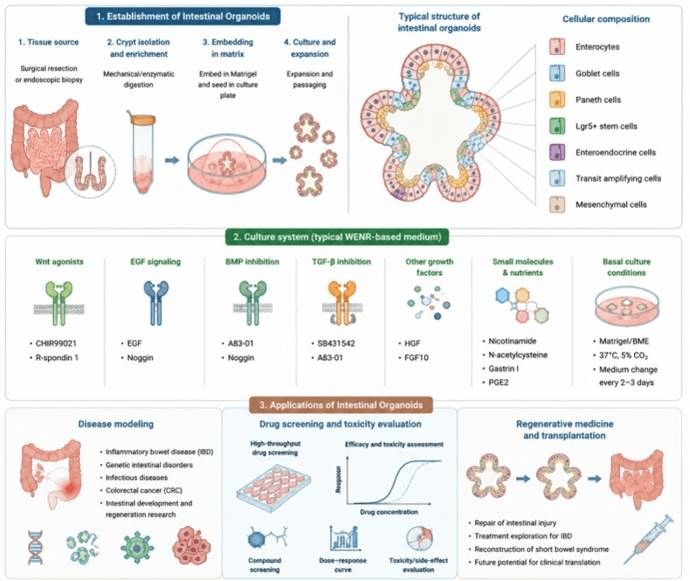
Establishment, culture system, and applications of intestinal organoids.
Common Reagents for Intestinal Organoid Culture
Recommended Markers for Small Intestinal Epithelial Organoids
Data display.
(A) Organoid culture status (bright-field morphology)
(B) Multicolor immunofluorescence staining
(C) Post-translational modification proteomics
(D) Epigenetic profiling (ChIP-seq / ATAC-seq)
(E) Gene editing validation (CRISPR)