
info@ucallmlabs.com
1. Overview
The full name of the severe acute respiratory syndrome coronavirus is Severe Acute Respiratory Syndrome Coronavirus (SARS‑CoV). Initially, the virus was identified in Guangdong Province, China, in late 2002. It is a positive‑sense, single‑stranded RNA virus that can cause a fatal respiratory infection known as Severe Acute Respiratory Syndrome (SARS). This virus belongs to the genus Betacoronavirus, which also includes SARS‑CoV‑2 and MERS‑CoV. The World Health Organization (WHO) declared it a global public health threat in 2003. The virus is transmitted from person to person, with an incubation period of approximately 2‑10 days. Some reports indicate that infected individuals can transmit the virus before symptom onset, primarily through respiratory droplets expelled by coughing and sneezing.
2. Background Information
2.1 What is SARS‑CoV?
SARS‑CoV (Severe Acute Respiratory Syndrome Coronavirus) is an enveloped, positive‑sense, single‑stranded RNA virus belonging to the family Coronaviridae, subfamily Orthocoronavirinae, genus Betacoronavirus, and subgenus Sarbecovirus. It is the causative agent of severe acute respiratory syndrome (SARS). The SARS‑CoV genome is approximately 29.7 kb in length and contains a 5' untranslated region (UTR), the large replicase region ORF1a/ORF1b, genes encoding structural proteins, accessory genes, a 3’ untranslated region, and a poly(A) tail.
The 5’ two‑thirds of the genome encode the replicase polyproteins pp1a and pp1ab, which are processed into 16 nonstructural proteins (nsps). These proteins form the viral replication‑transcription complex (RTC) and participate in viral RNA synthesis, processing, proofreading and immune evasion.
The 3’ region encodes four major structural proteins—Spike (S), Envelope (E), Membrane (M), and Nucleocapsid (N)—as well as several accessory proteins. The Spike protein mediates host‑cell attachment and membrane fusion, while the N protein binds viral RNA and contributes to genome packaging.
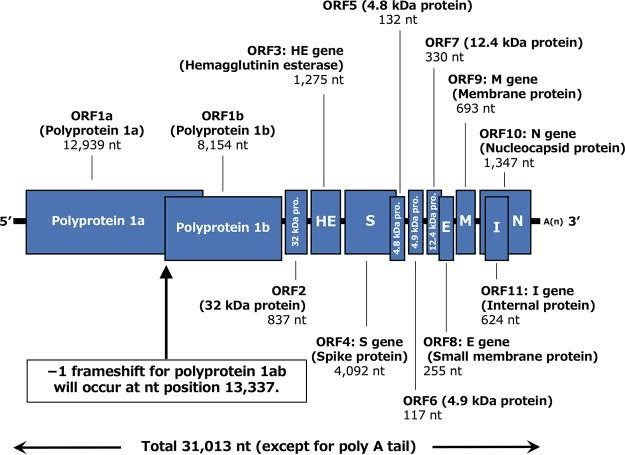
SARS‑CoV genome annotation (PMID: 12730500)
2.2 SARS‑CoV Genome & Classification
SARS‑CoV has a large positive‑sense RNA genome of approximately 29.7 kb. Its genome can be broadly divided into a 5' replicase region and a 3’ structural/accessory region.
| Genome Region | Major Products | Main Function |
|---|---|---|
| ORF1a | pp1a → nsp1–11 | Replication and host‑cell regulation |
| ORF1b | pp1ab → nsp12–16 | RNA synthesis and processing |
| S | Spike | Receptor binding and membrane fusion |
| ORF3a | ORF3a | Host interaction and pathogenicity |
| E | Envelope | Assembly and release |
| M | Membrane | Virion assembly |
| ORF6 | ORF6 | Host immune modulation |
| ORF7a/b | Accessory proteins | Host interaction |
| ORF8 | ORF8 | Immune modulation and adaptation |
| N | Nucleocapsid | RNA binding and genome packaging |
2.3 What Are SARS‑CoV Structural Proteins?
SARS‑CoV contains four major structural proteins: Spike (S), Envelope (E), Membrane (M), and Nucleocapsid (N). Among these proteins, Spike is the primary surface antigen and plays a central role in viral entry. The S protein contains the S1 subunit, which contains the receptor‑binding domain (RBD), and the S2 subunit, which contains the membrane‑fusion machinery. The N protein binds viral RNA and participates in genome packaging, replication and transcription. M and E are mainly involved in virion assembly, budding and release.
Structural Protein Targets
| Protein | Full name | Main Function |
|---|---|---|
| S | Spike protein | ACE2 binding and membrane fusion |
| S1 | Spike S1 | Receptor binding |
| RBD | Receptor‑binding domain | ACE2 interaction |
| S2 | Spike S2 | Membrane fusion |
| N | Nucleocapsid | RNA binding and packaging |
| M | Membrane protein | Virion assembly |
| E | Envelope protein | Assembly and release |
2.4 Mechanism of Cell Entry and Replication
2.4.1 Viral Attachment and Receptor Recognition
The SARS‑CoV Spike protein recognizes angiotensin‑converting enzyme 2 (ACE2) on susceptible host cells. The RBD within the S1 subunit is primarily responsible for interaction with ACE2. Several host factors have also been reported to influence SARS‑CoV attachment or entry, including DC‑SIGN, L‑SIGN, heparan sulfate, and other cellular factors. However, these factors should be distinguished from ACE2, which remains the best‑established primary receptor.
2.4.2 Spike Protein Activation
Following ACE2 binding, the Spike protein undergoes proteolytic activation. Major host proteases involved include cathepsin L, cathepsin B, and TMPRSS2. Cathepsins can mediate S protein cleavage and activation, facilitating viral membrane fusion.
2.4.3 Viral RNA Replication
After viral entry and uncoating, the positive‑sense RNA genome is directly translated to produce pp1a and pp1ab. Viral proteases process these polyproteins into nsps 1‑16. The nsps assemble into the replication‑transcription complex (RTC). The RTC synthesizes negative‑sense RNA intermediates and subsequently produces genomic RNA and subgenomic RNAs.
2.4.4 Viral Assembly and Release
Newly synthesized genomic RNA associates with N protein to form the nucleocapsid. S, M and E proteins enter the secretory pathway and accumulate primarily in the endoplasmic reticulum‑Golgi intermediate compartment (ERGIC). Virion assembly occurs mainly at the ERGIC, followed by vesicular transport and release from infected cells.
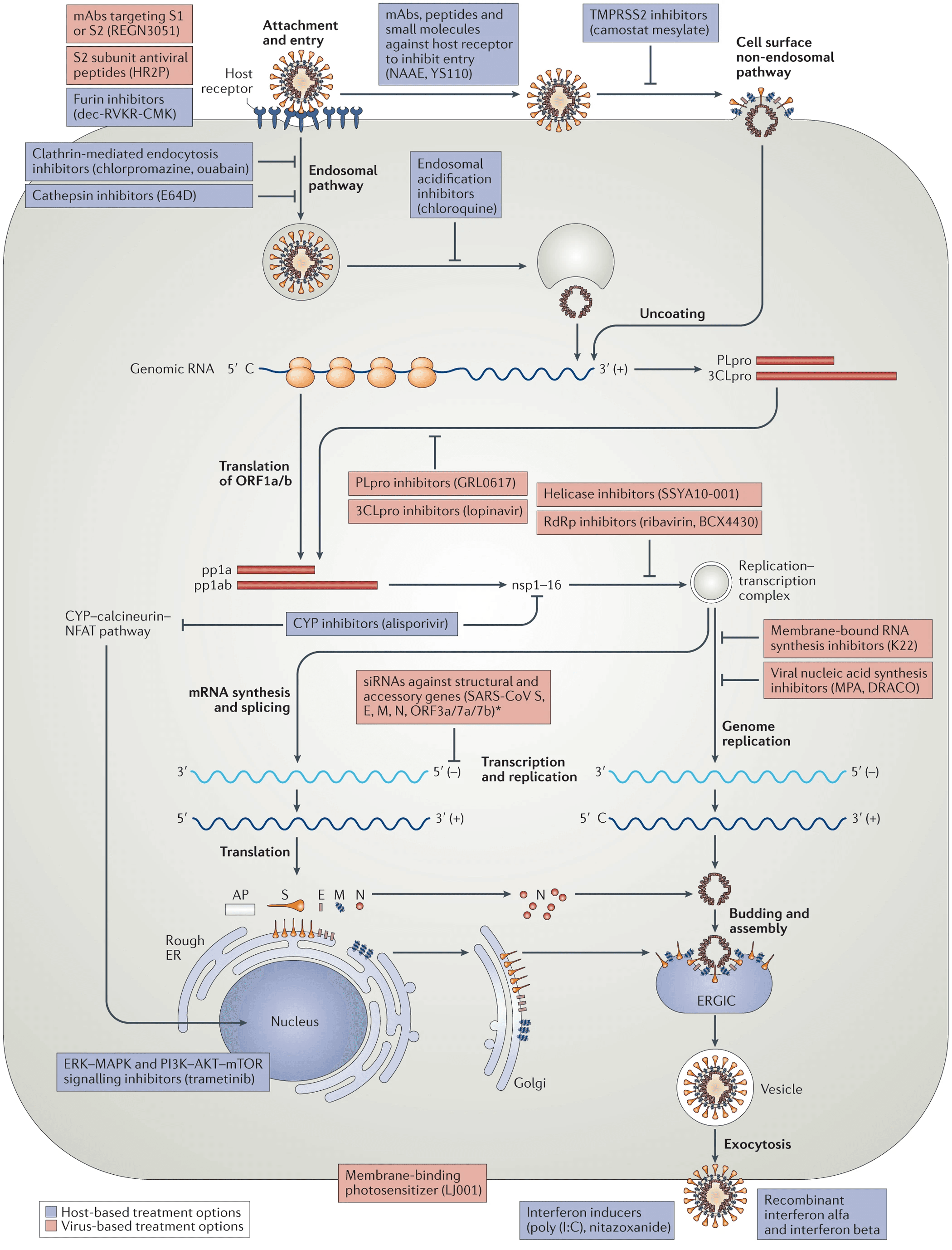
Virus‑based and host‑based treatment options targeting the coronavirus replication cycle. (PMID: 26868298)
2.5 Symptoms and Treatment
2.5.1 Clinical Symptoms
SARS‑CoV infection can result in a broad clinical spectrum ranging from asymptomatic infection to severe SARS. Common symptoms include:
- Fever
- Cough
- Sore throat
- Fatigue
- Headache
- Myalgia
- Nasal congestion
- Shortness of breath
Severe disease may involve pneumonia, hypoxaemia, acute respiratory distress, thrombotic complications and multi‑organ dysfunction.
2.5.2 Antiviral Treatment
Currently, antiviral treatments primarily target key proteins and enzymes involved in the viral replication process.
| Target | Protein | Function | Therapeutic Strategy |
|---|---|---|---|
| Mpro | nsp5 | Polyprotein processing | Mpro inhibitors |
| PLpro | nsp3 | Polyprotein processing | PLpro inhibitors |
| RdRp | nsp12 | RNA synthesis | RdRp inhibitors |
| Helicase | nsp13 | RNA unwinding | Helicase inhibitors |
| Spike | S | Viral entry | Neutralizing antibodies, entry inhibitors |
| ACE2‑S axis | S+ACE2 | Host‑cell entry | Entry inhibitors |
2.6 Targets for Intervention
2.6.1 Viral Targets
| Target | Protein | Biological Role |
|---|---|---|
| S | Spike | Receptor binding & fusion |
| RBD | Spike RBD | ACE2 interaction |
| S1 Subunit | S protein subunit | Receptor recognition |
| S2 Subunit | S protein subunit | Membrane fusion |
| N | Nucleocapsid | RNA binding & packaging |
| M | Membrane | Virion assembly |
| E | Envelope | Viral assembly & release |
| Mpro/3CLpro | nsp5 | Polyprotein processing |
| PLpro | nsp3 | Polyprotein processing |
| RdRp | nsp12 | RNA synthesis |
| Helicase | nsp13 | RNA unwinding |
| ExoN | nsp14 | RNA proofreading |
| nsp16 | nsp16 | RNA cap modification |
2.6.2 Host Receptors & Entry Factors
| Host Target | Type | Role in Infection |
|---|---|---|
| ACE2 | Receptor | Primary receptor for Spike |
| TMPRSS2 | Serine protease | Spike activation |
| Cathepsin L | Cysteine protease | Endosomal entry |
| Cathepsin B | Cysteine protease | Endosomal entry |
| DC‑SIGN | Attachment factor | Enhances viral attachment |
| L‑SIGN | Attachment factor | Enhances viral attachment |
| Heparan sulfate | Glycan | Viral attachment |
2.6.3 Host Signaling Pathways
| Pathway | Key Targets | Biological Role |
|---|---|---|
| ACE2–RAAS | ACE2, Ang II, AT1R | Viral entry & RAAS dysregulation |
| RIG‑I/MDA5–MAVS | RIG‑I, MDA5, MAVS | Viral RNA sensing |
| TBK1–IRF3 | TBK1, IRF3 | IFN production |
| JAK–STAT | JAK1, TYK2, STAT1/2 | IFN signaling |
| TLR signaling | TLR3, TLR4 | Viral RNA sensing |
| NF‑κB | IKK, p65 | Inflammatory response |
| MAPK | ERK, JNK, p38 | Stress/inflammatory signaling |
2.6.4 Immune & Inflammatory Targets
| Target | Category | Major Role |
|---|---|---|
| IFN‑α | Cytokine | Antiviral response |
| IFN‑β | Cytokine | Antiviral response |
| IFN‑γ | Cytokine | Cellular immunity |
| IL‑6 | Cytokine | Inflammatory response |
| IL‑1β | Cytokine | Inflammasome signaling |
| TNF‑α | Cytokine | Inflammation |
| CXCL10 | Chemokine | Immune‑cell recruitment |
| CCL2 | Chemokine | Monocyte recruitment |
2.7 Vaccine Types and Development Progress
Several vaccine platforms have been explored for SARS‑CoV, including inactivated vaccines, live‑attenuated vaccines, viral‑vector vaccines, recombinant protein‑subunit vaccines, and DNA vaccines. The development of these vaccines has provided foundational knowledge for coronavirus vaccinology. However, the SARS outbreak was contained in 2003 and no SARS‑CoV vaccine was licensed, with most candidates remaining in preclinical or early‑stage clinical development.
2.7.1 Inactivated Vaccines
Inactivated SARS‑CoV vaccines were produced by propagating the virus and chemically inactivating it with β‑propiolactone. A formalin‑inactivated whole‑virion SARS‑CoV vaccine candidate entered Phase I clinical trials.
2.7.2 Live‑Attenuated Vaccines
Live‑attenuated vaccine candidates explored for SARS‑CoV included recombinant attenuated influenza virus expressing the SARS‑CoV spike protein, attenuated vesicular stomatitis virus (VSV) expressing the SARS‑CoV spike protein, and live attenuated recombinant measles vaccine. All remained in preclinical development.
2.7.3 Viral‑Vector Vaccines
Viral‑vector vaccines use non‑replicating or replication‑defective viral vectors to deliver genetic information encoding the SARS‑CoV Spike protein. A recombinant modified vaccinia virus Ankara (MVA) expressing the SARS‑CoV S protein was among the candidates explored.
2.7.4 Recombinant Protein‑Subunit Vaccines
Recombinant protein‑subunit vaccines use purified SARS‑CoV antigens, primarily the Spike protein, S1 subunit, or the receptor‑binding domain (RBD). A recombinant subunit vaccine containing the SARS‑CoV S protein formulated with aluminum hydroxide adjuvant entered Phase I clinical trials. Other preclinical candidates included recombinant fusion proteins combining RBD fragments with the IgG1‑Fc fragment.
2.7.5 DNA Vaccines
DNA vaccines encoding the SARS‑CoV Spike protein were also explored in preclinical studies.
2.7.6 mRNA Vaccines
While mRNA vaccine platforms were not extensively developed for SARS‑CoV specifically, the knowledge gained from SARS vaccine research contributed to the rapid development of mRNA vaccines for SARS‑CoV‑2.
2.8 Drugs
SARS‑CoV therapeutic agents can be broadly classified according to their primary molecular targets into virus‑targeted drugs, host‑targeted drugs, and drugs with unclear or non‑specific targets. Virus‑targeted drugs directly interfere with viral entry, polyprotein processing, or RNA replication, whereas host‑targeted drugs act on host proteins, signaling pathways, or pathological processes associated with SARS.
2.8.1 Virus‑Targeted Drugs
Virus‑targeted drugs directly act on SARS‑CoV proteins or viral particles. The major validated targets include Spike, Mpro/3CLpro, and RdRp/nsp12, while PLpro, nsp13, nsp14, and nsp16 remain important targets for antiviral drug discovery.
| Target | Drug | Biological Role | Mechanism |
|---|---|---|---|
| Spike | Convalescent serum | Viral entry | Neutralization |
| Spike/RBD | Monoclonal antibodies (e.g., CR3022) | ACE2 binding | Neutralization |
| Mpro/3CLpro | Lopinavir/Ritonavir | Polyprotein processing | Protease inhibition |
| RdRp/nsp12 | Remdesivir | RNA synthesis | Polymerase inhibition |
| Favipiravir | RNA synthesis | Polymerase inhibition | |
| Helicase | Helicase inhibitors (e.g., SSYA10‑001) | RNA unwinding | Helicase inhibition |
2.8.2 Host‑Targeted Drugs
Host‑targeted drugs act on host proteins or pathways involved in viral entry, inflammation, immune dysregulation, or thrombotic complications.
Host Protease‑Targeting Drugs
| Target | Drug | Biological Role | Mechanism |
|---|---|---|---|
| Cathepsin L | E64d | Endosomal entry | Protease inhibition |
| TMPRSS2 | Camostat mesylate | Spike activation | Protease inhibition |
JAK‑STAT Pathway‑Targeting Drugs
| Target | Drug | Biological Role | Mechanism |
|---|---|---|---|
| JAK1/JAK2 | Baricitinib | Cytokine signaling | JAK inhibition |
IL‑6 / TNF Pathways‑Targeting Drugs
| Target | Drug | Biological Role | Mechanism |
|---|---|---|---|
| IL‑6R | Tocilizumab | Inflammatory signaling | IL‑6R blockade |
| TNF‑α | Infliximab | Inflammatory signaling | TNF blockade |
Broad Anti‑Inflammatory Drugs
| Target | Drug | Biological Role | Mechanism |
|---|---|---|---|
| Glucocorticoid receptor | Dexamethasone | Inflammation | Immunosuppression |
| Methylprednisolone | Inflammation | Immunosuppression |
2.8.3 Drugs with Unclear or Non‑Specific Targets
| Target | Drug | Biological Role | Mechanism |
|---|---|---|---|
| Multiple proposed targets | Ribavirin | Viral/host processes | Multiple proposed mechanisms |
| Multiple host targets | Interferon‑α | Antiviral | Immune modulation |
| Interferon‑β | Antiviral | Immune modulation | |
| Chloroquine | Endosomal/entry | Endosomal modulation |
3. Related Products & Services
- Recombinant Antigens & Receptors
- Antibodies
- Detection Kits
- Recombinant Protein Expression Services
- Antibody Development Services
4. Resources
5. References
- Peiris, J. S., Lai, S. T., Poon, L. L., et al. (2003). Coronavirus as a possible cause of severe acute respiratory syndrome. The Lancet, 361(9366), 1319‑1325.
- Drosten, C., Günther, S., Preiser, W., et al. (2003). Identification of a novel coronavirus in patients with severe acute respiratory syndrome. The New England Journal of Medicine, 348(20), 1967‑1976.
- Ksiazek, T. G., Erdman, D., Goldsmith, C. S., et al. (2003). A novel coronavirus associated with severe acute respiratory syndrome. The New England Journal of Medicine, 348(20), 1953‑1966.
- Rota, P. A., Oberste, M. S., Monroe, S. S., et al. (2003). Characterization of a novel coronavirus associated with severe acute respiratory syndrome. Science, 300(5624), 1394‑1399.
- Marra, M. A., Jones, S. J., Astell, C. R., et al. (2003). The genome sequence of the SARS‑associated coronavirus. Science, 300(5624), 1399‑1404.
- Li, W., Moore, M. J., Vasilieva, N., et al. (2003). Angiotensin‑converting enzyme 2 is a functional receptor for the SARS coronavirus. Nature, 426(6965), 450‑454.
- Simmons, G., Gosalia, D. N., Rennekamp, A. J., et al. (2005). Inhibitors of cathepsin L prevent severe acute respiratory syndrome coronavirus entry. Proceedings of the National Academy of Sciences, 102(33), 11876‑11881.
- Bosch, B. J., Martina, B. E., Van Der Zee, R., et al. (2004). Severe acute respiratory syndrome coronavirus (SARS‑CoV) infection inhibition using spike protein heptad repeat‑derived peptides. Proceedings of the National Academy of Sciences, 101(22), 8455‑8460.
- Cinatl, J., Morgenstern, B., Bauer, G., et al. (2003). Glycyrrhizin, an active component of liquorice roots, and replication of SARS‑associated coronavirus. The Lancet, 361(9374), 2045‑2046.
- Chu, C. M., Cheng, V. C., Hung, I. F., et al. (2004). Role of lopinavir/ritonavir in the treatment of SARS: initial virological and clinical findings. Thorax, 59(3), 252‑256.
- Groneberg, D. A., Poutanen, S. M., Low, D. E., et al. (2005). Treatment and vaccines for severe acute respiratory syndrome. The Lancet Infectious Diseases, 5(3), 147‑155.
- Jiang, S., He, Y., Liu, S. (2005). SARS vaccine development. Emerging Infectious Diseases, 11(7), 1016‑1020.
- Perlman, S., Netland, J. (2009). Coronaviruses post‑SARS: update on replication and pathogenesis. Nature Reviews Microbiology, 7(6), 439‑450.
- Zumla, A., Chan, J. F., Azhar, E. I., et al. (2016). Coronaviruses—drug discovery and therapeutic options. Nature Reviews Drug Discovery, 15(5), 327‑347.
- Totura, A. L., Bavari, S. (2019). Broad‑spectrum coronavirus antiviral drug discovery. Expert Opinion on Drug Discovery, 14(4), 397‑412.
- Yang, H., Bartlam, M., Rao, Z. (2006). Drug design targeting the main protease, the Achilles' heel of coronaviruses. Current Pharmaceutical Design, 12(35), 4573‑4590.
- De Clercq, E. (2006). Potential antivirals and antiviral strategies against SARS coronavirus infections. Expert Review of Anti‑infective Therapy, 4(2), 291‑302.