
info@ucallmlabs.com
Hormones secreted by the thyroid gland play an indispensable role in organ development and the regulation of internal homeostasis. Over the past two decades, animal models and traditional cell lines have been widely adopted for investigating organ developmental mechanisms, drug screening, and toxicological assessment. Nevertheless, interspecies differences greatly hinder in-depth research into human-specific physiological processes, and conventional cell models lack the three-dimensional architecture of native human organs. Although ex vivo tissue slices preserve complete cellular composition, they are plagued by multiple limitations including difficult access to healthy specimens, incapability of long-term culture, and high susceptibility of cells to dedifferentiation. The emergence of organoid technology effectively overcomes these drawbacks. As three-dimensional multicellular biomimetic structures constructed in vitro, organoids faithfully recapitulate the morphological architecture and physiological functions of native organs, and are mainly divided into two categories: pluripotent stem cell-induced organoids and primary tissue-derived organoids. Studies have revealed that tissue-derived organoids can be successfully generated even if tissue-resident adult stem cells have not been clearly identified. This indicates that in vitro culture systems are capable of activating dormant progenitor cells, expanding rare stem-like cells, or reprogramming differentiated cells to acquire stem cell properties. Among them, pluripotent stem cell-derived organoids can fully recapitulate the whole process of embryonic development with abundant cell yields. In contrast, tissue-derived organoids feature relatively simple structures and limited cell output, making them more suitable for studies on tissue injury and repair mechanisms.
Organoid technology has become a core tool for translational thyroid medicine research and exhibits great potential in exploring thyroid developmental mechanisms, establishing disease models and developing regenerative therapies. Combined with cutting-edge technologies such as single-cell multi-omics sequencing, CRISPR gene editing, co-culture systems and microfluidic organ-on-a-chip platforms, thyroid organoid models enable systematic analysis of thyroid physiological regulatory mechanisms and precise identification of novel therapeutic targets. In the future, only by unifying global experimental standards and strictly complying with clinical manufacturing specifications can such in vitro biomimetic models be safely and efficiently applied to clinical treatment and realize the clinical translation of basic research findings.
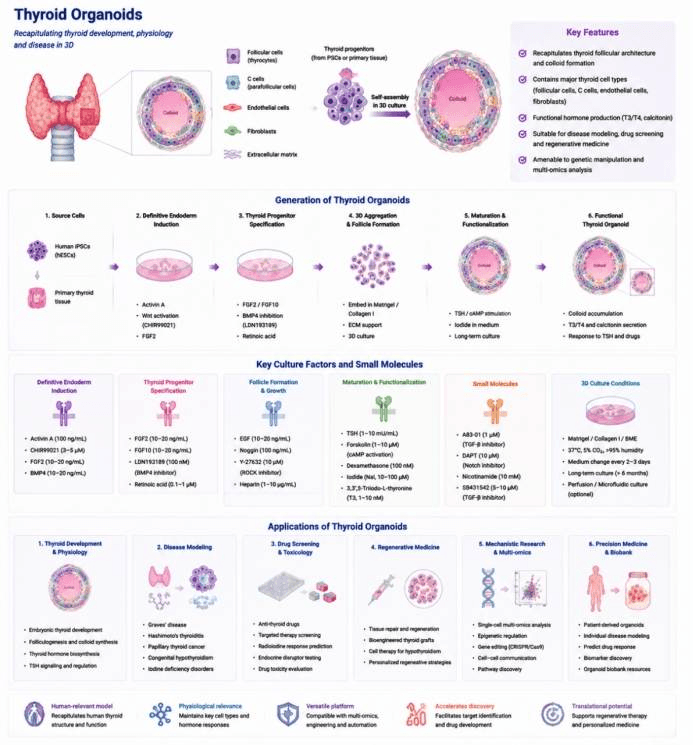
Generation, Culture, and Applications of thyroid Organoids.
Data display.
(A) Organoid culture status (bright-field morphology)
(B) Multicolor immunofluorescence staining
(C) Post-translational modification proteomics
(D) Epigenetic profiling (ChIP-seq / ATAC-seq)
(E) Gene editing validation (CRISPR)