info@ucallmlabs.com
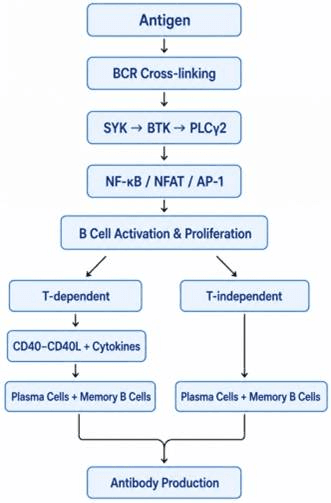
B cells primarily recognize antigens through the B-cell receptor (BCR) and initiate intracellular signaling cascades. Antigen binding to the BCR promotes BCR clustering and activates Src family kinases and SYK. These signals subsequently activate downstream molecules, including BTK, BLNK, and PLCγ2, ultimately converging on transcription factors such as NF-κB, NFAT, and AP-1, which induce B-cell activation, survival, and proliferation. BCR signaling can also cooperate with signals from other receptors to enhance B-cell responses to antigens.
Depending on the type of antigen and the availability of helper signals, B-cell activation can be classified into two major modes: T cell-dependent (TD) activation and T cell-independent (TI) activation.
T cell-dependent B-cell activation typically occurs in response to protein antigens. B cells first capture and internalize antigens through the BCR, process them, and present antigen-derived peptides via MHC class II molecules to CD4⁺ T cells. Subsequently, B cells receive CD40–CD40L co-stimulatory signals and cytokine signals such as IL-21 from T follicular helper (Tfh) cells, promoting B-cell proliferation, antibody class switching, affinity maturation, and differentiation into memory B cells and plasma cells.
In contrast, certain antigens with highly repetitive structures, such as some polysaccharides and microbial components, can induce T cell-independent B-cell activation through strong BCR cross-linking and innate immune signals mediated by receptors such as Toll-like receptors (TLRs).
BAFF (B-cell Activating Factor) is an essential cytokine for maintaining B-cell survival and homeostasis. Through receptors such as the BAFF receptor (BAFF-R), BAFF supports the survival and maintenance of mature B cells.
Core Process of B Cell Activation