
info@ucallmlabs.com
1 Overview
Chikungunya virus (CHIKV) is the prototype species of the genus Alphavirus within the family Togaviridae and is the causative agent of chikungunya fever. It is an enveloped, positive‑sense, single‑stranded RNA virus with a spherical virion, approximately 70 nm in diameter.
The name "chikungunya" derives from the Makonde language in Tanzania, meaning "that which bends up," referring to the contorted posture of patients suffering from severe joint pain. The virus was first identified during a 1952–1953 outbreak in Tanzania. CHIKV is transmitted primarily by Aedes aegypti and Aedes albopictus mosquitoes. The 2005–2006 Indian Ocean epidemic (notably on Réunion Island) was followed by rapid spread to Asia, the Americas, and Europe.
CHIKV is currently endemic in more than 110 countries globally, with over 20 million cases reported since 2005. In 2024, approximately 480,000 cases and more than 200 deaths were reported worldwide. In July 2025, a large‑scale outbreak occurred in Guangdong Province, China, resulting in more than 9,000 confirmed cases. CHIKV comprises three major genetic lineages: West African, East/Central/South African (ECSA, including the Indian Ocean Lineage IOL), and Asian.
2 Background Information
2.1 What is Chikungunya Virus?
Chikungunya virus is an enveloped, positive‑sense, single‑stranded RNA virus belonging to the family Togaviridae and genus Alphavirus. The virion is spherical, approximately 70 nm in diameter, composed of genomic RNA, capsid (C) proteins, and a host‑derived lipid bilayer envelope studded with heterodimers of envelope proteins E1 and E2.
The CHIKV genome is a positive‑sense single‑stranded RNA of approximately 11.8–12 kb. The genome contains two open reading frames (ORFs) separated by a non‑coding junction and flanked by 5′UTR and 3′UTR:
5′ORF: translated from genomic RNA (gRNA), encoding the non‑structural polyprotein P1234, which is cleaved into four non‑structural proteins (nsP1–nsP4)
3′ORF: translated from 26S subgenomic RNA (sgRNA), encoding the structural polyprotein, which gives rise to five structural proteins: capsid (C), E3, E2, 6K, and E1
The non‑structural polyprotein is approximately 2,472 amino acids, and the structural polyprotein is approximately 1,244 amino acids.
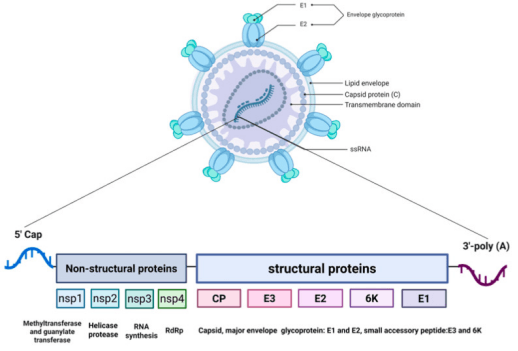
Schematic representation of the chikungunya virus (PMID: 42043217)
2.2 Chikungunya Virus Genome & Classification
CHIKV belongs to the genus Alphavirus in the family Togaviridae, closely related to other arthritogenic alphaviruses such as O'nyong‑nyong virus and Ross River virus. Its genome is a positive‑sense single‑stranded RNA of approximately 11.8–12 kb.
The genome contains two open reading frames:
| Region | Encoded product | Function |
|---|---|---|
| 5′ORF | Nonstructural proteins nsP1–nsP4 | Form the viral replicase complex responsible for viral RNA synthesis |
| 3′ORF | Structural proteins C–E3–E2–6K–E1 | Viral assembly, envelope formation, and cell entry |
Based on phylogenetic analysis, CHIKV is divided into three major genetic lineages:
West African lineage
East/Central/South African (ECSA) lineage: includes the Indian Ocean Lineage (IOL)
Asian lineage
Despite multiple genetic lineages, CHIKV exists as a single serotype.
2.3 What Are Chikungunya Virus Structural Proteins?
CHIKV encodes five structural proteins:
| Protein | Length (aa) | Main Function |
|---|---|---|
| C (Capsid) | 261 | Nucleocapsid assembly; N‑terminal RNA‑binding domain binds genomic RNA; C‑terminal serine protease domain mediates autoproteolytic cleavage |
| E3 | — | Stabilizes E2E1 heterodimers; protects immature spikes from acidic environment |
| E2 | — | Receptor binding; mediates interaction with host cell surface receptors |
| 6K | — | Increases membrane permeability; involved in virus budding |
| E1 | — | Membrane fusion; triggers fusion of viral and endosomal membranes in acidic endosomes |
2.3.1 Capsid Protein (C)
The capsid protein contains an N‑terminal RNA‑binding domain (residues 1–113) and a C‑terminal protease domain (residues 114–261). The N‑terminal domain is rich in positively charged amino acids (arginine and lysine) and binds genomic RNA via an 18‑amino‑acid coiled‑coil α‑helix. The C‑terminal domain possesses chymotrypsin‑like serine protease activity with a catalytic triad (His139, Asp161, Ser213), responsible for autocatalytic cleavage of the capsid from the structural polyprotein.
2.3.2 Envelope Proteins (E1 and E2)
E1 and E2 play central roles in viral entry: E2 mediates receptor recognition and binding, while E1 triggers membrane fusion in the acidic endosomal environment. E2 and E1 form heterodimers on the viral envelope surface.
2.4 Mechanism of Cell Entry and Replication
2.4.1 Viral Attachment and Receptor Recognition
CHIKV infection begins with the binding of the viral E2 glycoprotein to host cell surface receptors. Identified receptors and attachment factors include:
Mxra8: primary membrane receptor
Glycosaminoglycans (GAGs): attachment factors
DC‑SIGN, CD147, TIM: co‑receptors (roles not fully elucidated)
2.4.2 Viral Entry
The virus enters host cells via clathrin‑mediated endocytosis. After early endosome formation, endosomal acidification triggers dissociation of E1‑E2 heterodimers, exposing the fusion loop of E1. The fusion loop inserts into the endosomal membrane, mediating fusion of the viral and endosomal membranes and releasing the nucleocapsid into the cytoplasm.
2.4.3 Viral RNA Replication
After nucleocapsid release, the capsid disassembles, releasing the positive‑sense genomic RNA. Viral replication occurs entirely in the host cell cytoplasm:
Non‑structural protein translation: genomic RNA is directly translated into the non‑structural polyprotein P1234
Polyprotein cleavage: nsP2 protease cleaves P1234, releasing nsP1–nsP4
Replicase complex formation: nsP1–nsP4 assemble with genomic RNA and host factors to form the replicase complex
RNA synthesis: negative‑strand RNA intermediates are synthesized using positive‑strand RNA as template, followed by synthesis of new positive‑strand genomic RNA and 26S subgenomic RNA
Replication occurs in spherules formed at the plasma membrane, which protect viral dsRNA from degradation and recognition by host pattern‑recognition receptors. As infection proceeds, spherules are internalized to form large cytopathic vacuoles (CPV‑I).
2.4.4 Viral Assembly and Release
The 26S subgenomic RNA is translated into the structural polyprotein C‑pE2‑6K‑E1:
Capsid release: the capsid is cleaved from the polyprotein by its own protease activity
Capsid assembly: free capsid proteins bind positive‑sense genomic RNA to form nucleocapsids in the cytoplasm
Envelope protein maturation: the pE2‑6K‑E1 precursor enters the ER lumen for maturation and is transported via the Golgi to the plasma membrane
Budding: mature E1‑E2 heterodimers are deposited in the "virus budding microdomain" at the cell membrane; nucleocapsids migrate to this region and new virions are released by budding
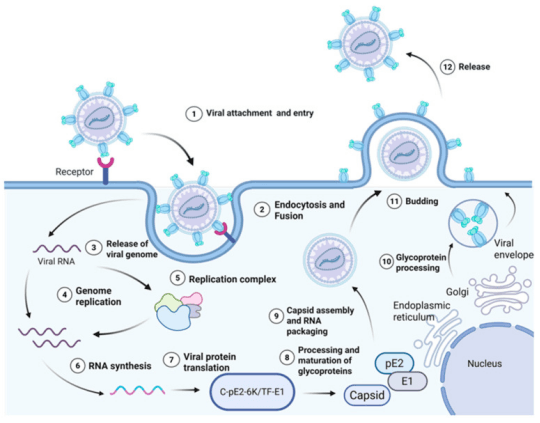
Replication and structural protein processing of the chikungunya virus (PMID: 42043217)
2.5 Symptoms and Treatment
2.5.1 Clinical Symptoms
The incubation period for CHIKV infection is typically 4–8 days (range 2–12 days). The disease is characterized by acute onset of fever and severe joint pain:
Fever: acute onset, predominantly low‑ to moderate‑grade, occasionally high‑grade, lasting 1–7 days
Arthralgia: typically symmetric, polyarticular, severe and debilitating
Other symptoms: joint swelling, myalgia, headache, nausea, fatigue, rash
Joint pain may persist for weeks, months, or even years; up to 60% of patients may develop chronic debilitating arthralgia. The elderly and neonates are at higher risk for severe disease. Occasional cases of eye, heart, and neurological complications have been reported.
2.5.2 Treatment
Currently, no specific antiviral drug is approved for the treatment of CHIKV infections. Clinical management is primarily supportive:
Fever and pain management: paracetamol/acetaminophen
Adequate hydration
Rest
NSAIDs are not recommended: may increase bleeding risk until dengue is ruled out
2.6 Targets for Intervention
2.6.1 Viral Targets
| Target | Protein | Biological Role |
|---|---|---|
| E2 | Envelope glycoprotein E2 | Receptor recognition and binding |
| E1 | Envelope glycoprotein E1 | Membrane fusion |
| nsP2 | Nonstructural protein 2 | Polyprotein cleavage (protease), helicase activity |
| nsP3 | Nonstructural protein 3 | Viral replication, immune antagonism (macrodomain) |
| nsP4 | Nonstructural protein 4 | RNA‑dependent RNA polymerase (RdRp) |
| nsP1 | Nonstructural protein 1 | RNA capping, replication complex membrane anchoring |
2.6.2 Host Receptors & Entry Factors
| Host Target | Type | Role in Infection |
|---|---|---|
| Mxra8 | Membrane receptor | Primary virus receptor |
| Glycosaminoglycans (GAGs) | Attachment factors | Viral attachment |
| DC‑SIGN, CD147, TIM | Co‑receptors | Viral entry (roles not fully elucidated) |
2.6.3 Host Signaling Pathways
| Pathway | Key Targets | Biological Role |
|---|---|---|
| Inflammatory pathways | TNF, IL6, MAPK3 | Inflammatory response |
| Cellular oxidative folding | — | Host pathway required for viral replication |
| MAPK signaling | Inflammatory and stress signaling |
2.7 Vaccine Types and Development Progress
In 2023 and 2025, two CHIKV vaccines received regulatory approval.
2.7.1 VLA1553 (IXCHIQ®, Live‑Attenuated Vaccine)
VLA1553 is a single‑dose live‑attenuated vaccine featuring a 60‑amino‑acid deletion in the hypervariable domain of nsP3. It is the first FDA‑approved CHIKV vaccine, approved in the United States and European Union in 2023, followed by Canada in 2024. The Phase III trial demonstrated favorable safety in 3,082 participants (including 346 adults ≥65 years). However, 2025 real‑world data identified safety signals of increased risk of severe adverse events (including neurological complications) in the elderly population, prompting the EU and UK to issue age restrictions against use in adults ≥65 years, while the U.S. temporarily suspended its use pending further review. IXCHIQ is the U.S. trade name.
2.7.2 PXVX0317 (VIMKUNYA™, Virus‑Like Particle Vaccine)
PXVX0317 is a virus‑like particle (VLP) vaccine. It was approved by the U.S. FDA, EU, and UK regulators in 2025 for individuals aged 12 years and older. VIMKUNYA™ is the trade name.
2.7.3 ChAdOx1 Chik (Adenovirus‑Vectored Vaccine)
ChAdOx1 Chik is a single‑dose adenovirus‑vectored vaccine. Phase I trial demonstrated it was safe and elicited cross‑protective functional antibodies against four distinctive CHIKV lineages.
2.7.4 Other Vaccine Candidates
| Vaccine | Type | Status |
|---|---|---|
| MV‑CHIK/V184 | Measles virus‑vectored | Phase III completed (halted Feb 2023) |
| BBV87 | Inactivated virus | Phase II/III ongoing |
| mRNA‑1388 | mRNA vaccine | Phase I completed |
2.7.5 Vaccine Trials in Africa
In 2026, Institut Pasteur launched the ACT‑CHIK project (Accelerating Clinical Trials for CHIKungunya Vaccine in Africa), a major four‑year initiative to advance CHIKV vaccine development in Africa.
2.8 Drugs
Currently, no FDA‑approved small‑molecule therapeutic is available for CHIKV. Drug development efforts focus on the following areas:
2.8.1 Virus‑Targeted Drugs
| Target | Drug/candidate | Biological Role | Stage |
|---|---|---|---|
| nsP4 (RdRp) | VV261 (double prodrug of 4′‑FlU) | RdRp inhibition, 90% inhibitory effect | Clinical candidate |
| 4′‑Fluorouridine (4′‑FlU) | RdRp inhibition | In vitro | |
| NHC (β‑d‑N4‑hydroxycytidine) | RdRp inhibition | In vitro | |
| Favipiravir (T705) | RdRp inhibition | Animal studies | |
| Sofosbuvir | RdRp inhibition | In vitro (combination) | |
| Molnupiravir | RdRp inhibition | In vitro (combination) | |
| nsP2 helicase | Emetine dihydrochloride (ED) | nsP2 helicase inhibition | Animal studies |
| nsP3 macrodomain | MDOLL0273 (thiobarbiturate‑indole scaffold) | Selective CHIKV macrodomain inhibitor | HTS‑identified |
| E2 envelope protein | Sulfonamide drugs (e.g., Bosentan) | E2 allosteric inhibition | In silico drug repurposing |
| nsP2 protease | Novel peptide inhibitors | nsP2 protease inhibition | Computational design |
| Multiple targets | Niclosamide, gambogic acid, celastrol | Multiple mechanisms | HTS‑identified |
VV261 is a novel nucleotide analog, a double prodrug of 4′‑FlU, showing 90% inhibitory effect against CHIKV in rapid screening. Emetine dihydrochloride (ED) inhibits CHIKV replication by binding to nsP2 and inhibiting its helicase activity, significantly reducing viremia in a C57BL/6 mouse model with no clinical symptoms of joint swelling.
2.8.2 Host‑Targeted Drugs
| Target | Drug | Mechanism | Stage |
|---|---|---|---|
| G3BP1 | L7, WIN, SB2, etc. | Host protein G3BP1 inhibition | In vitro |
| Multiple host targets | Suramin, baicalin, halofuginone, betulinic acid, andrographolide, itraconazole | Multiple mechanisms | In vitro |
2.9 Epidemiology
CHIKV is endemic in more than 110 countries across Africa, Asia, the Indian Ocean and South Pacific islands, Europe, and the Americas. From mid‑2022 through mid‑2025, approximately 1.2 million CHIK cases were reported globally. In 2024, approximately 480,000 cases and more than 200 deaths were reported worldwide. In July 2025, a large‑scale outbreak occurred in Guangdong Province, China, with over 9,000 confirmed cases.
2.10 Diagnosis
First week of illness: direct detection of CHIKV in blood samples using molecular tests such as RT‑PCR
After the first week: serological tests to detect antibodies produced in response to CHIKV infection
3 Related Products & Services
Recombinant Antigens & Receptors
Antibodies
Detection Kits
Recombinant Protein Expression Services
Antibody Development Services
4 Resources
5 References
Schwartz, O., Albert, M. L. (2010). Biology and pathogenesis of chikungunya virus. Nature Reviews Microbiology, 8(7), 491–500.
de Souza, W. M., Lecuit, M., Weaver, S. C. (2025). Chikungunya virus and other emerging arthritogenic alphaviruses. Nature Reviews Microbiology, 23(9), 585–601.
Silva, L. A., Dermody, T. S. (2017). Chikungunya virus: epidemiology, replication, disease mechanisms, and prospective intervention strategies. The Journal of Clinical Investigation, 127(3), 737–749.
Voss, J. E., Vaney, M. C., Duquerroy, S., et al. (2010). Glycoprotein organization of Chikungunya virus particles revealed by X‑ray crystallography. Nature, 468(7324), 709–712.
Solignat, M., Gay, B., Higgs, S., et al. (2009). Replication cycle of chikungunya: A re‑emerging arbovirus. Virology, 393(2), 183–197.
Zhang, R., Kim, A. S., Fox, J. M., et al. (2018). Mxra8 is a receptor for multiple arthritogenic alphaviruses. Nature, 557(7706), 570–574.
Basore, K., Kim, A. S., Nelson, C. A., et al. (2019). Cryo‑EM structure of Chikungunya virus in complex with the Mxra8 receptor. Cell, 177(7), 1725–1737.e16.
Schneider, M., Narciso‑Abraham, M., Hadl, S., et al. (2023). Safety and immunogenicity of a single‑shot live‑attenuated chikungunya vaccine: A double‑blind, multicentre, randomised, placebo‑controlled, phase 3 trial. The Lancet, 401(10394), 2138–2147.
Akahata, W., Yang, Z. Y., Andersen, H., et al. (2010). A virus‑like particle vaccine for epidemic Chikungunya virus protects nonhuman primates against infection. Nature Medicine, 16(3), 334–338.
Bennett, S. R., McCarty, J. M., Ramanathan, R., et al. (2022). Safety and immunogenicity of PXVX0317, an aluminium hydroxide‑adjuvanted chikungunya virus‑like particle vaccine: A randomised, double‑blind, parallel‑group, phase 2 trial. The Lancet Infectious Diseases, 22(9), 1343–1355.
Tindale, L. C., Richardson, J. S., Anderson, D. M., et al. (2025). Chikungunya virus virus‑like particle vaccine safety and immunogenicity in adults older than 65 years: A phase 3, randomised, double‑blind, placebo‑controlled trial. The Lancet, 405(10487), 1353–1361.
Chikungunya virus virus‑like particle vaccine safety and immunogenicity in adolescents and adults in the USA: A phase 3, randomised, double‑blind, placebo‑controlled trial. (2025). The Lancet, 405(10487), 1343–1352.
Tsetsarkin, K. A., Chen, R., Sherman, M. B., et al. (2011). Chikungunya virus emergence is associated with a change in vector competence of Aedes aegypti mosquitoes. PLoS Neglected Tropical Diseases, 5(10), e1345.
Tsetsarkin, K. A., Chen, R., Yun, R., et al. (2014). Multi‑peaked adaptive landscape for Chikungunya virus evolution predicts continued fitness optimization in Aedes albopictus mosquitoes. Nature Communications, 5, 4084.
Zhang, Y., Tang, S., Chen, L., et al. (2025). Investigation of a clinical trial drug VV261 as a potent antiviral candidate against Chikungunya virus. Signal Transduction and Targeted Therapy.