
info@ucallmlabs.com
Epithelial Stem Cells Derived from Pluripotent Stem Cells
Ectoderm‑Induced Pluripotent Stem Cell‑Derived Epithelial Stem Cells: Building Next‑Generation Epithelial Tissue Research Platforms
Epithelial tissues are essential barrier and functional tissues in the human body, widely distributed in the skin, cornea, hair follicles, and the surfaces of various organs. They play critical roles in maintaining tissue homeostasis, facilitating injury repair, and regulating disease development. Epithelial stem cells possess continuous self‑renewal and differentiation capabilities and serve as a key cellular source for epithelial tissue maintenance and regeneration. However, conventional tissue‑derived epithelial stem cells face challenges such as limited sample availability, significant donor variability, and restricted expansion capacity, which hinder their applications in disease modeling, drug screening, and regenerative medicine research.
Pluripotent stem cells (PSCs), including human embryonic stem cells (hESCs) and induced pluripotent stem cells (iPSCs), possess unlimited proliferative capacity and the potential to differentiate into diverse cell types, providing a novel approach for establishing standardized and scalable sources of epithelial stem cells. By mimicking embryonic ectoderm formation and lineage specification processes, researchers can guide PSCs to acquire ectodermal characteristics and further generate epithelial stem/progenitor cell populations.
During ectodermal differentiation, developmental signaling pathways such as BMP signaling play important roles in regulating the transition of pluripotent stem cells toward non‑neural ectoderm and surface ectoderm lineages. Following directed induction, PSC‑derived ectodermal cells can further differentiate into epidermal and other epithelial lineages, generating cell populations expressing typical basal epithelial stem/progenitor markers, including TP63, KRT5, and KRT14. These PSC‑derived epithelial stem/progenitor cells exhibit robust expansion capacity and can further mature into functional keratinocytes and three‑dimensional stratified epithelial structures.
Representative studies of PSC‑derived epidermal stem/progenitor cells demonstrate that ectoderm induction technologies provide a critical foundation for establishing reproducible and scalable epithelial cell production systems. This approach supports applications in skin regeneration, wound repair, inherited skin disease modeling, organoid construction, drug evaluation, cosmetic safety testing, and disease mechanism studies by providing reliable cellular models.
With continued advances in stem cell‑directed differentiation technologies, cell culture systems, and tissue engineering approaches, ectoderm‑induced PSC‑derived epithelial stem cells are becoming an important platform connecting fundamental biological research with translational medicine. These technologies provide innovative solutions for developing standardized, high‑quality, and next‑generation epithelial research systems.
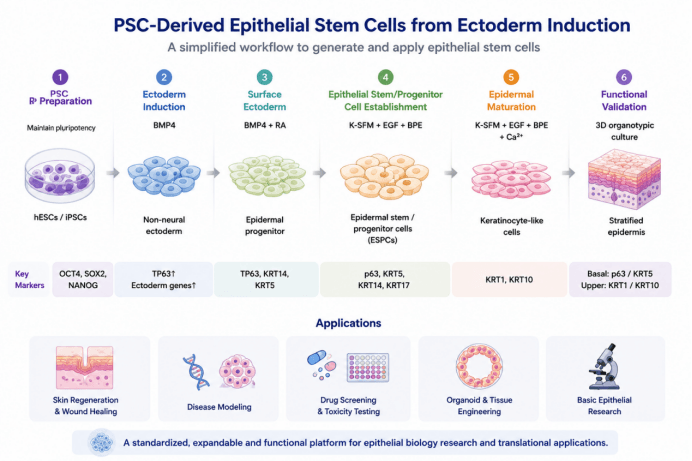
Human ESC/iPSC‑derived epithelial stem cells are generated by recapitulating embryonic ectoderm development, where BMP‑mediated signaling induces pluripotent stem cells toward surface ectoderm, followed by the establishment of p63⁺/KRT5⁺/KRT14⁺ epidermal stem/progenitor cells. These cells can be further differentiated into mature keratinocytes and three‑dimensional stratified epidermal models, providing standardized cellular sources for skin regeneration, disease modeling, drug screening, and tissue engineering applications.
| Stage | Added Factors / Conditions | Function | Cell Type / Stage | Stage‑Specific Identification Markers |
|---|---|---|---|---|
| hESC/iPSC Preparation | Matrigel coating; E8 or mTeSR medium; Y‑27632 (during passaging) | Maintains pluripotent stem cell state and improves single‑cell survival and attachment efficiency | Human pluripotent stem cells (hESCs/iPSCs) | OCT4⁺, SOX2⁺, NANOG⁺ |
| Initiation of Ectoderm Induction | BMP4 (BMP signaling activation) | Activates non‑neural ectoderm fate and promotes epidermal lineage specification | Surface ectoderm | TP63 initiation; upregulation of ectoderm‑related genes |
| Surface Ectoderm Formation | BMP4 + epidermal lineage induction conditions (commonly including retinoic acid, RA, and other ectoderm/epidermal fate regulators) | Promotes commitment of surface ectoderm toward epidermal lineage | Epidermal progenitor cells | TP63⁺, KRT14⁺, KRT5⁺ |
| Establishment of Epidermal Stem/Progenitor Cells | Epidermal induction and expansion medium; Keratinocyte Serum‑Free Medium (K‑SFM) + EGF (Epidermal Growth Factor) + BPE (Bovine Pituitary Extract) | Generates stem/progenitor cell populations with basal epidermal characteristics and supports proliferation and expansion | Epidermal stem and progenitor cells (ESPCs) | p63⁺, KRT5⁺, KRT14⁺, KRT17⁺ |
| Epidermal Lineage Maturation and Validation | Keratinocyte culture conditions: Keratinocyte Serum‑Free Medium (K‑SFM) or Defined Keratinocyte‑SFM; EGF; BPE; CaCl₂ supplementation to increase Ca²⁺ levels | Promotes epidermal differentiation and functional validation | Keratinocyte‑like cells | KRT1⁺, KRT10⁺ (differentiated keratinocyte markers) |
| Functional Validation | Three‑dimensional organotypic epidermal raft culture | Validates the ability to generate stratified epidermal structures | Stratified epidermis | Basal layer: p63/KRT5; Upper layers: KRT1/KRT10 |