
info@ucallmlabs.com
B cells (B lymphocytes) are a critical component of the adaptive immune system, responsible for antibody production, antigen presentation, and the establishment of immune memory. Hematopoietic stem cells (Hematopoietic Stem Cells, HSCs), as the primary source responsible for lifelong blood system regeneration, can progressively differentiate into mature B cells through a series of lineage commitment and developmental stages. The HSC-derived B cell differentiation system recapitulates human B lymphopoiesis in the bone marrow microenvironment and enables the directed generation of B cells from HSCs through cytokine regulation and specialized culture conditions, progressing through common lymphoid progenitors (CLPs), pro-B/pre-B cells, and ultimately mature B cells.
During this differentiation process, key cytokines including Stem Cell Factor (SCF), Fms-related tyrosine kinase 3 ligand (FLT3L), and Interleukin-7 (IL-7) cooperatively regulate early hematopoietic maintenance, lymphoid lineage commitment, and B cell expansion. In parallel, transcriptional regulatory networks involving IKZF1, TCF3/E2A, EBF1, and PAX5 drive B cell fate determination and functional maturation. Through optimization of the differentiation system, HSC-derived B cells expressing typical B cell markers, including CD19, CD20, CD79a, IgM, and IgD, can be generated as reliable cellular models for studying human B cell development, immune disease mechanisms, antibody drug screening, immune cell engineering, and cell therapy research.
Based on an established HSC-directed differentiation platform, a comprehensive range of B cell differentiation products covering different developmental stages can be provided, including early B cell progenitors, immature B cells, and mature B cell models, supporting fundamental immunology research, drug evaluation, and the development of next-generation immunotherapeutic strategies.
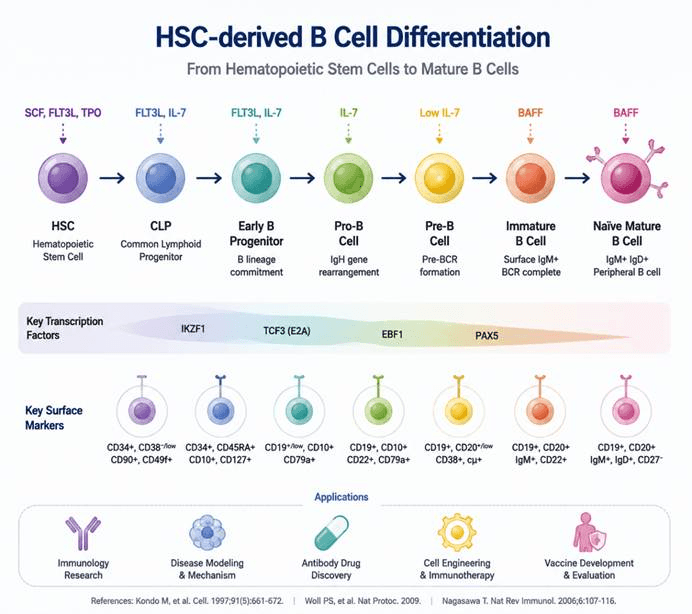
Schematic diagram of HSC-derived B cell differentiation process.
Hematopoietic stem cells (HSCs) undergo stepwise differentiation into mature naïve B cells under the regulation of key cytokines including SCF, FLT3L, IL-7, and BAFF, progressing through the stages of common lymphoid progenitors (CLPs), B cell progenitors, pro-B cells, pre-B cells, and immature B cells. This developmental process is precisely controlled by key transcription factors such as IKZF1, E2A, EBF1, and PAX5, which regulate B cell lineage commitment and functional maturation. Different developmental stages can be identified through stage-specific markers, including CD19, CD20, CD79a, IgM, and IgD, providing an important human cell model platform for studying B cell development, immune disease mechanisms, and cell therapy research.
Differentiation Stage | Added Factors / Culture Conditions | Core Biological Function | Corresponding Cell Type / Developmental Stage | Stage-specific Identification Markers |
Stage 1: HSC Maintenance and Lymphoid Lineage Initiation | Serum-free hematopoietic culture medium; SCF (Stem Cell Factor), FLT3 ligand (FLT3L), TPO (Thrombopoietin); low levels of IL-3/IL-6 (in some systems) | Maintains survival and proliferation of CD34⁺ HSC/HSPCs and initiates lymphoid lineage specification from multipotent hematopoietic stem cells | HSC → Multipotent Progenitor (MPP) | HSC: CD34⁺, CD38⁻/low, CD90⁺, CD45RA⁻, CD49f⁺; MPP: CD34⁺CD38⁺CD45RA⁻ |
Stage 2: Common Lymphoid Progenitor (CLP) Formation | FLT3L + IL-7 (IL-7 is commonly required in human systems); OP9 stromal cells or human bone marrow stromal cell co-culture | Induces lymphoid lineage commitment, restricts myeloid potential, and initiates B/T/NK lineage developmental programs | MPP → Common Lymphoid Progenitor (CLP) | CD34⁺CD45RA⁺CD10⁺CD127 (IL-7Rα)⁺; transcription factors: IKZF1, TCF3 (E2A), EBF1 |
Stage 3: B Lineage Commitment | FLT3L + IL-7; OP9/OP9-DL1 or human stromal cell-supported culture system | Activates B cell developmental programs; EBF1 induces B cell-associated gene expression, while PAX5 stabilizes B cell identity | CLP → Early B progenitor | CD34⁺CD19⁺/low, CD10⁺, CD79a⁺; EBF1↑, PAX5↑ |
Stage 4: Pro-B Cell Formation | Continuous IL-7 stimulation; reduced or withdrawn FLT3L; supportive stromal cell culture | Promotes expansion of B cell precursors; initiates immunoglobulin heavy chain D-J and V-DJ recombination | Pro-B cell (early bone marrow B cell developmental stage) | CD19⁺, CD10⁺, CD34⁺/⁻, CD79a⁺, CD22⁺; initiation of IgH rearrangement |
Stage 5: Pre-B Cell Maturation | Reduced IL-7 signaling; stromal cell support; moderate stimulation of BCR developmental signals | Completes μ heavy chain expression, forms pre-BCR, and promotes immunoglobulin light chain rearrangement | Pre-B cell | CD19⁺, CD10⁺, CD20⁺/low, CD79a⁺, CD38⁺, cytoplasmic μ chain⁺ |
Stage 6: Immature B Cell Generation | IL-7 withdrawal; BAFF supplementation (in some maturation systems); bone marrow-mimicking microenvironment | Enables complete BCR expression and acquisition of antigen recognition capability | Immature B cell (bone marrow output stage) | CD19⁺, CD20⁺, IgM⁺, CD22⁺, CD79b⁺ |
Stage 7: Mature Naïve B Cell Generation | BAFF support; peripheral lymphoid environment simulation | Promotes B cell maturation, survival, and peripheral B cell homeostasis | Naïve mature B cell | CD19⁺CD20⁺IgM⁺IgD⁺CD27⁻ |