
info@ucallmlabs.com
Hematopoietic Stem Cells (HSCs) are the core cell population responsible for the continuous renewal of the human immune system. Through multi-stage lineage commitment and thymic selection processes, HSCs can differentiate into mature T cells with immune functions. The in vitro differentiation system of HSC-derived T cells recapitulates the natural T-cell developmental process by utilizing advanced culture platforms, including Notch signaling pathway activation, OP9-DL1/DLL4 co-culture systems, and Artificial Thymic Organoids (ATOs), enabling directed induction from hematopoietic stem/progenitor cells to mature T cells.
During differentiation, HSCs first progress through the Multipotent Progenitor (MPP) and Common Lymphoid Progenitor (CLP) stages. Under the regulation of Notch1 signaling, cells undergo T-cell lineage commitment to form Early T-cell Progenitors (ETPs), followed by thymic developmental stages including Double-Negative (DN) and Double-Positive (DP) phases, ultimately generating mature CD4⁺ helper T cells and CD8⁺ cytotoxic T cells. Cytokines such as SCF, FLT3L, and IL-7, together with DLL4-mediated Notch signaling activation, effectively promote T-cell development, TCR rearrangement, and establishment of mature T-cell phenotypes.
The HSC-derived T-cell platform provides an important cellular model for studying immune development mechanisms, evaluating T-cell functions, developing genetically engineered immune cells, and advancing next-generation cell therapy products. Through standardized culture systems and multi-stage quality control strategies, functional T cells expressing typical T-cell markers (CD3⁺, TCRαβ⁺, CD4⁺ or CD8⁺) can be generated, providing reliable research tools for immune disease studies, cancer immunotherapy, and regenerative medicine applications.
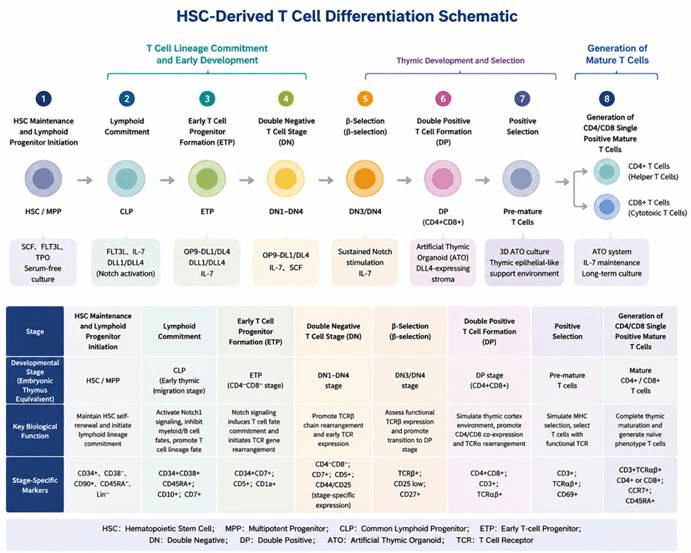
Schematic diagram of HSC-derived T-cell differentiation process.
This figure illustrates the continuous developmental process from HSCs to mature T cells, including HSC/MPP maintenance, lymphoid lineage commitment, early T-cell progenitor (ETP) formation, DN/DP thymic development, positive selection, and CD4⁺/CD8⁺ single-positive T-cell maturation stages. Through Notch signaling activation, OP9-DL1/DLL4 co-culture, and Artificial Thymic Organoid (ATO) systems, combined with key factors such as SCF, FLT3L, and IL-7, the natural thymic developmental environment can be recapitulated to achieve directed in vitro generation of functional T cells. The figure summarizes the culture conditions, biological functions, and stage-specific identification markers corresponding to each differentiation stage.
Differentiation Stage | Added Factors / Culture Conditions | Core Biological Functions | Corresponding Cell Type / Embryonic Development Stage | Stage-Specific Identification Markers |
1. HSC Maintenance and Lymphoid Progenitor Initiation | SCF, FLT3L, TPO; serum-free culture system | Maintains HSC self-renewal capacity and initiates commitment toward the lymphoid lineage | Hematopoietic Stem Cells (HSCs); Multipotent Progenitors (MPPs) | CD34⁺, CD38⁻, CD90⁺, CD45RA⁻, Lin⁻ |
2. Lymphoid Lineage Commitment | FLT3L, IL-7; Notch ligand (DLL1/DLL4) stimulation | Activates the Notch1 pathway, suppresses myeloid and B-cell fates, and promotes T-cell lineage specification | Common Lymphoid Progenitors (CLPs); corresponding to early embryonic thymus migration stage | CD34⁺CD38⁺CD45RA⁺; CD10⁺; CD7⁺ |
3. Early T-cell Progenitor (ETP) Formation | OP9-DL1 or OP9-DL4 stromal cell co-culture; DLL1/DLL4-mediated Notch activation; IL-7 | Notch signaling induces T-cell lineage commitment and initiates T-cell receptor (TCR) gene rearrangement programs | Early T-cell Progenitors (ETPs), analogous to embryonic thymic CD4⁻CD8⁻ stage | CD34⁺CD7⁺; CD5⁺; CD1a⁺ |
4. Double Negative (DN) T-cell Stage | OP9-DL1/DLL4 co-culture; IL-7; SCF | Promotes TCRβ chain rearrangement and early T-cell receptor expression | DN1–DN4 thymocyte developmental stages | CD4⁻CD8⁻; CD7⁺; CD5⁺; CD44/CD25 stage-dependent expression |
5. β-Selection Stage | Continuous Notch stimulation; IL-7 | Enables functional TCRβ expression and promotes transition into the DP stage | DN3/DN4 thymocytes | TCRβ⁺; CD25 downregulation; CD27⁺ |
6. Double Positive (DP) T-cell Formation | Artificial Thymic Organoid (ATO) system; DLL4-expressing stromal support cells | Recapitulates the thymic cortical environment and promotes CD4/CD8 co-expression and TCRα rearrangement | CD4⁺CD8⁺ thymocytes | CD4⁺CD8⁺; CD3⁺; TCRαβ⁺ |
7. Positive Selection | ATO three-dimensional culture system; thymic epithelial-like supportive environment | Mimics thymic MHC-mediated selection and enriches cells with functional TCRs | Immature mature-stage T cells | CD3⁺; TCRαβ⁺; CD69⁺ |
8. Generation of CD4/CD8 Single-Positive Mature T Cells | ATO system; IL-7 maintenance; long-term culture | Completes thymic maturation and generates naïve T cells | Mature CD4⁺ helper T cells and CD8⁺ cytotoxic T cells | CD3⁺TCRαβ⁺CD4⁺ or CD3⁺TCRαβ⁺CD8⁺; CCR7⁺; CD45RA⁺ |