
info@ucallmlabs.com
Immunotherapy is an important therapeutic strategy that treats diseases by activating, enhancing, redirecting, or relieving immune suppression. In cancer research, the core concept of immunotherapy is to utilize immune cells such as T cells, NK cells, and dendritic cells to recognize tumor-associated antigens and enhance their ability to eliminate tumor cells. Unlike traditional therapeutic approaches that directly target tumor cells, immunotherapy focuses more on processes including immune recognition, immune activation, tumor cell killing, and immune memory formation.
Currently, common cancer immunotherapy strategies include CAR-T, CAR-NK, TCR-T, Immune Checkpoint Inhibitors, Cancer Vaccines, and Dendritic Cell Vaccines. These strategies regulate anti-tumor immune responses through different approaches, including engineering immune cells, antigen-specific recognition, relieving immune suppression, and enhancing antigen presentation.
CAR-T Cell Therapy
CAR-T (Chimeric Antigen Receptor T-cell) therapy is an adoptive cellular immunotherapy technology based on genetically engineered T cells. Researchers introduce artificially designed chimeric antigen receptors (CARs) into T cells through genetic engineering approaches, enabling T cells to recognize specific target antigens expressed on the surface of tumor cells. When CARs bind to target antigens, they activate T-cell signaling pathways and further induce cytokine release and cytotoxic responses, thereby killing tumor cells.
CAR-T studies typically include several steps, including T-cell isolation, activation, CAR gene introduction, cell expansion, and co-culture with tumor cells. In in vitro studies, the function of CAR-T cells can be evaluated by detecting CAR expression, T-cell activation, cytokine secretion, and tumor cell killing activity.
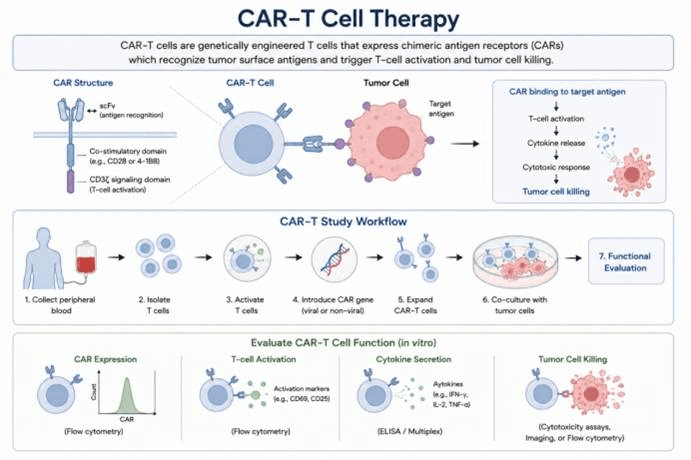
CAR‑T cell structure, experimental workflow and in vitro functional assays. Genetically modified CAR‑T cells express chimeric antigen receptors composed of scFv, co‑stimulatory domains and CD3ζ. CAR engagement with tumor antigen activates T cells to release cytokines and exert cytotoxicity against tumor cells. The workflow involves blood collection, T‑cell isolation, activation, CAR gene transduction, cell expansion, tumor co‑culture and functional testing. In vitro characterization detects CAR expression, T‑cell activation markers, cytokine secretion and tumor cytotoxicity.
CAR-NK Cell Therapy
CAR-NK (Chimeric Antigen Receptor Natural Killer Cell) therapy uses genetic engineering approaches to enable NK cells to express specific CARs, thereby providing NK cells with targeted recognition ability against specific tumor antigens. CAR-NK cells combine CAR-mediated antigen-specific recognition with the intrinsic natural cytotoxic mechanisms of NK cells. Similar to CAR-T studies, CAR-NK research typically involves co-culturing engineered NK cells with tumor cells to evaluate their antigen recognition, cell activation, degranulation, and tumor cell-killing capabilities.
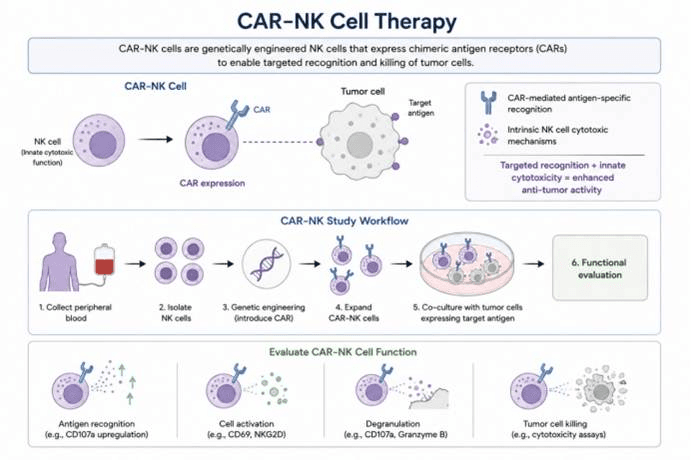
CAR-NK cell engineering workflow and in vitro functional characterization. Genetically modified CAR-NK cells express chimeric antigen receptors. CAR-NK cells integrate CAR-mediated antigen-specific recognition with intrinsic NK cytotoxicity to strengthen antitumor responses. The workflow consists of blood collection, NK isolation, CAR gene modification, expansion, tumor cell co-culture and functional testing. In vitro assays evaluate antigen recognition, NK activation, degranulation and tumor cytotoxicity.
TCR-T Cell Therapy
TCR-T (T-cell Receptor-engineered T-cell) therapy uses genetic engineering approaches to modify T cells so that they express engineered T-cell receptors (TCRs) capable of recognizing specific tumor antigen peptide–MHC complexes. Unlike CARs, which typically recognize antigens expressed on the surface of cells, TCRs can recognize antigen peptides that are processed from intracellular proteins and presented by MHC molecules. Therefore, TCR-T cells theoretically can target a broader range of tumor-associated antigens derived from intracellular proteins.
In TCR-T studies, engineered T cells are typically co-cultured with tumor cells expressing the corresponding target antigens. The function of TCR-T cells is evaluated by analyzing T-cell activation, cytokine secretion, and antigen-specific cytotoxicity.
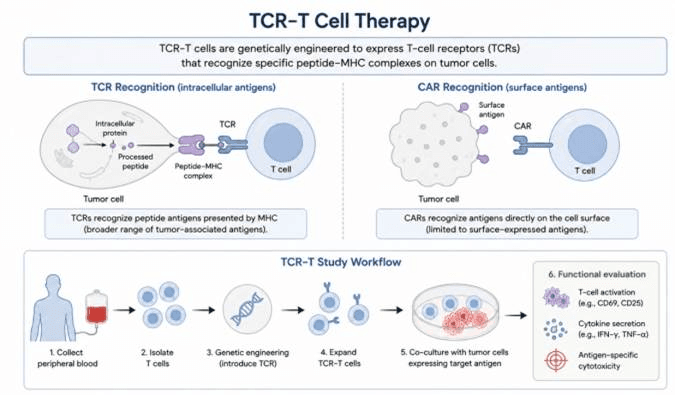
TCR‑T cell engineering workflow and antigen recognition compared with CAR-T. Engineered TCR‑T cells express recombinant TCRs that recognize peptide–MHC complexes derived from intracellular tumor proteins. In contrast, CARs bind unprocessed antigens only on the cell membrane. The TCR‑T workflow comprises blood collection, T-cell isolation, TCR gene transfer, cell expansion, tumor co‑culture and functional characterization. Functional readouts cover T-cell activation, cytokine release and antigen-specific cytotoxicity.
Immune Checkpoint Inhibitors
Immune Checkpoint Inhibitors (ICIs) restore or enhance the anti-tumor function of T cells by blocking negative regulatory signals in the immune system and relieving the suppression of T cells by the tumor microenvironment. Currently, the most extensively studied immune checkpoints include PD-1/PD-L1 and CTLA-4, as well as LAG-3, TIGIT, and TIM-3. Tumor cells or other cells within the tumor microenvironment can establish immunosuppressive signals by expressing immune checkpoint ligands, causing T cells to gradually enter a functionally impaired state. Blocking these signals can enhance T-cell activation and cytotoxicity.
Cancer Vaccines
Cancer vaccines promote antigen presentation and tumor-specific immune responses by providing the immune system with tumor-associated antigens (TAAs) or tumor-specific antigens (TSAs). Vaccines can utilize different forms of antigens, including peptides, proteins, DNA, RNA/mRNA, and tumor-cell-derived antigens. The core mechanism of cancer vaccines is not to directly kill tumor cells, but rather to enable or enhance the ability of the immune system to recognize tumor antigens. After antigens are taken up and processed by antigen-presenting cells, they can promote T-cell priming and subsequently induce tumor-specific T-cell responses.
Dendritic Cell Vaccines
Dendritic Cell Vaccines (DC vaccines) are a type of cellular immunotherapy strategy centered on dendritic cells (DCs). DCs are important antigen-presenting cells that connect innate immunity and adaptive immunity. They can uptake, process, and present tumor-associated antigens, thereby activating tumor-specific T cells. In typical DC vaccine studies, cells derived from monocytes or other sources can be obtained and induced to differentiate into DCs. These DCs are then loaded with tumor-associated antigens and undergo maturation treatment. Subsequently, antigen-loaded DCs are co-cultured with T cells to evaluate their antigen presentation capacity and T-cell activation ability.