
info@ucallmlabs.com
1.1 Mouse Models
Mouse models are one of the most commonly used in vivo research systems in immunology and tumor immunology studies. Mice possess well-developed innate and adaptive immune systems and have extensive genetic tools, allowing researchers to investigate the roles of specific immune molecules or signaling pathways in disease processes through approaches such as gene knockout, gene knock-in, and conditional gene editing. Meanwhile, mouse models enable the observation of dynamic interactions among immune cells, tumor cells, stromal cells, and other immune components within an intact tissue and systemic environment, thereby overcoming the limitations of purely in vitro cellular experiments.
1.2 Syngeneic Tumor Models
Syngeneic tumor models are an important class of mouse models widely used in tumor immunology research. These models typically involve the transplantation of tumor cells derived from a specific mouse strain into immunocompetent mice with the same or highly matched genetic background. Compared with traditional xenograft models using immunodeficient mice, the greatest advantage of syngeneic models is the preservation of a complete host immune system. Therefore, these models are particularly suitable for studying tumor immune surveillance, immune escape, immune editing, immune cell infiltration, and responses to immunotherapy. For example, after tumor formation, researchers can analyze the proportions and functional changes of different immune cell populations within tumor tissues, including CD8⁺ T cells, CD4⁺ T cells, NK cells, Tregs, macrophages, and myeloid-derived suppressor cells (MDSCs).
However, syngeneic models use mouse tumor cells and mouse immune systems; therefore, their results cannot fully reflect the genetic heterogeneity of human tumors or human immune responses. In addition, tumors are often established through subcutaneous injection in experimental settings, which differs from the tissue environment of human orthotopic tumors.
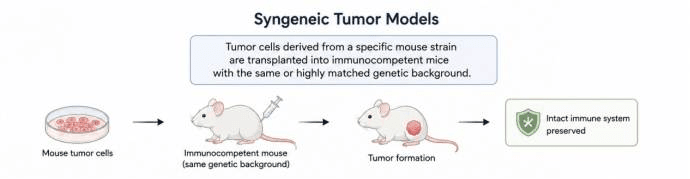
Workflow of syngeneic tumor models. In syngeneic tumor models, tumor cells originating from a defined mouse strain are implanted into immunocompetent mice of the same genetic background. Tumor cells are inoculated into recipient mice to form tumors. This model retains a fully functional immune system and is widely applied for in vivo immunotherapy studies.
1.3 Xenograft Models
Xenograft models are typically established by transplanting human tumor cells or patient-derived tumor tissues into immunodeficient mice, allowing human tumors to survive and expand in the mouse body. According to the source of tumors, xenograft models can be further classified into cell-line-derived xenograft (CDX) and patient-derived xenograft (PDX). CDX models usually utilize established tumor cell lines and therefore have advantages including simple experimental operation, high reproducibility, and suitability for drug screening. PDX models directly use patient-derived tumor tissues and can, to some extent, preserve the original tumor architecture, genetic characteristics, and partial heterogeneity, making them widely used for drug response studies and translational research.
An important advantage of xenograft models is their ability to investigate the growth, invasion, metastasis, and therapeutic responses of human tumor cells in vivo. These models are highly valuable for studying tumor cell biology as well as the interactions between tumor cells and the tumor microenvironment. However, the major limitation of traditional xenograft models is that the host animals usually lack a functional immune system. Therefore, although human tumors can be studied in mice, these models cannot directly reproduce the complete interactions between the human immune system and tumors.
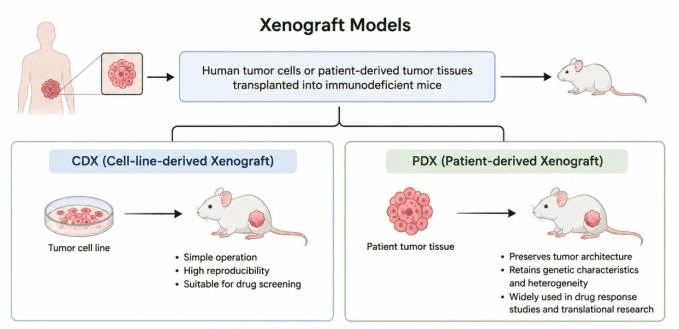
CDX and PDX xenograft models. Xenograft models implant human tumor materials into immunodeficient mice. CDX uses in vitro tumor cell lines, with easy operation and high reproducibility for drug screening. PDX is established from patient tumor tissues, retaining tumor histology, genetic profiles and heterogeneity, and is commonly applied for translational preclinical studies and drug response evaluation.
1.4 Humanized Mouse Models
Humanized mouse models are established based on immunodeficient mice by transplanting human-derived immune cells, hematopoietic stem cells, or tissues, thereby establishing a human immune system to a certain extent in mice, and are used to study the functions of human immune cells in vivo. For immuno-oncology, the importance of humanized mice lies in their ability to combine human-derived tumors with a human immune system, providing an in vivo platform for studying the interactions between human immune cells and tumors.
In human tumor research, humanized mice can be further combined with CDX, PDX, or patient-derived immune cells to establish models that more closely resemble the human tumor–immune environment. For example, transplanting human tumors into mice with a reconstructed human immune system allows simultaneous observation of tumor growth and changes in human T cells, B cells, NK cells, myeloid cells, and other immune cells. This makes humanized mice particularly suitable for studying immune checkpoint inhibitors, CAR-T cells, TCR-T cells, NK-cell therapy, T-cell engagers, tumor vaccines, and other immunotherapy strategies. However, humanized mice do not represent a complete replication of the human immune system. In practical research, humanized mice should be considered an important bridge connecting in vitro studies and clinical studies, rather than a complete substitute for the human physiological environment.