
info@ucallmlabs.com
Following infection, the host first recognizes pathogen-associated molecular patterns (PAMPs) through the innate immune system and rapidly initiates immune defense mechanisms. A properly regulated inflammatory response helps eliminate pathogens and restore tissue homeostasis, whereas persistent or excessive immune activation may lead to tissue damage, systemic inflammation, and even organ dysfunction.
Learn more about our pathogenic microorganism research topic.
1.1 Viral Infection
After viruses enter host cells, viral nucleic acids can be recognized by innate immune sensors, including RIG-I-like receptors (RLRs), Toll-like receptors (TLRs), and the cGAS–STING pathway. These recognition events activate downstream signaling pathways such as TBK1–IRF3/IRF7 and NF-κB, inducing the expression of type I/III interferons and other inflammatory mediators.
Interferons subsequently activate interferon-stimulated genes (ISGs) through the JAK–STAT signaling pathway, establishing an antiviral state and restricting viral replication. Under normal conditions, innate immune responses cooperate with adaptive immunity to eliminate viral infections.
However, some viruses can evade immune surveillance by suppressing interferon production, interfering with antigen presentation, or modulating host signaling pathways. When immune responses become dysregulated, persistent production of inflammatory cytokines and continuous immune cell recruitment may further contribute to tissue injury and immunopathology.
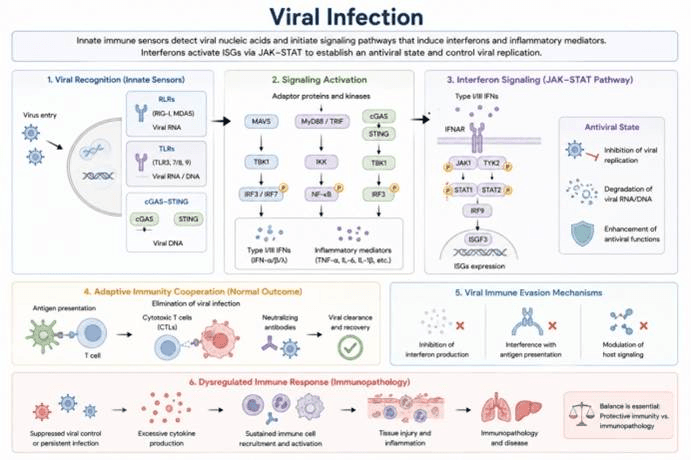
Immune response to viral infection. Viral nucleic acids are sensed by innate immune receptors including RLRs, TLRs and cGAS‑STING. Activated signalling cascades induce interferons and proinflammatory cytokines. IFNs engage the JAK‑STAT pathway to induce ISGs and establish an antiviral state. Antigen presentation elicits adaptive immunity, where CTLs and neutralizing antibodies eliminate virus. Viruses can evade host immunity through multiple mechanisms. Overexuberant immune activation causes cytokine excess, tissue damage and immunopathology. Proper balance is required to achieve antiviral protection without severe host injury.
1.2 Bacterial Infection
During bacterial infection, the host immune system recognizes bacterial components, including lipopolysaccharide (LPS), lipoproteins, flagellin, and peptidoglycan, through innate immune sensing mechanisms. Receptors such as Toll-like receptors (TLRs), NOD1, and NOD2 participate in the recognition of these bacterial molecules and subsequently activate downstream NF-κB and MAPK signaling pathways, promoting the production of inflammatory mediators including TNF-α, IL-6, IL-1β, and CXCL8/IL-8.
Meanwhile, inflammasomes such as NLRP3 can sense infection-associated cellular stress and danger signals, leading to caspase-1 activation and the maturation of IL-1β and IL-18, thereby amplifying inflammatory responses.
Subsequently, neutrophils, monocytes, and macrophages are recruited to the site of infection, where they contribute to pathogen clearance through phagocytosis, reactive oxygen species (ROS) generation, degranulation, and other effector mechanisms.
When immune responses triggered by bacterial infection become dysregulated, excessive inflammation may further progress to systemic inflammation, sepsis, and organ dysfunction.
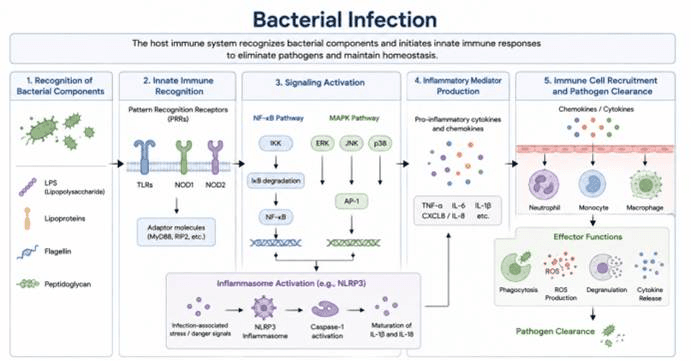
Innate immune response to bacterial infection. Bacterial components such as LPS, lipoproteins, flagellin and peptidoglycan are recognized by PRRs (TLRs, NOD1/NOD2), activating NF‑κB and MAPK signaling. These pathways induce proinflammatory cytokines and chemokines that recruit neutrophils, monocytes and macrophages. Recruited immune cells clear bacteria via phagocytosis, ROS production, degranulation and cytokine release. NLRP3 inflammasome activation further promotes caspase‑1‑dependent maturation of IL‑1β and IL‑18, amplifying host defense.
1.3 Innate Immune Response
Innate immunity represents the first line of defense against infection. Unlike adaptive immunity, which is characterized by highly antigen-specific responses, the innate immune system relies on pattern recognition receptors (PRRs) to rapidly detect pathogen-associated molecular patterns (PAMPs) and damage-associated molecular patterns (DAMPs). Following infection, immune cells including macrophages, monocytes, neutrophils, and dendritic cells are among the first responders involved in pathogen recognition and elimination. PRR activation induces the production of interferons, TNF-α, IL-1β, IL-6, and chemokines, thereby promoting inflammatory responses and immune cell recruitment. Meanwhile, mechanisms including phagocytosis, reactive oxygen species (ROS) production, complement activation, and antigen presentation collectively restrict pathogen dissemination and provide essential signals for subsequent adaptive immune responses. Therefore, innate immune responses exhibit a dual role: appropriate activation promotes pathogen clearance, whereas persistent or excessive activation can lead to excessive inflammation and tissue damage.
1.4 Cytokine Storm
A cytokine storm is a severe inflammatory state caused by excessive or dysregulated immune activation. Infections, immunotherapies, or other immune stimuli can induce the uncontrolled release of large amounts of pro-inflammatory cytokines and chemokines under certain conditions. Among these mediators, IL-1β, IL-6, TNF-α, IFN-γ, and various chemokines promote continuous immune cell recruitment and activation, creating a positive feedback loop that further amplifies inflammation. Highly activated monocytes/macrophages, neutrophils, and T cells can release additional inflammatory mediators, causing localized inflammation to expand into systemic inflammation. In severe cases, persistent cytokine signaling can result in endothelial dysfunction, vascular leakage, tissue injury, and multi-organ dysfunction. Therefore, infection studies should not only evaluate pathogen clearance, but also monitor the magnitude of immune activation and whether inflammatory responses become dysregulated. Severe viral infections, such as COVID-19, represent important disease models for studying cytokine dysregulation.
1.5 Inflammatory Signaling
Infection-induced inflammatory responses involve multiple interconnected signaling networks. Among them, NF-κB, MAPK, JAK–STAT, inflammasome, and cGAS–STING pathways represent some of the most important signaling modules in infection and inflammation research. These pathways coordinate immune cell activation, inflammatory mediator production, antiviral defense, and tissue responses, thereby regulating the balance between protective immunity and inflammatory pathology.
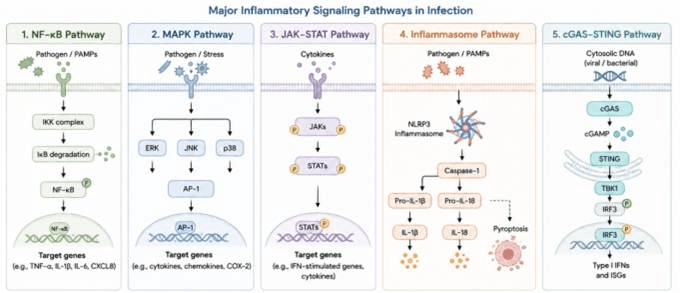
Key inflammatory signaling pathways in infection. Five principal innate immune signaling cascades are summarized. PAMPs initiate the NF‑κB and MAPK pathways to induce proinflammatory mediators. Cytokines activate the JAK‑STAT axis for interferon and cytokine gene expression. The NLRP3 inflammasome activates caspase‑1 for maturation of IL‑1β/IL‑18 and pyroptosis. Cytosolic DNA triggers the cGAS‑STING‑TBK1‑IRF3 cascade to produce type I IFNs and ISGs. Together these pathways orchestrate host inflammatory and antiviral/antibacterial immunity.
| Signaling Pathway | Major Triggers | Key Molecules | Major Effects |
| TLR–NF-κB | LPS, bacterial/viral PAMPs | TLR → MyD88/TRIF → NF-κB | Production of inflammatory cytokines including TNF-α, IL-6, and IL-1β |
| MAPK | PAMPs, cellular stress | ERK, JNK, p38 | Regulation of inflammatory cytokine production and stress responses |
| NOD Signaling | Bacterial peptidoglycan | NOD1/NOD2 → RIPK2 → NF-κB | Induction of inflammatory responses and antibacterial defense |
| NLRP3 Inflammasome | Infection, ROS, cellular stress | NLRP3 → ASC → Caspase-1 | Maturation of IL-1β and IL-18; induction of pyroptosis |
| cGAS–STING | Cytosolic DNA | cGAS → STING → TBK1 → IRF3 | Production of type I interferons |
| RLR Signaling | Viral RNA | RIG-I/MDA5 → MAVS → TBK1/IRF3 | Production of type I/III interferons |
| JAK–STAT | Cytokines such as IFNs and IL-6 | JAK → STAT | Activation of interferon-stimulated genes (ISGs), inflammation, and immune regulation |
Learn about our featured antibody panels for signaling pathway research