
info@ucallmlabs.com
1. Overview
Lassa mammarenavirus (LASV) is the prototype species of the genus Mammarenavirus within the family Arenaviridae and is the causative agent of Lassa fever. It is an enveloped, negative‑sense, single‑stranded, bisegmented RNA virus with spherical virions, 70–150 nm in diameter, featuring a smooth surface envelope with T‑shaped spikes (7–10 nm).
LASV was first discovered in Nigeria in 1969. The virus is transmitted to humans primarily through the urine and faeces of the multimammate rat (Mastomys natalensis) and is endemic in West African countries such as Nigeria, Sierra Leone, Guinea, and Liberia. Lassa fever is one of the most serious public health threats in the region, with an estimated 100,000 to 500,000 infections and approximately 5,000 deaths annually. Case fatality rates among hospitalized patients can range from 15% to 70%, with pregnant women and children facing higher mortality risks.
The World Health Organization (WHO) has designated Lassa virus as a priority pathogen due to its potential to cause large outbreaks,urging accelerated research and development of vaccines and therapeutics. However, no LASV‑specific vaccine or antiviral therapy is currently licensed worldwide.
2. Background Information
2.1 What is Lassa mammarenavirus?
Lassa virus is an enveloped, negative‑sense, single‑stranded, bisegmented RNA virus belonging to the family Arenaviridae and genus Mammarenavirus. Virions are spherical, 70–150 nm in diameter, with T‑shaped glycoprotein spikes on the envelope surface. The interior contains a helical nucleocapsid, approximately 400–1300 nm in length. The name "arena" (meaning "sandy") derives from the electron‑dense granules observed within virions—these are actually host cell ribosomes.
The LASV genome consists of two negative‑sense RNA segments: a large (L) segment and a small (S) segment. Both segments employ an ambisense coding strategy, meaning each contains two open reading frames (ORFs) oriented in opposite directions, separated by a non‑coding intergenic region (IGR). The L segment (approximately 7.2 kb) encodes the matrix protein Z and the RNA polymerase L; the S segment (approximately 3.4 kb) encodes the nucleoprotein NP and the glycoprotein precursor GPC.
2.2 Lassa mammarenavirus Genome & Classification
LASV belongs to the genus Mammarenavirus in the family Arenaviridae. The genus Mammarenavirus is divided into Old World and New World groups. LASV is an Old World arenavirus, closely related to Lymphocytic choriomeningitis virus (LCMV). The natural hosts of Old World arenaviruses are rodents of the sub‑family Murinae. LASV exists in multiple genetic lineages, primarily lineages I–IV, distributed across different geographical regions of West Africa.
2.3 What Are Lassa mammarenavirus Structural Proteins?
LASV encodes only four structural proteins, yet their functions are highly sophisticated:
Region | Encoded by | Main Function |
NP (Nucleoprotein) | S segment | Binds viral RNA to form ribonucleoprotein complexes (RNPs); possesses 3′→5′ exoribonuclease activity involved in immune evasion |
GPC (Glycoprotein precursor) | S segment | Cleaved by host protease SKI‑1/S1P into GP1 and GP2, forming the surface spike complex |
Z (Matrix protein) | L segment | Multifunctional matrix protein; mediates RNP membrane recruitment, viral assembly, and budding; interacts with L protein |
L (Large protein/RdRp) | L segment | RNA‑dependent RNA polymerase (approximately 200 kDa); catalyzes viral RNA transcription and replication |
2.4 Mechanism of Cell Entry and Replication
2.4.1 Viral Attachment and Receptor Recognition
LASV infection begins with the binding of the viral spike complex to host cell surface receptors. GP1 first binds to α‑dystroglycan (α‑DG) on the cell surface. α‑DG is the primary cell surface receptor for LASV.
2.4.2 Viral Entry
Following α‑DG binding, the virus enters the host cell via a clathrin‑independent endocytic pathway. After internalization, the virus is trafficked to late endosomal/lysosomal compartments. In the acidic endosomal environment, the spike complex undergoes conformational changes, and GP1 binds to a second receptor on the endosomal membrane—lysosomal associated membrane protein 1 (LAMP1) . LAMP1 binding triggers GP2‑mediated membrane fusion, releasing the viral RNP into the cytoplasm.
2.4.3 Viral RNA Replication
After RNP release into the cytoplasm, the L protein (RdRp) initiates transcription and replication of the viral genome:
l Transcription: the negative‑sense RNA genome is transcribed into mRNAs. The virus employs a cap‑snatching mechanism—the N‑terminal endonuclease domain of the L protein cleaves the 5′ cap structure from host mRNAs for use in viral mRNA capping
l Replication: full‑length positive‑sense RNA intermediates (antigenomes) are synthesized using negative‑sense RNA as template
l Progeny negative‑sense genomic RNAs are synthesized using positive‑sense RNA as template
Due to the ambisense coding strategy, early genes (NP and Z) are transcribed directly from the genomic RNA, while late genes (GPC and L) are transcribed from the antigenomic RNA produced during replication.
2.4.4 Viral Assembly and Release
Newly synthesized NP associates with progeny genomic RNA and L protein to form new RNPs. Z protein recruits RNPs to the cell membrane, and viruses acquire their envelope by budding from the host cell membrane, releasing new virions. Progeny virus particles are predominantly released from the apical surface of infected cells.
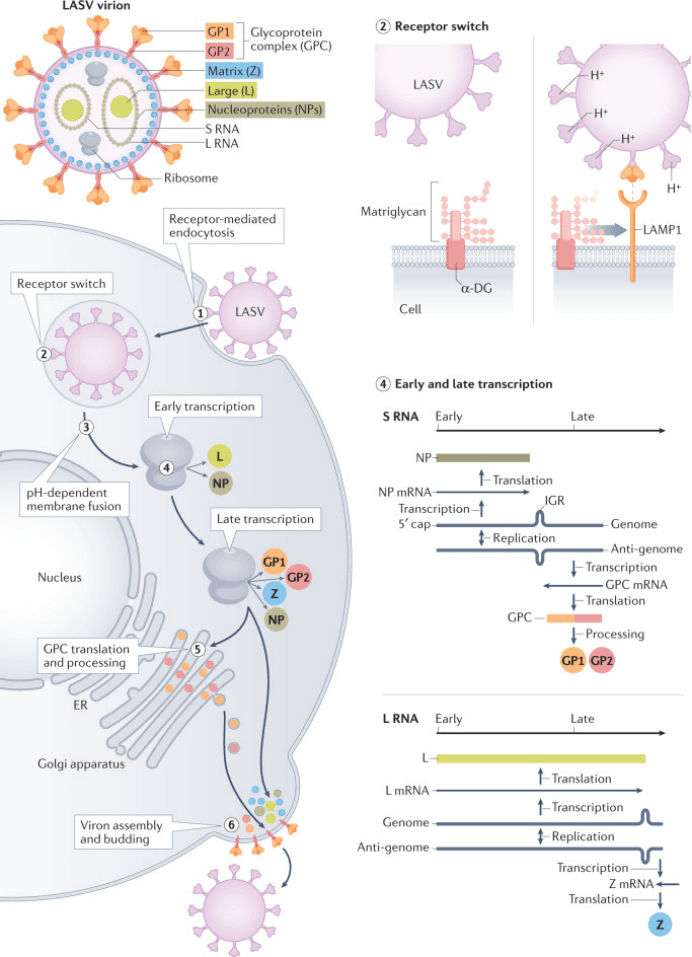
Lassa virus structure, genome organization and replication strategy. (PMID: 36097163)
2.5 Symptoms and Treatment
2.5.1 Clinical Symptoms
The incubation period for Lassa fever is typically 6–21 days. Approximately 80% of infections are asymptomatic or present with only mild symptoms. Common symptoms in symptomatic patients include:
l Gradually progressive fever
l Weakness and malaise
l Headache, muscle pain
l Gastrointestinal symptoms (nausea, vomiting, diarrhoea, dysphagia, epigastric pain)
l Sore throat, cough
l Facial swelling
Approximately 20% of patients develop severe symptoms, including haemorrhage, respiratory distress, repeated vomiting, facial swelling, and shock. Severe cases may progress to seizures, multi‑organ failure, and death. Pregnant women face extremely high maternal and fetal mortality rates. Sensorineural hearing loss is a significant long‑term sequela of Lassa fever.
Case fatality rates among hospitalized patients range from 15% to 70%, depending on healthcare access and treatment timeliness.
2.5.2 Antiviral Treatment
Currently, no specific antiviral therapy is approved for Lassa virus infection.
l Ribavirin: the only antiviral drug currently used for treating Lassa fever. Intravenous ribavirin is the standard of care; initiation within the first 6 days of illness can significantly reduce mortality. Ribavirin is also used occasionally for post‑exposure prophylaxis. However, ribavirin has limited efficacy and is unsuitable for use in pregnant women and their unborn children.
l Supportive care: including correction of fluid and electrolyte imbalances and symptomatic treatment, is essential.
2.6 Targets for Intervention
2.6.1 Viral Targets
Target | Protein | Biological Role |
GPC | Glycoprotein complex (GP1/GP2) | Receptor binding & membrane fusion |
L protein (RdRp) | RNA polymerase | RNA transcription & replication |
L protein (CEN) | Cap‑dependent endonuclease | Cap‑snatching, mRNA capping |
NP | Nucleoprotein | RNP formation, immune evasion |
Z | Matrix protein | Assembly & budding |
2.6.2 Host Receptors & Entry Factors
Host Target | Type | Role in Infection |
α‑Dystroglycan | Cell surface receptor | Initial viral attachment |
LAMP1 | Endosomal membrane receptor | Triggers membrane fusion at low pH |
SKI‑1/S1P protease | Host protease | GPC proteolytic cleavage activation |
2.6.3 Host Signaling Pathways
Pathway | Key Targets | Biological Role |
Interferon pathway | IFN‑α/β | Antiviral response, suppressed by NP exonuclease activity |
Endocytic pathway | — | Viral entry |
2.7 Vaccine Types and Development Progress
Currently, no Lassa virus vaccine is licensed worldwide. However, several candidates have advanced to clinical trials.
2.7.1 ChAdOx1 Lassa (Adenovirus‑Vectored Vaccine)
The ChAdOx1 Lassa vaccine, developed by the University of Oxford, uses the same viral vector platform as the Oxford/AstraZeneca COVID‑19 vaccine. In December 2025, the first‑in‑human Phase 1 clinical trial (VITAL01) was launched, enrolling 31 volunteers aged 18–55 to assess safety and immunogenicity. The trial is funded by the Coalition for Epidemic Preparedness Innovations (CEPI).
2.7.2 MV‑LASV (Recombinant Measles‑Vectored Vaccine)
The recombinant measles‑vectored vaccine (MV‑LASV) is one of the candidates that has entered clinical trials. Phase 1 trials demonstrated robust immunogenicity in adults, with approximately 95% seroconversion at 30 days post‑vaccination.
2.7.3 rVSVΔG-LASV-GPC (Recombinant Vesicular Stomatitis Virus-Vectored Vaccine)
This vaccine is based on the recombinant vesicular stomatitis virus (rVSV) platform—the same platform used for the Ervebo Ebola vaccine. The vaccine provided 100% protection in 10 vaccinated macaques and has recently progressed to Phase 2 clinical trials. In HLA transgenic mice, MVA‑vectored vaccines (expressing LASV GPC or NP) also induced robust polyfunctional CD8⁺ and CD4⁺ T cell responses.
2.7.4 Other Vaccine Candidates
l Inactivated vaccines: e.g., BBV87 (same platform as the chikungunya vaccine), in preclinical or early clinical stages
l DNA vaccines: in preclinical development
l Virus-like particle (VLP) vaccines: in preclinical development
2.7.5 Vaccine Development Ecosystem
The Lassa fever Coalition, led by the West African Health Organization (WAHO) with support from CEPI and partners, is advancing Lassa vaccine development and future equitable introduction across affected regions. A 2025 systematic review evaluated 51 studies (including 2 clinical trials and 49 preclinical studies) covering 30 vaccine candidates. However, no clinical trial data are currently available for special populations such as pregnant women, infants, children, or adolescents.
2.8 Drugs
Currently, no specific small‑molecule antiviral is approved for Lassa virus. Treatment relies primarily on ribavirin and supportive care. Several novel antiviral candidates are in preclinical or clinical development:
2.8.1 Virus-Targeted Drugs
Target | Drug/candidate | Mechanism | Stage |
GPC (entry) | ARN‑75039 | Entry inhibitor | Research |
L protein (CEN) | CENis (compounds #B/#261) | Cap‑dependent endonuclease inhibition | Animal models |
L protein (RdRp) | 4′‑Fluorouridine (4′‑FlU) | RdRp inhibition | Animal models |
Favipiravir | RdRp inhibition | Research | |
Multiple targets | Flunarizine | Calcium‑channel blocker; inhibits vRNP activity and GP fusion activity | Drug repurposing |
Niloticin | Multi‑target binder | In silico screening | |
Saracatinib | Src family kinase inhibitor; broad‑spectrum anti‑arenavirus activity | FDA‑approved drug repurposing |
2.9 Epidemiology
l Disease burden: LASV causes an estimated 100,000 to 500,000 infections and approximately 5,000 deaths annually in endemic regions
l Geographic distribution: endemic in West African countries including Nigeria, Guinea, Liberia, and Sierra Leone. Nigeria is a hotspot, with 1,189 confirmed cases in 2020, the highest annual total
l Seasonality: transmission occurs year‑round, with an increase in case numbers during the dry season (January to April)
l Transmission routes:
² Animal‑to‑human: contact with urine, faeces, or contaminated food/water sources from infected multimammate rats
² Human‑to‑human: contact with infected blood, tissues, or bodily fluids
l High‑risk populations: pregnant women, children, healthcare workers
l Vertical transmission: approximately 79.1% of infected pregnancies result in vertical transmission
l Imported cases: Lassa fever can be imported to non‑endemic regions through international travel
2.10 Diagnosis
Diagnosis of Lassa fever relies on laboratory testing, including:
l RT‑PCR: detection of viral RNA in blood, the gold standard for acute‑phase diagnosis
l Antigen detection: detection of viral antigens
l Serology: detection of anti‑LASV IgM/IgG antibodies
2.11 Prevention
l Environmental control: reduce contact with multimammate rats; prevent rodent entry into homes and food storage areas
l Food safety: store food properly to avoid rodent contamination
l Personal protective measures: healthcare workers should use standard precautions
l Post‑exposure prophylaxis: ribavirin may be used for PEP
l Vaccines: none currently licensed (see Section 2.7)
3. Related Products & Services
l Recombinant Antigens & Receptors
l Antibodies
l Detection Kits
l Recombinant Protein Expression Services
l Antibody Development Services
4. Resources
5. References
1. Garry, R. F. (2023). Lassa fever—the road ahead. Nature Reviews Microbiology, 21, 87–96.
2. Andersen, K. G., Shapiro, B. J., Matranga, C. B., et al. (2015). Clinical sequencing uncovers origins and evolution of Lassa virus. Cell, 162(4), 738–750.
3. Bowen, M. D., Rollin, P. E., Ksiazek, T. G., et al. (2000). Genetic diversity among Lassa virus strains. Journal of Virology, 74(15), 6992–7004.
4. Prescott, J. B., Marzi, A., Safronetz, D., et al. (2017). Immunobiology of Ebola and Lassa virus infections. Nature Reviews Immunology, 17, 195–207.
5. Hallam, H. J., Hallam, S., Rodriguez, S. E., et al. (2018). Baseline mapping of Lassa fever virology, epidemiology and vaccine research and development. npj Vaccines, 3, 11.
6. Cao, W., Henry, M. D., Borrow, P., et al. (1998). Identification of α-dystroglycan as a receptor for lymphocytic choriomeningitis virus and Lassa fever virus. Science, 282(5396), 2079–2081.
7. Shimojima, M., Ströher, U., Ebihara, H., Feldmann, H., & Kawaoka, Y. (2012). Identification of cell surface molecules involved in dystroglycan-independent Lassa virus cell entry. Journal of Virology, 86(4), 2067–2078.
8. Qi, X., Lan, S., Wang, W., et al. (2010). Cap binding and immune evasion revealed by Lassa nucleoprotein structure. Nature, 468, 779–783.
9. Hastie, K. M., King, L. B., Zandonatti, M. A., et al. (2012). Structural basis for the dsRNA specificity of the Lassa virus NP exonuclease. PLoS ONE, 7, e44211.
10. Eichler, R., Lenz, O., Garten, W., & Strecker, T. (2006). The role of single N-glycans in proteolytic processing and cell surface transport of the Lassa virus glycoprotein GP-C. Virology Journal, 3, 41.
11. McCormick, J. B., King, I. J., Webb, P. A., et al. (1986). Lassa fever. Effective therapy with ribavirin. New England Journal of Medicine, 314, 20–26.
12. Eberhardt, K. A., Mischlinger, J., Jordan, S., et al. (2019). Ribavirin for the treatment of Lassa fever: A systematic review and meta-analysis. International Journal of Infectious Diseases, 87, 15–20.
13. Salam, A. P., et al. (2022). Ribavirin for treating Lassa fever: A systematic review of pre-clinical studies and implications for human dosing. PLoS Neglected Tropical Diseases, 16, e0010289.
14. Michaels-Strasser, S., et al. (2020). Lassa fever in pregnancy: A systematic review and meta-analysis. The Lancet Infectious Diseases.
15. Safronetz, D., Mire, C., Rosenke, K., et al. (2015). A recombinant vesicular stomatitis virus-based Lassa fever vaccine protects guinea pigs and macaques against challenge with geographically and genetically distinct Lassa viruses. PLoS Neglected Tropical Diseases, 9, e0003736.
16. Dörner, F., et al. (2019). Vaccines inducing immunity to Lassa virus glycoprotein and nucleoprotein protect macaques after a single shot. Science Translational Medicine.
17. Bardach, A., Berrueta, M., Ciapponi, A., et al. (2025). Efficacy, safety, and immunogenicity of Lassa fever vaccines: A living systematic review and landscape analysis of vaccine candidates. PLoS ONE, 20, e0338128.
18. Amberg, S. M., Snyder, B., Vliet-Gregg, P. A., et al. (2022). Safety and pharmacokinetics of LHF-535, a potential treatment for Lassa fever, in healthy adults. Antimicrobial Agents and Chemotherapy, 66, e00951-22.
19. Cross, R. W., et al. (2026). Oral 4′-fluorouridine rescues nonhuman primates from advanced Lassa fever. Nature.
20. Eudy, E., Woodburn, D., Reeder, R., et al. (2026). The virus entry inhibitor ARN-75039 provides therapeutic protection against Lassa virus infection in guinea pigs. Science Translational Medicine, 18(845), eadx0938.