```
Lysozincrosis
1.1 Mechanism Overview
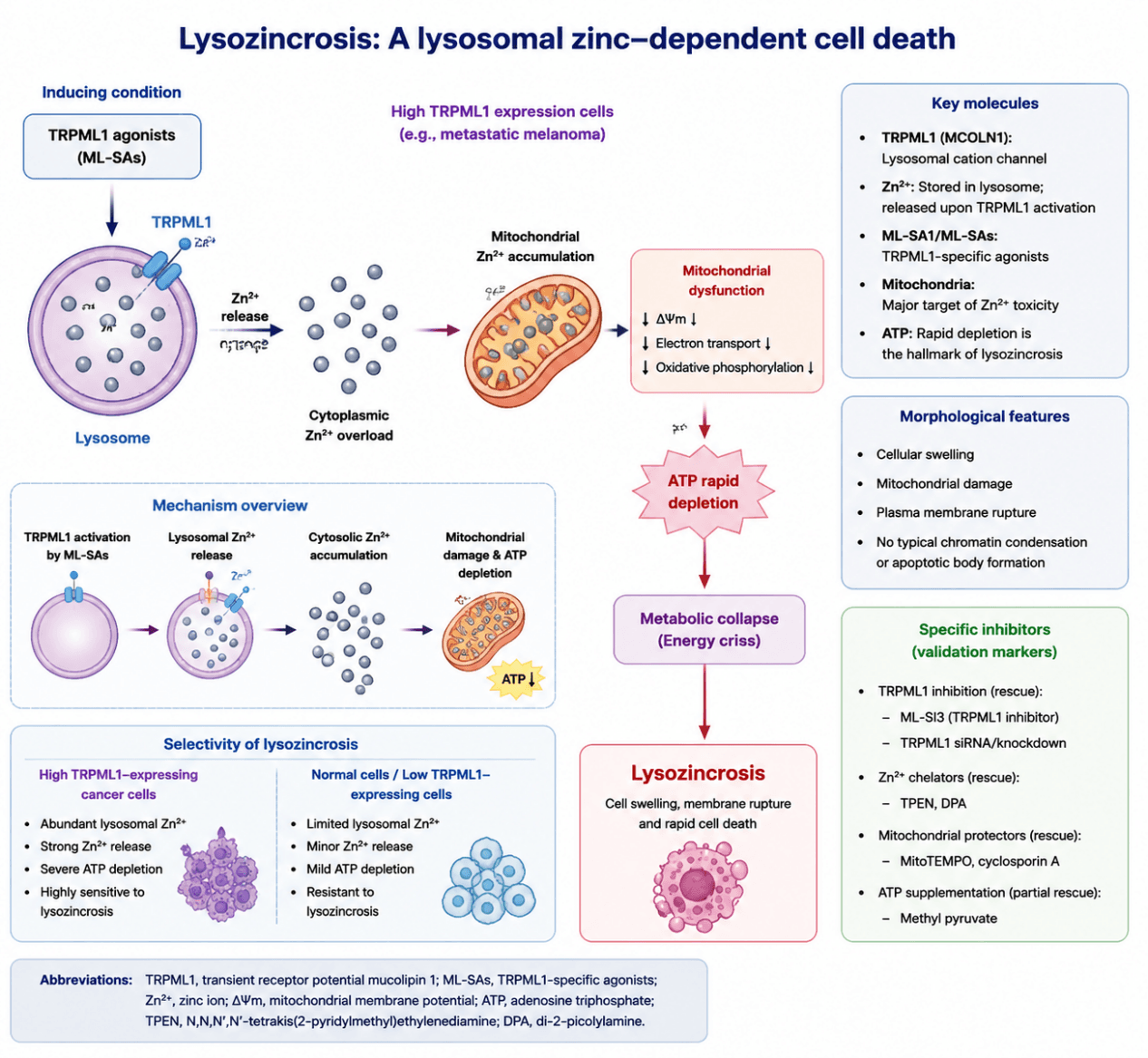
Zinc ions (Zn²⁺) are essential trace elements that sustain normal cellular metabolism and physiological functions, yet aberrant zinc accumulation can trigger severe cytotoxicity. Recent studies have identified that TRPML1, a lysosomal ion channel highly expressed in metastatic melanoma cells, acts as a critical regulator of lysozincrosis. Upon activation by specific TRPML1 agonists (ML‑SAs), TRPML1 facilitates rapid efflux of lysosome‑stored Zn²⁺ into the cytosol, resulting in intracellular zinc overload. Excessive Zn²⁺ further accumulates within mitochondria, impairs mitochondrial membrane integrity, suppresses oxidative phosphorylation, induces mitochondrial dysfunction and sharp ATP depletion, ultimately leading to cellular energy exhaustion and initiating lysozincrosis.
Distinct from ferroptosis (reliant on lipid peroxidation) and cuproptosis (driven by aggregation of lipoylated proteins), lysozincrosis is characterized by TRPML1‑mediated lysosomal Zn²⁺ release, mitochondrial injury and metabolic collapse. Notably, metastatic melanoma cells with high TRPML1 expression are profoundly susceptible to lysozincrosis, whereas normal cells remain minimally affected. This indicates that targeting the TRPML1‑Zn²⁺ axis to trigger lysozincrosis may constitute a tumor‑selective anti‑cancer therapeutic strategy.
Lysozincrosis Mechanism Diagram. The TRPML1 agonist ML‑SA activates lysosomal TRPML1 channels, triggers lysosomal Zn²⁺ release and induces intracellular zinc overload as well as mitochondrial Zn²⁺ accumulation. This leads to mitochondrial dysfunction, suppressed oxidative phosphorylation and rapid ATP depletion, and ultimately initiates a novel Zn²⁺‑dependent regulated cell death termed lysozincrosis via metabolic collapse.
1.2 Target List
Core Targets of Lysozincrosis
| Mechanism Module |
Target (Gene/Protein) |
Full Name |
Function |
Role in Lysosome‑dependent Cell Death |
| Lysosomal Zinc Release and Ion Homeostasis |
TRPML1 |
Transient receptor potential mucolipin 1 |
A lysosomal ion channel that mediates Zn²⁺ release from lysosomes |
Core channel regulating lysosomal Zn²⁺ efflux; activation by ML‑SA initiates lysosome‑dependent zinc‑mediated cell death (lysozincrosis) |
| TRPML1 agonist binding site |
TRPML1 agonist‑binding region |
Binding region for TRPML1 activators such as ML‑SA1 and ML‑SAs |
Mediates agonist‑induced TRPML1 activation and promotes lysosomal Zn²⁺ release |
Key Downstream Damage Targets
| Mechanism Module |
Target (Gene/Protein) |
Full Name |
Function |
Alterations in Lysozincrosis |
| Mitochondrial Complex I Dysfunction |
NDUFS1, NDUFS2, NDUFV1 |
NADH dehydrogenase Fe‑S protein 1/2; NADH dehydrogenase flavoprotein 1 |
Components of mitochondrial respiratory Complex I involved in NADH electron transport |
Zn²⁺ accumulation disrupts electron flux and impairs Complex I activity |
| Mitochondrial Complex II Dysfunction |
SDHA, SDHB |
Succinate dehydrogenase flavoprotein subunit A / iron‑sulfur subunit B |
Catalyzes succinate oxidation and transfers electrons to the respiratory chain |
Zn²⁺ stress reduces respiratory activity and compromises Complex II function |
| Mitochondrial Complex III Dysfunction |
UQCRC1, UQCRC2 |
Ubiquinol‑cytochrome c reductase core protein 1 / 2 |
Mediates electron transfer within mitochondrial Complex III |
Impaired electron transport increases mitochondrial ROS production |
| Mitochondrial Complex IV Dysfunction |
COX4I1, MT‑CO1 |
Cytochrome c oxidase subunit 4 isoform 1 / Mitochondrially encoded cytochrome c oxidase subunit 1 |
Mediates oxygen consumption and oxidative phosphorylation |
Zn²⁺ overload impairs Complex IV activity and disrupts oxidative phosphorylation |
| ATP Synthesis Dysfunction |
ATP5F1A, ATP5F1B |
ATP synthase F1 subunit alpha / beta |
Catalyzes ATP synthesis through mitochondrial oxidative phosphorylation |
Mitochondrial dysfunction causes rapid ATP depletion |
1.3 Application Scheme
| Purpose |
Target Panel |
| Confirm the occurrence of lysozincrosis |
TRPML1 (MCOLN1) + Zn²⁺ release + reduced ATP levels |
| Detect TRPML1‑mediated Zn²⁺ efflux |
TRPML1 (MCOLN1) + LAMP1 (lysosomal localization) |
| Verify intracellular Zn²⁺ accumulation |
Zn²⁺ fluorescent probes (FluoZin3 / Zinpyr) + TPEN rescue assay |
| Identify lysosomes as the source of Zn²⁺ release |
TRPML1 (MCOLN1) + LAMP1 + LysoTracker |
| Evaluate mitochondrial Zn²⁺ toxic injury |
MitoTracker + Zn²⁺ probe + COX4 |
| Assess mitochondrial dysfunction |
COX4 + ATP5A + NDUFS1 |
| Detect impaired oxidative phosphorylation |
NDUFS1 (Complex I) + SDHA (Complex II) + UQCRC2 (Complex III) + COX4 (Complex IV) |
| Confirm ATP depletion |
ATP5A + ATP5B + ATP quantification assay |
| Monitor energy stress response |
AMPK + pAMPK |
| Detect mitochondrial oxidative damage |
MitoSOX (mtROS) + 4HNE + Nrf2/HO1 |
1.4 References
- Du W, Gu M, Hu M, Pinchi P, Chen W, Ryan M, Nold T, Bannaga A, Xu H. Lysosomal Zn²⁺ release triggers rapid, mitochondria‑mediated, non‑apoptotic cell death in metastatic melanoma. Cell Reports. 2021;37(3):109848. doi: 10.1016/j.celrep.2021.109848.
```