info@ucallmlabs.com
Macrophages are important innate immune effector cells whose functions are highly dependent on the surrounding tissue microenvironment and stimulation signals. Classical studies generally categorize macrophage activation into two major functional states: M1-like inflammatory activation and M2-like reparative activation.
It is important to emphasize that M1/M2 are not absolute or mutually exclusive macrophage types, but rather a classical experimental framework used to describe different macrophage functional states. In real tissue environments, macrophages exhibit continuous, dynamic, and highly heterogeneous activation states.
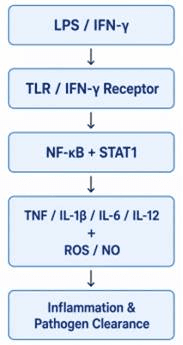
M1-like macrophages are typically induced by inflammatory stimuli such as LPS and IFN-γ. Following activation of pattern recognition receptors (PRRs), including TLRs, downstream signaling pathways such as NF-κB, MAPK, and STAT1 are activated, inducing the expression of inflammatory genes. M1-like macrophages produce inflammatory mediators including TNF, IL-1β, IL-6, and IL-12, while enhancing ROS and nitric oxide (NO) production and pathogen clearance capacity. Therefore, the M1-like state is primarily associated with anti-microbial defense, inflammation, and immune activation.
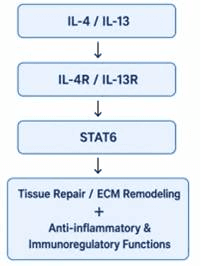
In contrast, M2-like macrophages are typically induced by type 2 cytokines such as IL-4 and IL-13, which activate signaling pathways including STAT6 and promote the expression of genes involved in tissue repair, extracellular matrix remodeling, and inflammation regulation. M2-like macrophages are generally associated with tissue repair, wound healing, immune regulation, and maintenance of tissue homeostasis. In the tumor microenvironment, some tumor-associated macrophages (TAMs) may also acquire functional states characterized by immune suppression and tissue remodeling.
Core Process of Macrophage Activation
M1-like Inflammatory Activation
M2-like Reparative Activation