
info@ucallmlabs.com
Mesenchymal Stem Cells (MSCs) are adult stem cells with self-renewal capacity and multilineage differentiation potential, which can be directionally differentiated into adipocytes under specific induction conditions. The differentiation process of MSC-derived adipocytes recapitulates key biological events of in vivo adipogenesis, typically progressing through multiple stages, including MSC maintenance, adipogenic lineage commitment, adipocyte precursor formation, and functional maturation of adipocytes. Classical in vitro adipogenic induction systems utilize a combination of factors such as dexamethasone (Dex), IBMX, insulin, and indomethacin to sequentially activate the core adipogenic transcriptional regulatory network involving C/EBPβ/δ, PPARγ, and C/EBPα. These signaling cascades promote lipid droplet formation, lipid accumulation, and the expression of adipocyte functional genes. Mature MSC-derived adipocytes exhibit typical adipocyte characteristics, including abundant neutral lipid droplet accumulation and expression of mature adipogenic markers such as FABP4, Adiponectin (ADIPOQ), Perilipin-1, and LPL. This differentiation model provides an important platform for studying adipose tissue development, energy metabolism regulation, and the mechanisms underlying metabolic disorders such as obesity and diabetes. In addition, MSC-derived adipocytes are widely applied in tissue engineering, drug screening, and regenerative medicine research. Owing to the stable expansion capacity, multilineage differentiation potential, and controllable in vitro induction systems of MSCs, MSC-derived adipocytes have become a valuable cellular model for investigating adipogenesis mechanisms, adipose tissue functional reconstruction, and metabolic disease modeling.
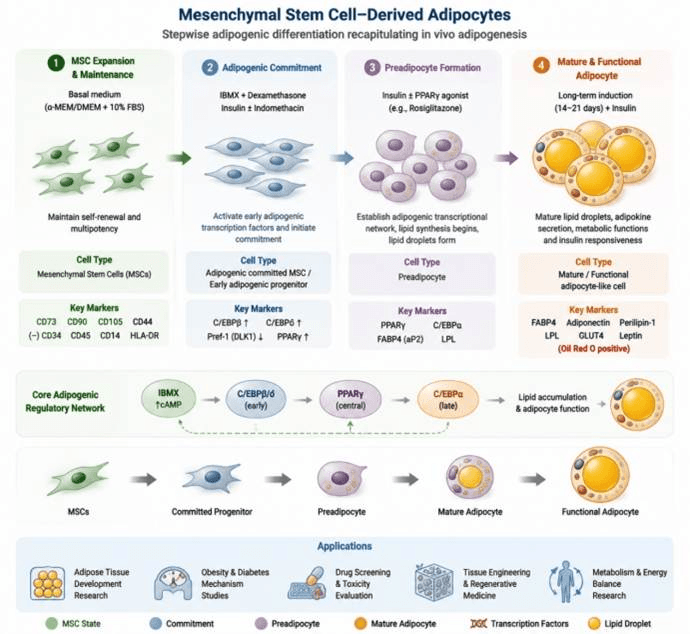
Mesenchymal stem cells (MSCs) undergo stepwise adipogenic induction in vitro, progressing through adipogenic commitment, preadipocyte formation, and mature adipocyte differentiation, ultimately generating functional adipocytes with lipid droplet accumulation, adipokine secretion, and metabolic activity. This model recapitulates in vivo adipogenesis and provides a stable cellular platform for adipose tissue development studies, metabolic disease research, drug screening, and tissue engineering applications.
| Differentiation Stage | Added Factors / Culture Conditions | Core Biological Function | Corresponding Cell Type / Developmental Stage | Stage-Specific Identification Markers |
| MSC Expansion and Maintenance Stage | Basal culture medium (α-MEM/DMEM + 10% FBS); maintenance under low differentiation conditions | Maintains MSC self-renewal capacity and multilineage differentiation potential, providing the initial cell population for adipogenic induction | Mesenchymal Stem Cells (MSCs) | Positive markers: CD73, CD90, CD105, CD44; Negative markers: CD34, CD45, CD14, HLA-DR |
| Adipogenic Commitment Stage | IBMX (phosphodiesterase inhibitor), Dexamethasone (glucocorticoid), Insulin; Indomethacin included in some protocols | Increases intracellular cAMP levels, activates early adipogenic transcription factors, and initiates MSC commitment toward the adipogenic lineage | Adipogenic committed MSC / Early adipogenic progenitor | C/EBPβ↑, C/EBPδ↑, Pref-1 (DLK1) regulation, initiation of PPARγ expression |
| Preadipocyte Formation Stage | Continued adipogenic induction culture; Insulin stimulation activates PI3K-AKT signaling; PPARγ agonists (e.g., Rosiglitazone) may enhance differentiation | Establishes the core adipogenic transcriptional network, initiating lipid synthesis and lipid droplet formation | Preadipocyte | PPARγ, C/EBPα, FABP4 (aP2), LPL |
| Mature Adipocyte Stage | Long-term adipogenic induction culture (approximately 14–21 days); continuous Insulin stimulation | Promotes mature lipid droplet formation and acquisition of lipid storage capacity, adipokine secretion, and metabolic functions | Mature adipocyte | FABP4, Adiponectin (ADIPOQ), Perilipin-1, LPL, PPARγ; Oil Red O-positive lipid droplet staining |
| Functional Maturation Stage | Extended culture to stabilize adipocyte metabolic functions | Establishes insulin responsiveness and adipokine secretion capacity, mimicking physiological adipose tissue functions | Functional adipocyte-like cell | Adiponectin, Leptin, GLUT4, Perilipin-1; enhanced lipid droplet accumulation |