
info@ucallmlabs.com
1.Overview
The full name of the Middle East respiratory syndrome coronavirus is Middle East Respiratory Syndrome Coronavirus (MERS-CoV). The virus was first identified in Saudi Arabia and Jordan in 2012. It is a positive-sense, single-stranded RNA virus that can cause a fatal respiratory infection known as Middle East Respiratory Syndrome (MERS). This virus belongs to the genus Betacoronavirus, which also includes SARS-CoV and SARS-CoV-2. The World Health Organization (WHO) has declared it one of three high-impact zoonotic coronavirus diseases with pandemic potential. The virus is transmitted from person to person but with limited efficiency, with an incubation period of approximately 2-14 days. Dromedary camels are the primary animal reservoir for MERS-CoV, and the virus can be transmitted to humans through direct or indirect contact with infected camels.
2.Background Information
2.1 What is MERS-CoV?
MERS-CoV (Middle East Respiratory Syndrome Coronavirus) is an enveloped, positive-sense, single-stranded RNA virus belonging to the family Coronaviridae, subfamily Orthocoronavirinae, and genus Betacoronavirus. It is the causative agent of Middle East Respiratory Syndrome (MERS). The MERS-CoV genome is approximately 30 kb in length and contains at least 10 open reading frames (ORFs). The genome contains a 5’ untranslated region (UTR), the large replicase region ORF1a/ORF1b, genes encoding structural proteins (S, E, M, N), accessory genes, a 3' untranslated region, and a poly(A) tail.
The 5’ region of the genome encodes the replicase polyproteins pp1a and pp1ab, which are processed by virus-encoded proteases—papain-like protease (PLpro) and 3C-like protease (3CLpro/Mpro)—into 16 nonstructural proteins (nsps). These proteins form the viral replication-transcription complex (RTC) and participate in viral RNA synthesis and processing.
The 3’ region encodes four major structural proteins—Spike (S), Envelope (E), Membrane (M), and Nucleocapsid (N)—as well as five accessory proteins (ORF3, ORF4a, ORF4b, ORF5, and ORF8b). The Spike protein mediates host-cell attachment and membrane fusion, while the N protein binds viral RNA and contributes to genome packaging.
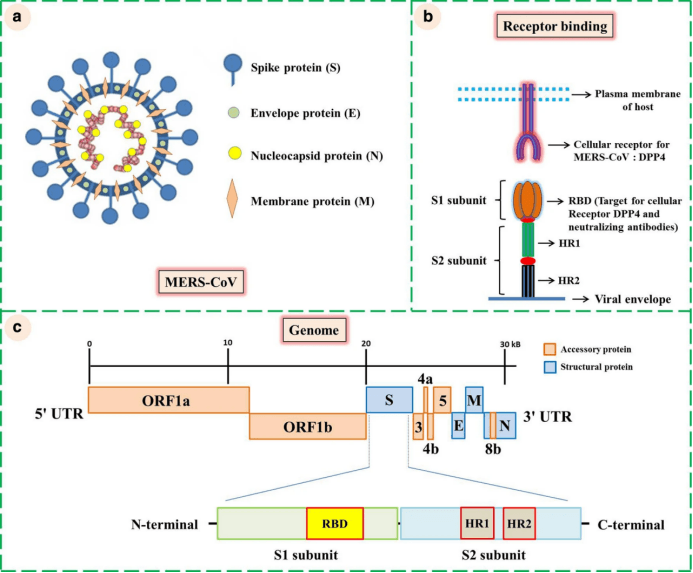
Schematic structures of MERS-CoV proteins (PMID: 33461573)
2.2 MERS-CoV Genome & Classification
MERS-CoV has a large positive-sense RNA genome of approximately 30 kb. Its genome can be broadly divided into a 5’ replicase region and a 3’ structural/accessory region.
| Genome Region | Major Products | Main Function |
| ORF1a | pp1a → nsp1–11 | Replication and host-cell regulation |
| ORF1b | pp1ab → nsp12–16 | RNA synthesis and processing |
| S | Spike | Receptor binding and membrane fusion |
| ORF3 | ORF3 | Host interaction |
| ORF4a | ORF4a | Host immune modulation (dsRNA binding) |
| ORF4b | ORF4b | Host immune modulation |
| ORF5 | ORF5 | Host interaction |
| E | Envelope | Assembly and release |
| M | Membrane | Virion assembly |
| ORF8b | ORF8b | Host interaction |
| N | Nucleocapsid | RNA binding and genome packaging |
2.3 What Are MERS-CoV Structural Proteins?
MERS-CoV contains four major structural proteins: Spike (S), Envelope (E), Membrane (M), and Nucleocapsid (N). Among these proteins, Spike is the primary surface antigen and plays a central role in viral entry. The S protein contains the S1 subunit, which contains the receptor-binding domain (RBD) responsible for recognizing the host receptor dipeptidyl peptidase 4 (DPP4), and the S2 subunit, which contains the membrane-fusion machinery formed by heptad repeats HR1 and HR2. The N protein binds viral RNA and participates in genome packaging, replication and transcription. M and E are mainly involved in virion assembly, budding and release.
Structural Protein Targets
| Protein | Full name | Main Function |
| S | Spike protein | ACE2 binding and membrane fusion |
| S1 | Spike S1 | Receptor recognition (contains RBD) |
| RBD | Receptor-binding domain | DPP4 interaction |
| S2 | Spike S2 | Membrane fusion (contains HR1 and HR2) |
| N | Nucleocapsid | RNA binding and packaging |
| M | Membrane protein | Virion assembly |
| E | Envelope protein | Assembly and release |
2.4 Mechanism of Cell Entry and Replication
2.4.1 Viral Attachment and Receptor Recognition
The MERS-CoV Spike protein recognizes dipeptidyl peptidase 4 (DPP4, also known as CD26) on susceptible host cells. The RBD within the S1 subunit (residues 367–588) is primarily responsible for interaction with DPP4. High-resolution crystallographic studies have revealed that the MERS-CoV RBD consists of a core and a receptor-binding subdomain, and the receptor-binding subdomain interacts directly with the eight-bladed β-propeller domain of DPP4. Unlike SARS-CoV, which uses ACE2 as its receptor, MERS-CoV uses DPP4 as its receptor. DPP4 is expressed on many types of human tissues, including lung, kidney, small intestine, liver, and prostate, which might explain some of the extrapulmonary manifestations (e.g., renal failure) seen in MERS.
2.4.2 Spike Protein Activation
Following DPP4 binding, the Spike protein undergoes proteolytic activation. The S protein must be cleaved at the S1/S2 boundary by human proteases for membrane fusion to occur. Major host proteases involved include cathepsins and TMPRSS2.
2.4.3 Viral RNA Replication
After viral entry and uncoating, the positive-sense RNA genome is directly translated to produce pp1a and pp1ab. Viral proteases PLpro and 3CLpro process these polyproteins into nsps 1-16. The nsps assemble into the replication-transcription complex (RTC), which associates with double-membrane vesicles (DMVs) derived from the endoplasmic reticulum. The RTC synthesizes negative-sense RNA intermediates and subsequently produces genomic RNA and subgenomic RNAs.
2.4.4 Viral Assembly and Release
Newly synthesized genomic RNA associates with N protein to form the nucleocapsid. S, M and E proteins enter the secretory pathway and accumulate primarily in the endoplasmic reticulum-Golgi intermediate compartment (ERGIC). Virion assembly occurs mainly at the ERGIC, followed by maturation in the Golgi body and release from infected cells.
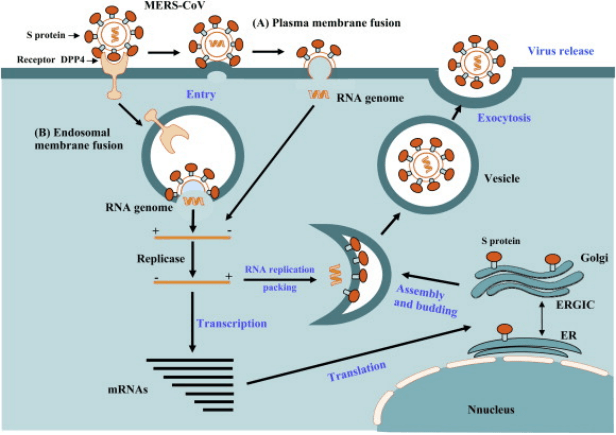
The life cycle of MERS-CoV. (PMID: 23791956)
2.5 Symptoms and Treatment
2.5.1 Clinical Symptoms
MERS-CoV infection can result in a broad clinical spectrum ranging from asymptomatic infection to severe MERS. Common symptoms include:
Fever
Cough
Shortness of breath
Sore throat
Fatigue
Myalgia
Pneumonia
Gastrointestinal symptoms including diarrhoea
Severe disease may involve severe pneumonia, acute respiratory distress syndrome, renal failure, pericarditis, disseminated intravascular coagulation, and multi-organ dysfunction. Approximately 37% of MERS cases reported to WHO have died, but this likely is an overestimation as surveillance systems may miss mild or asymptomatic MERS cases.
2.5.2 Antiviral Treatment
There is currently no specific treatment licensed for MERS. Treatment of patients is supportive, targeted to the clinical condition. However, several promising virus-specific therapies are under investigation. Results from in vitro and animal studies suggest that a combination of lopinavir/ritonavir and interferon-β1b may be effective against MERS-CoV. The MIRACLE trial is investigating the efficacy of lopinavir/ritonavir combined with recombinant interferon-β1b for MERS-CoV infection.
| Target | Protein | Function | Therapeutic Strategy |
| Mpro/3CLpro | nsp5 | Polyprotein processing | Mpro inhibitors |
| PLpro | nsp3 | Polyprotein processing | PLpro inhibitors |
| RdRp | nsp12 | RNA synthesis | RdRp inhibitors |
| Spike | S | Viral entry | Neutralizing antibodies, entry inhibitors |
| DPP4-S axis | S+DPP4 | Host-cell entry | Entry inhibitors |
2.6 Targets for Intervention
2.6.1 Viral Targets
| Target | Protein | Biological Role |
| S | Spike | Receptor binding & fusion |
| RBD | Spike RBD | ACE2 interaction |
| S1 Subunit | S protein subunit | Receptor recognition |
| S2 Subunit | S protein subunit | Membrane fusion |
| N | Nucleocapsid | RNA binding & packaging |
| M | Membrane | Virion assembly |
| E | Envelope | Viral assembly & release |
| Mpro/3CLpro | nsp5 | Polyprotein processing |
| PLpro | nsp3 | Polyprotein processing |
| RdRp | nsp12 | RNA synthesis |
2.6.2 Host Receptors & Entry Factors
| Host Target | Type | Role in Infection |
| DPP4/CD26 | Receptor | Primary receptor for Spike |
| TMPRSS2 | Serine protease | Spike activation |
| Cathepsins | Cysteine protease | Endosomal entry |
2.6.3 Host Signaling Pathways
| Pathway | Key Targets | Biological Role |
| RIG-I/MDA5–MAVS | RIG-I, MDA5, MAVS | Viral RNA sensing |
| TLR signaling | TLR3, TLR4 | Viral RNA sensing |
| JAK–STAT | JAK1, TYK2, STAT1/2 | IFN signaling |
| NF-κB | IKK, p65 | Inflammatory response |
| MAPK | ERK, JNK, p38 | Stress/inflammatory signaling |
2.6.4 Immune & Inflammatory Targets
| Target | Category | Major Role |
| IFN-α | Cytokine | Antiviral response |
| IFN-β | Cytokine | Antiviral response |
| IFN-γ | Cytokine | Cellular immunity |
| IL-6 | Cytokine | Inflammatory response |
| IL-1β | Cytokine | Inflammasome signaling |
| TNF-α | Cytokine | Inflammation |
| CXCL10 | Chemokine | Immune-cell recruitment |
2.7 Vaccine Types and Development Progress
Currently, no MERS vaccine is licensed worldwide. With a case-fatality rate of approximately 36%, MERS-CoV has been classified by the World Health Organization (WHO) as a priority pathogen for vaccine development. Multiple MERS vaccine candidates have entered clinical trials, primarily based on the Spike protein. To date, three vaccine candidates based on the MERS-CoV spike protein have been shown to be safe and immunogenic in human phase 1 clinical trials: MVA-MERS-S, ChAdOx1 MERS, and GLS-5300.
2.7.1 MVA-MERS-S (viral-vector)
Based on modified vaccinia virus Ankara. A Phase 1b trial (140 healthy adults) showed good safety; the high-dose group (10⁸ PFU) with extended prime-boost interval elicited higher antibody titres, with a third booster significantly enhancing responses. Long-term follow-up demonstrated durable immunity for at least 24 months with cross-neutralization of spike mutants.
2.7.2 ChAdOx1 MERS (viral-vector
Based on chimpanzee adenovirus. Phase 1 trial showed a single dose induced both humoral and cellular immune responses, with good safety and tolerability.
2.7.3 GLS-5300 / INO-4700 (DNA vaccine)
The first MERS DNA vaccine to enter clinical trials. Over 85% of participants in Phase 1 developed immune responses. A Phase 2a trial (192 healthy adults) showed INO-4700 was well tolerated; the highest dose group (2 mg) achieved 42% RBD-binding IgG seroreactivity and 29%–50% T-cell response rates.
2.7.4 mRNA vaccines
RBD-targeted mRNA vaccines demonstrated superior immunogenicity and protection over full-length S protein versions in animal models.
2.7.5 Other novel candidates
Include bat influenza virus-vectored intranasal vaccine, Newcastle disease virus-vectored vaccine, CD40-targeted intranasal recombinant protein vaccine, and virus-like particle (VLP) vaccines, all in preclinical development.
2.8 Drugs
MERS-CoV therapeutic agents can be broadly classified according to their primary molecular targets into virus-targeted drugs, host-targeted drugs, and drugs with unclear or non-specific targets. There is currently no specific antiviral treatment licensed for MERS. Virus-targeted drugs directly interfere with viral entry, polyprotein processing, or RNA replication, whereas host-targeted drugs act on host proteins, signaling pathways, or pathological processes associated with MERS.
2.8.1 Virus-Targeted Drugs
Virus-targeted drugs directly act on MERS-CoV proteins or viral particles. The major validated targets include Spike, Mpro/3CLpro, and PLpro, while RdRp/nsp12 remains an important target for antiviral drug discovery.
| Target | Drug | Biological Role | Mechanism |
| Spike | Neutralizing antibodies (e.g., SAB-301) | Viral entry | Neutralization |
| Mpro/3CLpro | Lopinavir/Ritonavir | Polyprotein processing | Protease inhibition |
| Danoprevir | Polyprotein processing | Protease inhibition | |
| PLpro | Sunitinib | Polyprotein processing | Protease inhibition |
| 6-Thioguanine, 6-Mercaptopurine | Polyprotein processing | Protease inhibition | |
| RdRp | Remdesivir | RNA synthesis | RNA synthesis inhibition |
2.8.2 Host-Targeted Drugs
Host-targeted drugs act on host proteins or pathways involved in viral entry, inflammation, immune dysregulation, or thrombotic complications.
Host Protease-Targeting Drugs
| Target | Drug | Biological Role | Mechanism |
| Cathepsins | E-64-D/K11777 | Endosomal entry | Protease inhibition |
| TMPRSS2 | Camostat mesylate | Spike activation | Protease inhibition |
JAK-STAT Pathway-Targeting Drugs
| Target | Drug | Biological Role | Mechanism |
| JAK1/JAK2 | Baricitinib | Cytokine signaling | JAK inhibition |
Broad Anti-Inflammatory Drugs
| Target | Drug | Biological Role | Mechanism |
| Glucocorticoid receptor | Dexamethasone | Inflammation | Immunosuppression |
2.8.3 Drugs with Unclear or Non-Specific Targets
| Target | Drug | Biological Role | Mechanism |
| Multiple proposed targets | Ribavirin | Viral/host processes | Multiple proposed mechanisms |
| Multiple host targets | Interferon-α | Antiviral | Immune modulation |
| Interferon-β | Antiviral | Immune modulation | |
| Chloroquine | Endosomal/entry | Endosomal modulation |
3.Related Products & Services
Recombinant Antigens & Receptors
Antibodies
Detection Kits
Recombinant Protein Expression Services
Antibody Development Services
4.Resources
5.References
Rabaan, A. A., Al-Ahmed, S. H., Sah, R., et al. (2021). MERS-CoV: epidemiology, molecular dynamics, therapeutics, and future challenges. Annals of clinical microbiology and antimicrobials, 20(1), 8.
Li, Y. H., Hu, C. Y., Wu, N. P., et al. (2019). Molecular Characteristics, Functions, and Related Pathogenicity of MERS-CoV Proteins. Engineering (Beijing, China), 5(5), 940–947.
Raj, V. S., Mou, H., Smits, S. L., et al. (2013). Dipeptidyl peptidase 4 is a functional receptor for the emerging human coronavirus-EMC. Nature, 495(7440), 251–254.
Lu, G., Hu, Y., Wang, Q., et al. (2013). Molecular basis of binding between novel human coronavirus MERS-CoV and its receptor CD26. Nature, 500(7461), 227–231.
Wang, N., Shi, X., Jiang, L., et al. (2013). Structure of MERS-CoV spike receptor-binding domain complexed with human receptor DPP4. Cell research, 23(8), 986–993.
Zumla, A., Chan, J. F., Azhar, E. I., et al. (2016). Coronaviruses - drug discovery and therapeutic options. Nature reviews. Drug discovery, 15(5), 327–347.
Chafekar, A., Fielding, B. C. (2018). MERS-CoV: Understanding the Latest Human Coronavirus Threat. Viruses, 10(2), 93.
Zumla, A., Hui, D. S., Perlman, S. (2015). Middle East respiratory syndrome. Lancet (London, England), 386(9997), 995–1007.
Arabi, Y. M., Balkhy, H. H., Hayden, F. G., et al. (2017). Middle East Respiratory Syndrome. New England Journal of Medicine, 376(6), 584–594.
Kandeel, M., Morsy, M. A., Abd El-Lateef, H. M., et al. (2023). Safety and immunogenicity of the ChAdOx1, MVA-MERS-S, and GLS-5300 DNA MERS-CoV vaccines. International immunopharmacology, 118, 109998.
Raadsen, M. P., Dahlke, C., Fathi, A., et al. (2025). Safety, immunogenicity, and optimal dosing of a modified vaccinia Ankara-based vaccine against MERS-CoV in healthy adults: a phase 1b, double-blind, randomised placebo-controlled clinical trial. The Lancet. Infectious diseases, 25(2), 231–242.
Choi, J. A., Kim, J. O. (2022). Middle East Respiratory Syndrome coronavirus vaccine development: updating clinical studies using platform technologies. Journal of microbiology (Seoul, Korea), 60(3), 238–246.