
info@ucallmlabs.com
1. Introduction
Pluripotent stem cells (ESCs/iPSCs) possess the potential to differentiate into diverse cell lineages and serve as important cellular sources for constructing neurological disease models, drug screening platforms, and regenerative medicine research. Based on the classical Dual SMAD Inhibition strategy, the combined application of the BMP signaling inhibitor Noggin and the TGF‑β/Activin pathway inhibitor SB431542 efficiently promotes the transition of pluripotent stem cells toward a neural ectoderm fate, followed by the generation of proliferative and multipotent neural progenitor cells. This approach significantly improves the efficiency and reproducibility of PSC‑derived neural cell production, establishing a standardized induction system from pluripotent stem cells to neural ectoderm and neural progenitors. The generated neural progenitor cells can be further directed to differentiate into various neural cell types, including dopaminergic neurons and motor neurons, providing reliable cellular resources for studies of neural development, neurodegenerative disease modeling, drug evaluation, and cell therapy research.
2. Workflow Overview
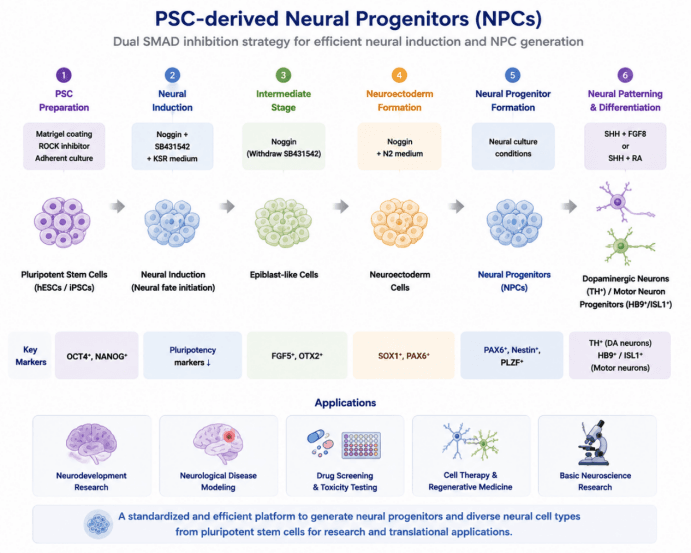
A standardized workflow for efficiently generating neural progenitor cells (NPCs) from hESCs/iPSCs using the Dual SMAD Inhibition strategy. By inhibiting BMP and TGF‑β/Activin signaling pathways with Noggin and SB431542, pluripotent stem cells are guided through neural induction and neural ectoderm formation, leading to the establishment of neural progenitor cell systems with robust proliferative and differentiation potential. The resulting NPCs can be further differentiated into various neural cell types, including dopaminergic neurons and motor neurons, providing a reliable cellular platform for neural development studies, disease modeling, drug screening, and regenerative medicine applications.
3. Induction Protocol
| Stage | Added Factors / Conditions | Function | Cell Type / Stage | Stage‑Specific Identification Markers |
|---|---|---|---|---|
| hESC/iPSC Preparation | Matrigel coating; ROCK inhibitor; adherent culture | Improves single‑cell survival and establishes a uniform culture system | Pluripotent stem cells | OCT4⁺, NANOG⁺ |
| Neural Induction | Noggin + SB431542 + KSR medium | Inhibits BMP and Activin/TGF‑β signaling pathways to initiate neural fate specification | Neural induction stage | Downregulation of pluripotency markers |
| Intermediate Stage | Noggin maintenance; SB431542 withdrawal | Promotes formation of an epiblast‑like state | Epiblast‑like cells | FGF5⁺, OTX2⁺ |
| Neural Ectoderm Formation | Noggin + N2 medium transition | Promotes neural lineage specification | Neural ectoderm cells | SOX1⁺, PAX6⁺ |
| Neural Progenitor Cell Formation | Neural maintenance culture conditions | Generates neural progenitor cells with proliferative and differentiation potential | Neural Progenitors (NPCs) | PAX6⁺, Nestin⁺, PLZF⁺ |
| Neural Patterning | SHH + FGF8 or SHH + Retinoic Acid (RA) | Induces neuronal subtype specification | Dopaminergic neuron / Motor neuron progenitors | TH⁺ (dopaminergic neurons); HB9⁺/ISL1⁺ (motor neurons) |