
info@ucallmlabs.com
The prostate is an essential male gonadal organ, and its secretions account for approximately 30% of human seminal fluid. While the overall morphology of the prostate varies among species, the hierarchical cellular architecture of prostatic acini is highly conserved. Multiple in vitro culture studies using primary prostate epithelial cells have focused on characterizing prostate stem cells. These studies confirm that basal cells possess bipotent differentiation capacity, capable of generating both basal and luminal cell lineages, thereby exhibiting typical stem cell properties. Nevertheless, conventional in vitro culture models have notable limitations: they fail to recapitulate the native tissue structure of the prostate in vivo and struggle to sustain physiological expression levels of the androgen receptor.
Mouse models have laid a vital experimental foundation for investigating prostate biological mechanisms, yet findings derived from these models cannot be directly translated to human prostate tissue. The primary contributing factor lies in prominent interspecies differences in the expression patterns of stem cell markers. Classic prostate stem cell markers including c-kit, CD177 and CD133 are exclusively expressed in human prostate basal cells, whereas in mice, they are detected in basal cells as well as subsets of luminal cells. At present, stable and mature human prostate research models remain scarce, which substantially impedes the clinical translation of basic research outcomes.
Prostate organoids can faithfully recapitulate the physiological structure of the prostate and undergo efficient genetic and phenotypic modification via inhibitor treatment, retroviral transfection, CRISPR/Cas9 gene editing and other approaches. Featuring simple operation, cost effectiveness and high stability, they serve as a superior alternative experimental model.
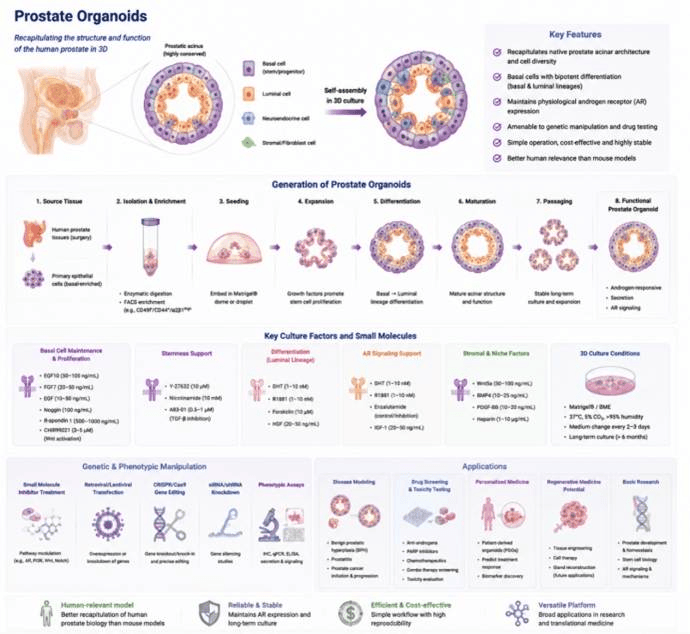
Generation, Culture, and Applications of Prostate Organoids.
Common Reagents for Prostate Organoid Culture
Recommended Markers for Prostate Organoids
Data display.
(A) Organoid culture status (bright-field morphology)
(B) Multicolor immunofluorescence staining
(C) Post-translational modification proteomics
(D) Epigenetic profiling (ChIP-seq / ATAC-seq)
(E) Gene editing validation (CRISPR)