
info@ucallmlabs.com
As the largest functional organ of the human body, the skin performs multiple physiological functions including physical barrier defense, sensory signal transduction and the regulation of body temperature homeostasis. Structurally, it consists of three layers: the epidermis, dermis and subcutaneous tissue. The epidermis is composed of densely arranged keratinocytes, which form the stratum corneum to resist external stimuli and injuries. The dermis is a sophisticated connective tissue abundant in mechanoreceptors, sensory nerves, blood vessels, sweat glands, hair follicles, extracellular matrix and fibroblasts. Subcutaneous adipose tissue mainly undertakes energy storage and reserves diverse growth factors. Furthermore, the skin is equipped with a complete local immune defense system. Epidermal Langerhans cells and dermal dendritic cells constitute the innate immune barrier of the skin. Once local infection occurs, peripheral leukocytes can be recruited to participate in immune responses and injury defense.
Skin diseases represent highly prevalent public health conditions worldwide. More than 5.4 million new skin cancer cases are reported each year, and approximately 500,000 patients receive clinical repair treatment for burns and various cutaneous wounds. At present, mouse models remain the primary in vivo tool for investigating skin development and pathological mechanisms of skin disorders. Nevertheless, prominent interspecies differences exist between human and mouse skin, especially regarding wound repair mechanisms, which severely restrict the clinical translation of animal experimental findings.
Skin organoids exhibit tremendous application potential in exploring skin developmental mechanisms, drug screening and regenerative medicine, with their research value reflected in three main aspects. Firstly, they facilitate research on skin developmental mechanisms. As superior in vitro models, skin organoids help dissect how chemical signals modulate skin maturation and systematically elucidate the developmental rules of human skin, effectively overcoming limitations such as the scarcity of human clinical samples and species bias in animal models. Secondly, they support disease modelling and high-throughput drug screening. These models faithfully recapitulate pathological phenotypes including atopic dermatitis, hereditary skin diseases, skin cancers, as well as skin damage induced by ionizing radiation and chemical stimulation, providing a stable and reliable experimental platform for clarifying disease pathogenesis, developing innovative therapeutic regimens and conducting high-throughput drug screening. Thirdly, they advance research on regenerative medicine and clinical wound repair. Skin organoids can be adopted to analyze the pathophysiological progression of surgical trauma, accidental wounds and burn injuries, possessing great value in cutaneous wound regeneration and repair. Meanwhile, they show promising prospects for facial aesthetic reconstruction and the treatment of disorders characterized by skin appendage defects such as alopecia. Patient-derived skin organoids established via three-dimensional culture also offer novel research strategies for individualized mechanistic study and precise targeted therapy of hereditary skin disorders.
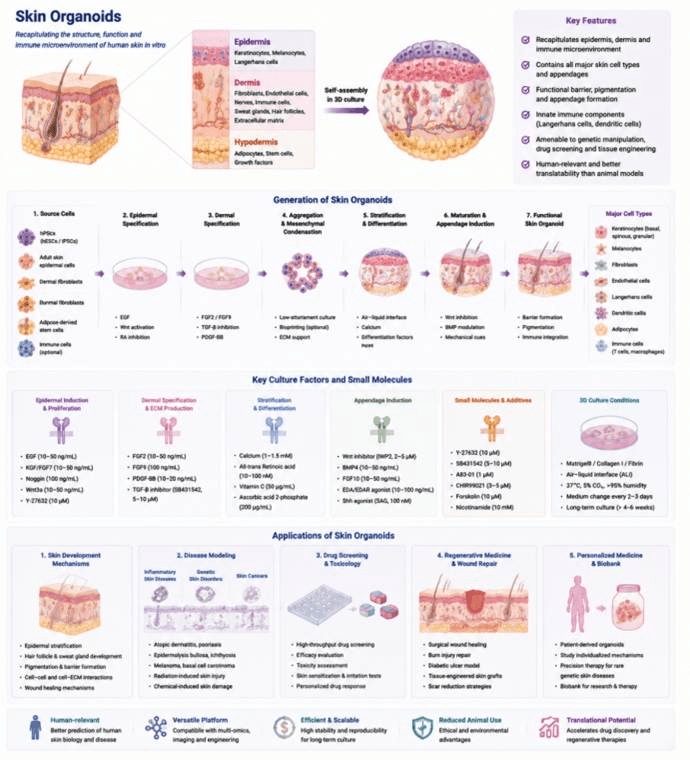
Generation, Culture, and Applications of skin Organoids.
Data display.
(A) Organoid culture status (bright-field morphology)
(B) Multicolor immunofluorescence staining
(C) Post-translational modification proteomics
(D) Epigenetic profiling (ChIP-seq / ATAC-seq)
(E) Gene editing validation (CRISPR)