
info@ucallmlabs.com
Solid Tumor Cancer Stem Cells (Solid Tumor CSCs) are a specialized subpopulation of cells present in various solid tumors that possess self-renewal capacity, differentiation potential, and tumor-initiating ability. Extensive studies have demonstrated that CSCs play critical roles in tumor initiation, progression, invasion, metastasis, therapeutic resistance, and disease recurrence, and are considered major drivers responsible for maintaining tumor heterogeneity and promoting malignant progression.
Stem-like cellular subpopulations have been identified in various types of solid tumors, including breast cancer, colorectal cancer, lung cancer, hepatocellular carcinoma, pancreatic cancer, glioblastoma, and ovarian cancer. CSCs maintain an undifferentiated state and enhance environmental adaptability through activation of multiple stemness-related regulatory pathways, including Wnt/β-catenin, Notch, Hedgehog, PI3K/AKT, and Hippo-YAP signaling pathways. In addition, their efficient DNA damage repair mechanisms, enhanced drug efflux capacity, and immune evasion properties make CSCs a major contributor to treatment failure and tumor recurrence.
With the development of advanced technologies such as tumor organoids, single-cell sequencing, patient-derived xenograft (PDX) models, and functional stem cell identification approaches, research on solid tumor CSCs has become an important field for elucidating tumor initiation mechanisms, discovering novel therapeutic targets, and developing precision drug screening strategies. Solid tumor CSC models enable more accurate simulation of tumor stemness maintenance, drug responses, and resistance development processes, providing critical research tools for anticancer drug discovery, mechanistic studies, and the establishment of personalized therapeutic strategies.
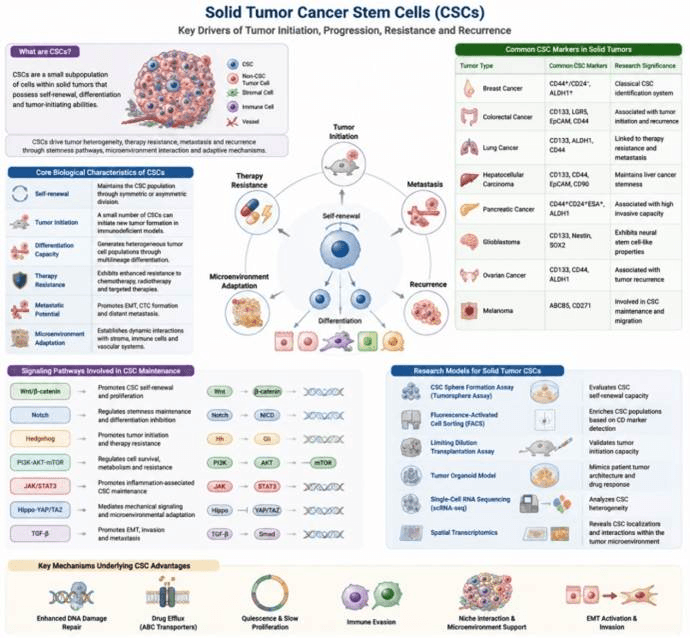
Solid tumor cancer stem cells (CSCs) are a specialized subpopulation of tumor cells with self-renewal capacity, differentiation potential, and tumor-initiating ability. CSCs play critical roles in maintaining tumor heterogeneity, promoting invasion and metastasis, therapeutic resistance, and tumor recurrence. This schematic summarizes the core biological characteristics, key regulatory signaling pathways, tumor-specific CSC markers, and commonly used research models, providing an important platform for investigating tumor initiation mechanisms, developing targeted therapies, and advancing precision drug screening strategies.
Core Biological Characteristics of Solid Tumor Cancer Stem Cells (CSCs)
| Characteristics | Biological Significance |
| Self-renewal | Maintains the CSC population through symmetric or asymmetric division to generate new CSCs |
| Tumor Initiation | A small number of CSCs can initiate new tumor formation in immunodeficient animal models |
| Differentiation Capacity | Generates heterogeneous tumor cell populations through multilineage differentiation |
| Therapy Resistance | Exhibits enhanced resistance to chemotherapy, radiotherapy, and targeted therapies |
| Metastatic Potential | Promotes epithelial–mesenchymal transition (EMT), circulating tumor cell (CTC) formation, and distant metastasis |
| Microenvironment Adaptation | Establishes dynamic interactions with tumor stroma, immune cells, and vascular systems |
Common Cancer Stem Cell (CSC) Markers in Solid Tumors
| Tumor Type | Common CSC Markers | Research Significance |
| Breast Cancer | CD44⁺/CD24⁻, ALDH1⁺ | Classical CSC identification system |
| Colorectal Cancer | CD133, LGR5, EpCAM, CD44 | Associated with tumor initiation and recurrence |
| Lung Cancer | CD133, ALDH1, CD44 | Linked to therapy resistance and metastasis |
| Hepatocellular Carcinoma | CD133, CD44, EpCAM, CD90 | Maintains liver cancer stemness |
| Pancreatic Cancer | CD44⁺CD24⁺ESA⁺, ALDH1 | Associated with high invasive capacity |
| Glioblastoma | CD133, Nestin, SOX2 | Exhibits neural stem cell-like properties |
| Ovarian Cancer | CD133, CD44, ALDH1 | Associated with tumor recurrence |
| Melanoma | ABCB5, CD271 | Involved in CSC maintenance and migration |
Signaling Pathways Involved in CSC Maintenance
| Signaling Pathway | Major Function |
| Wnt/β-catenin | Promotes CSC self-renewal and proliferation |
| Notch | Regulates stemness maintenance and differentiation inhibition |
| Hedgehog | Promotes tumor initiation and therapy resistance |
| PI3K-AKT-mTOR | Regulates cell survival, metabolism, and treatment resistance |
| JAK/STAT3 | Promotes inflammation-associated CSC maintenance |
| Hippo-YAP/TAZ | Mediates mechanical signaling and microenvironmental adaptation |
| TGF-β | Promotes epithelial–mesenchymal transition (EMT), invasion, and metastasis |
Research Models for Solid Tumor CSCs
| Model | Application |
| CSC Sphere Formation Assay (Tumorsphere Assay) | Evaluates CSC self-renewal capacity |
| Fluorescence-Activated Cell Sorting (FACS) | Enriches CSC populations based on CD marker expression |
| Limiting Dilution Transplantation Assay | Validates tumor initiation capacity |
| Tumor Organoid Model | Mimics patient tumor architecture and drug response |
| Single-Cell RNA Sequencing (scRNA-seq) | Analyzes CSC heterogeneity |
| Spatial Transcriptomics | Reveals CSC localization and interactions within the tumor microenvironment |