info@ucallmlabs.com
T-cell activation is a central process in adaptive immune responses. Naïve T cells require the integration of multiple signals, including antigen recognition, co-stimulatory signals, and cytokine signals, to achieve full activation.
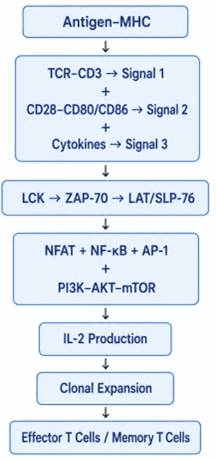
First, the T-cell receptor (TCR) recognizes peptide–MHC complexes presented by antigen-presenting cells (APCs), generating Signal 1. CD4⁺ T cells primarily recognize antigens presented by MHC class II molecules, whereas CD8⁺ T cells recognize antigens presented by MHC class I molecules. TCR signaling is transmitted intracellularly through the associated CD3 complex, activating early signaling molecules such as LCK and ZAP-70, which subsequently initiate multiple downstream signaling pathways.
Second, interaction between CD28 on T cells and CD80/CD86 on APCs provides Signal 2, which enhances TCR signaling and promotes cell survival, metabolic reprogramming, and proliferation.
The third signal is provided by cytokines such as IL-2, IL-12, IL-4, and TGF-β, which determine the functional differentiation fate of T cells according to the local immune microenvironment.
TCR and co-stimulatory signals ultimately converge on several major transcriptional and metabolic regulatory networks, including NFAT, NF-κB, and AP-1. The Ca²⁺–calcineurin pathway promotes NFAT activation, PKCθ-dependent signaling promotes NF-κB activation, and the Ras/MAPK pathway contributes to AP-1 formation. Together, these pathways regulate the expression of key genes such as IL-2.
Meanwhile, CD28 and cytokine signaling activate the PI3K–AKT–mTOR pathway, promoting glucose metabolism, protein synthesis, and cell-cycle progression, thereby providing metabolic support for T-cell clonal expansion. Ultimately, naïve T cells undergo a process of: Activation → IL-2 Production → Clonal Expansion → Effector Differentiation forming functionally specialized effector T cells. A subset of these cells further develops into long-lived memory T cells.
Core Process of T-Cell Activation