
info@ucallmlabs.com
Thyroid Hypothyroidism, Congenital Thyroid Developmental Defects, Brain–Lung–Thyroid Syndrome, and Hormone Dependence after Thyroid Surgery represent major unmet clinical needs in endocrine medicine. However, traditional thyroid research and drug development face significant technical challenges. Rodent models, such as mice and rats, exhibit substantial species differences in thyroid embryonic regulatory pathways compared with humans, making them unable to accurately recapitulate human thyroid differentiation, iodine metabolism, and hormone secretion regulation. In addition, primary human thyroid tissues are difficult to obtain and rapidly lose follicular architecture and hormone-producing functions during in vitro culture, preventing long-term stable maintenance. These limitations restrict applications in hypothyroidism repair, thyroid disease modeling, and endocrine drug evaluation. In 2015, a landmark study published in Cell Stem Cell established a standardized thyroid differentiation protocol for thyroid regeneration research. This study revealed that the coordinated action of BMP4 and FGF2 represents an essential and evolutionarily conserved signaling mechanism required for thyroid lineage specification. A serum-free, transgene-free directed differentiation system was developed using only sequential cytokine modulation, faithfully recapitulating the entire embryonic developmental trajectory from anterior foregut to mature thyroid follicles. The differentiation process consists of five sequential stages: definitive endoderm induction, foregut specification, thyroid progenitor specification, progenitor expansion, and three-dimensional follicular maturation. First, high-purity definitive endoderm is generated through Activin A stimulation. Subsequently, BMP/TGF-β pathway inhibitors are applied to establish and stabilize anterior foregut identity. BMP4 and FGF2 are then introduced to specifically activate the thyroid master transcription factor NKX2-1, while PAX8 co-expression is used to distinguish thyroid progenitors from lung progenitor populations. Finally, cells are transferred into a Matrigel-based three-dimensional culture system supplemented with maturation factors such as TSH and dexamethasone, enabling self-organization into mature thyroid follicle structures containing luminal cavities. Mature thyroid follicles exhibit robust expression of key thyroid functional genes, including Tg, TPO, NIS, and TSHR, and demonstrate essential physiological activities such as iodine uptake, thyroid hormone synthesis, and hormone secretion.
Gold-standard in vivo transplantation studies have demonstrated that purified mature thyroid follicles implanted into radioactive iodine-induced severe hypothyroid mice can survive long-term, integrate into host tissue, continuously secrete T3 and T4, and restore TSH negative-feedback regulation. The transplantation effectively corrects hypothyroidism-related pathological phenotypes, while exhibiting an extremely low risk of teratoma formation. Furthermore, this differentiation platform is compatible with healthy human ES/iPS cells as well as patient-specific iPS cells carrying NKX2-1 haploinsufficiency, enabling the establishment of congenital hypothyroidism disease models that directly reproduce patient-specific thyroid maturation defects. With clearly defined signaling sequences, high batch-to-batch consistency, and scalability for large-scale production, this standardized human thyroid follicle organoid platform can be broadly applied to congenital hypothyroidism mechanism studies, high-throughput screening of thyroid hormone and iodine metabolism-related drugs, preclinical development of thyroid replacement cell therapies, and fundamental research on human thyroid embryonic development. This technology provides a high-fidelity, traceable, and standardized human thyroid cell resource platform for endocrine disease research and regenerative medicine translation.
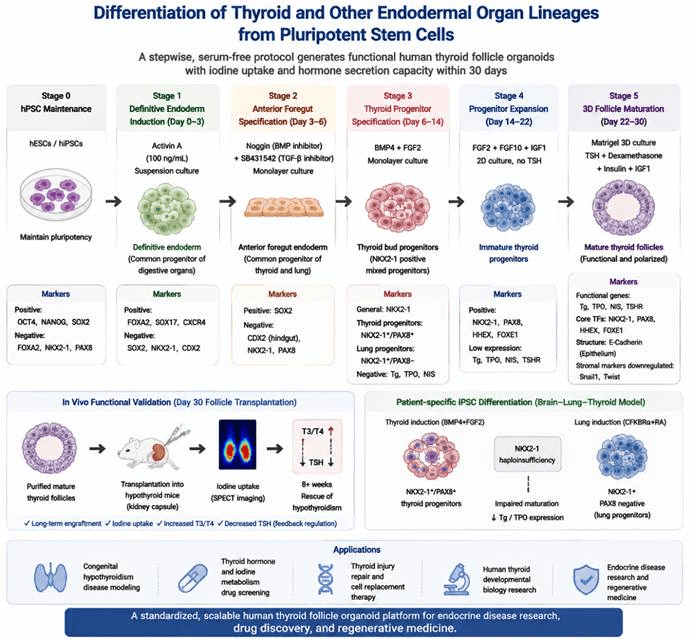
Differentiation process of pluripotent stem cell-derived thyroid lineage.
Through a five-stage serum-free directed differentiation system, pluripotent stem cells sequentially undergo definitive endoderm induction, foregut endoderm specification, thyroid progenitor specification, progenitor expansion, and three-dimensional follicular maturation, ultimately generating human thyroid follicular organoids with iodine uptake and thyroid hormone (T3/T4) synthesis functions. This platform recapitulates thyroid development and enables functional validation through in vivo transplantation and patient-derived iPSC models, providing a high-fidelity humanized model for studying congenital hypothyroidism mechanisms, drug screening, thyroid regeneration, and endocrine disease research.
Differentiation Stage | Added Factors / Culture Conditions | Core Biological Effects | Corresponding Cell Type / Embryonic Development Stage | Stage-Specific Identification Markers |
Stage 0: Pluripotent Stem Cell Maintenance (Mouse ES/iPS and Human ES/iPS) | Mouse: feeder layer + LIF stem cell mediumHuman: feeder-free mTeSR1 medium, monolayer clonal culture | Maintains the primitive pluripotent state and preserves full endoderm differentiation potential | Undifferentiated human/mouse pluripotent stem cells | Positive: OCT4, NANOG, SOX2Negative: FOXA2, NKX2-1, PAX8 |
Stage 1: Definitive Endoderm Induction (D0–3) | Serum-free differentiation medium; 100 ng/mL Activin A; embryoid body suspension culture | Activates gastrulation-related pathways, efficiently enriches definitive endoderm, and eliminates ectodermal and mesodermal contaminants | Embryonic definitive endoderm (common upstream progenitor for digestive and endocrine organs) | Positive: FOXA2, SOX17, CXCR4Negative: SOX2, NKX2-1, CDX2 |
Stage 2: Foregut Endoderm Specification (D3–6) | Basal differentiation medium; 200 ng/mL Noggin (BMP inhibitor) + 10 μM SB431542 (TGF-β inhibitor); monolayer adherent culture | Suppresses BMP/TGF-β signaling, blocks hindgut and mesodermal fate, and establishes SOX2-positive foregut identity | Embryonic foregut endoderm (common progenitor of thyroid and lung lineages) | Positive: SOX2Negative: CDX2 (hindgut marker), NKX2-1, PAX8 |
Stage 3: Thyroid Progenitor Specification (D6–14) | Medium supplemented with BMP4 + FGF2; without Wnt3a; monolayer culture; NKX2-1-positive cells can be fluorescently sorted at D14 | Synergistic activation of thyroid master transcriptional programs through BMP and FGF signaling; both pathways are essential. Wnt signaling is not required for thyroid specification. Enrichment of NKX2-1-positive progenitor cells | Embryonic ventral foregut thyroid bud progenitors (NKX2-1-positive mixed progenitors containing thyroid/lung subpopulations) | Broad marker: NKX2-1Subpopulation identification: NKX2-1⁺PAX8⁺ (thyroid progenitors), NKX2-1⁺PAX8⁻ (lung progenitors)Negative: Tg, TPO, NIS (mature thyroid markers) |
Stage 4: Thyroid Progenitor Expansion (D14–22) | 2D culture; FGF2 + FGF10 + IGF1; without TSH | Promotes proliferation and expansion of thyroid progenitor cells while preventing premature activation of hormone synthesis-related maturation programs | Immature thyroid progenitor cells | Positive: NKX2-1, PAX8, Hhex, Foxe1Low expression: Tg, TPO, NIS, TSHR |
Stage 5: 3D Thyroid Follicle Terminal Maturation (D22–30) | 3D Matrigel embedding; basal medium supplemented with TSH, dexamethasone, insulin, and IGF1 | TSH activates thyroid functional gene expression; 3D microenvironment promotes epithelial self-assembly into follicular structures with lumen formation, enabling iodine uptake and thyroid hormone synthesis | Mature thyroid follicular epithelium (similar to fetal thyroid tissue) | Core transcription factors: NKX2-1, PAX8, Hhex, Foxe1Functional proteins: Tg, TPO, NIS, TSHRStructural markers: E-Cadherin (epithelial marker); reduced stromal markers Snail1/Twist |
In Vivo Functional Validation (D30 Follicle Transplantation) | Purified mature thyroid follicular cells transplanted into the kidney capsule of hypothyroid mice and maintained for ≥8 weeks | Validates in vivo iodine uptake, T3/T4 synthesis and secretion, TSH feedback regulation, and restoration of hypothyroid phenotypes | Functional thyroid follicular tissue in vivo | Histology: NKX2-1, PAX8, Tg, T4 stainingImaging: Tc99m iodine uptake by SPECTFunctional outcomes: Increased serum T3/T4 levels and reduced TSH levels |
Patient-Derived iPSC Differentiation (Brain–Lung–Thyroid Syndrome / Hypothyroidism Model) | D0–14 differentiation follows the same protocol as mouse cells; maturation medium introduced at D19Thyroid induction: BMP4 + FGF2Lung induction control: CFKBR(A) + RA | Distinguishes thyroid versus lung progenitor pathways; NKX2-1 haploinsufficiency impairs terminal thyroid maturation | Patient-derived thyroid progenitor cells with NKX2-1 mutation defects | Thyroid-specific: NKX2-1⁺PAX8⁺Lung control: NKX2-1⁺ but PAX8⁻Defective iPSC lines: markedly reduced Tg/TPO expression |