
info@ucallmlabs.com
Teeth perform masticatory and phonetic functions and also affect facial appearance as well as patients’ psychological status. Dental tissues are highly mineralized structures with distinct mineralization levels and hardness among different components. Enamel forms the outer bulk of the dental crown and represents the most highly mineralized tissue in the human body. During tooth development, dental epithelial stem cells undergo directed differentiation into ameloblasts, which mediate enamel formation. Following tooth eruption, ameloblasts undergo apoptosis, and mature enamel thereby permanently loses its capacity for self-repair and regeneration. At present, enamel defects caused by trauma or bacterial infection are mainly restored with synthetic dental materials. Nevertheless, conventional dental restorative materials have multiple drawbacks, such as microleakage, poor osseointegration and retention, limited service life, and incapability of complete reconstruction of dental structure and function.
Organoid culture systems established from epithelial stem cells have been widely adopted for biological and pathological research on various human epithelial tissues. Human dental epithelial organoids can stably express stemness markers of epithelial cell rests of Malassez and sustain long-term in vitro expansion. Unlike most epithelial organoid systems, these odontogenic organoids can maintain stable growth without exogenous supplementation of epidermal growth factor. Furthermore, organoids retaining stem cell properties possess amelogenic differentiation potential and can recapitulate the biological characteristics and differentiation trajectories of dental epithelial stem cells and epithelial cell rests of Malassez in vitro. As a novel in vitro research platform, dental epithelial organoids facilitate in-depth analysis of the biological features, cellular plasticity and differentiation regulatory mechanisms of dental epithelial stem cells, offering innovative avenues for developing therapeutic strategies for dental tissue regeneration.
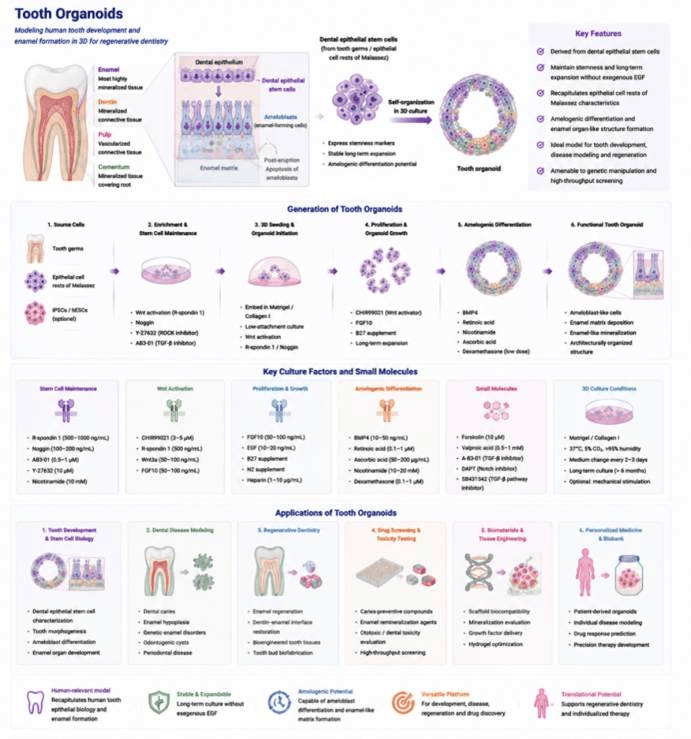
Generation, Culture, and Applications of Tooth Organoids.
Data display.
(A) Organoid culture status (bright-field morphology)
(B) Multicolor immunofluorescence staining
(C) Post-translational modification proteomics
(D) Epigenetic profiling (ChIP-seq / ATAC-seq)
(E) Gene editing validation (CRISPR)