
info@ucallmlabs.com
The kidney is a structurally sophisticated and highly hierarchically organized human organ, composed of approximately one million functional nephrons responsible for blood filtration. Each nephron comprises diverse specialized cell populations and consists of the renal corpuscle and highly convoluted tubular structures, which ultimately connect to the collecting duct system. While nephron numbers vary with age and health status, the overall nephron endowment is primarily established during embryonic renal development. Most kidney diseases lead to irreversible nephron damage and loss, underscoring the urgent demand for novel therapeutic strategies to complement conventional pharmacological interventions.
Primary and immortalized renal cell lines have been widely utilized to characterize specific renal cellular properties; however, these in vitro models cannot reconstruct the complete histological architecture of native kidney tissue. Furthermore, cell immortalization inevitably disrupts endogenous cell cycle regulation, thereby interfering with the accurate interpretation of disease-associated molecular mechanisms. Although animal models offer physiologically relevant experimental systems, their applications are constrained by inherent interspecies differences and ethical limitations, making them incapable of faithfully recapitulating human renal pathophysiology. The lack of authentic human kidney models severely impedes in-depth exploration of renal physiological functions and pathological mechanisms.
In recent years, organoid technology has evolved into a state-of-the-art biomedical research tool. Featuring polarized tissue structures and robust intercellular communication, organoids achieve superior simulation of the in vivo tissue microenvironment. The advancement of kidney organoid systems has pioneered new research avenues for investigating renal development, high-throughput drug screening, and precise disease modeling.
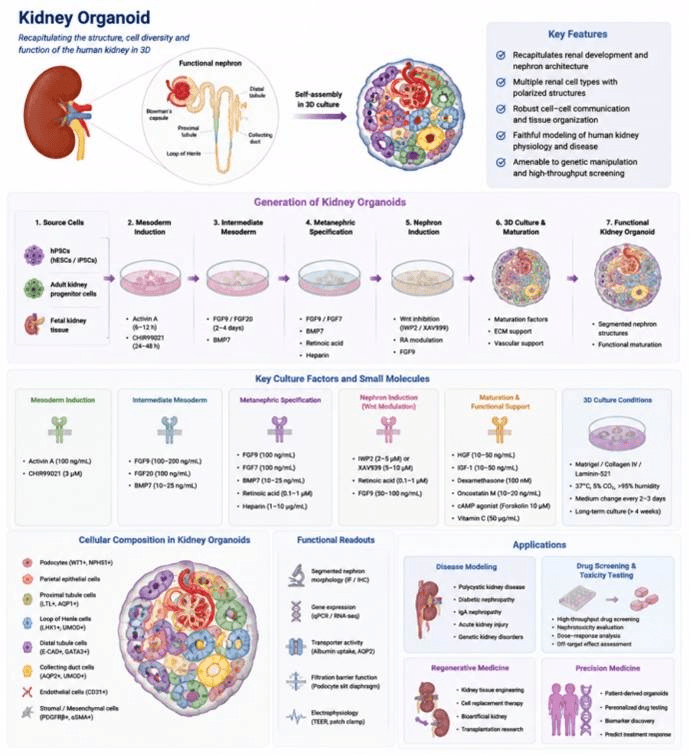
Potential applications of kidney organoid technology.
Common Reagents for Kidney Organoid Culture
Recommended Markers for Kidney Organoids
Data display.
(A) Organoid culture status (bright-field morphology)
(B) Multicolor immunofluorescence staining
(C) Post-translational modification proteomics
(D) Epigenetic profiling (ChIP-seq / ATAC-seq)
(E) Gene editing validation (CRISPR)