
info@ucallmlabs.com
Blood glucose homeostasis in the human body is dynamically regulated by insulin secreted from the pancreatic islets of Langerhans, which can sensitively detect fluctuations in circulating glucose concentrations. Permanent damage to this homeostatic regulatory mechanism triggers diabetes mellitus, which has gradually become a major threat to global public health. Epidemiological data predict that the number of adult diabetic patients will rise to 578 million by 2030 and further increase to 700 million by 2045.
Conventional in vitro cell culture systems remain the primary approach to investigate the biological characteristics of pancreatic cells. Nevertheless, these systems fail to reconstruct the complex microenvironmental conditions within living human tissues. In recent years, considerable progress has been made in tissue engineering. Researchers have constructed organoids by utilizing the innate self-assembly capacity of mammalian cells. Generated via advanced three-dimensional culture technology, organoids can closely mimic the unique structural features and functional phenotypes of native human organs.
Within pancreatic organoids, multiple cell types engage in dynamic interactions through sophisticated signal communication, mutual regulation, inductive feedback and functional coordination, collectively facilitating the formation of miniature tissue units with mature physiological functions. Organoids can effectively simulate the structure and function of human tissues in vitro. Accordingly, islet organoids offer a promising experimental platform for diabetic pathological modeling, candidate drug screening, and the functional quality assessment of cell-based therapies for diabetes.
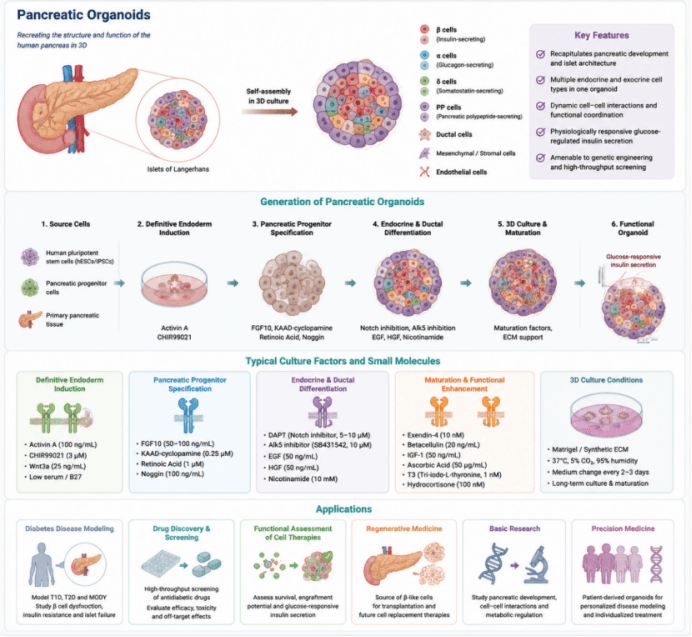
Diverse applications of pancreatic organoids. Pancreatic organoids recapitulating both exocrine and endocrine compartments of the pancreas are predominantly generated from human pluripotent stem cells (hPSCs) and clinical primary adult stem cells (ASCs). Organoid technology enables the establishment of ideal in vitro models that faithfully recapitulate pathological features of human pancreatic diseases. Meanwhile, pancreatic organoids serve as a promising research platform for personalized drug screening and translational regenerative medicine [35].
Common Reagents for Pancreatic Organoid Culture
Recommended Markers for Pancreatic Organoids
Data display.
(A) Organoid culture status (bright-field morphology)
(B) Multicolor immunofluorescence staining
(C) Post-translational modification proteomics
(D) Epigenetic profiling (ChIP-seq / ATAC-seq)
(E) Gene editing validation (CRISPR)