
info@mail.ucallm.com
Understanding Bone Homeostasis
Bone tissue is a continuously renewing, dynamically changing complex tissue. Its structure and function rely on the precise balance among bone formation, bone resorption and bone matrix maintenance. During this process, skeletal stem cells continuously generate osteolineage cells. Osteoblasts are responsible for new bone formation and bone matrix mineralization, while osteoclasts mediate the resorption of old bone tissue. As key sensory and regulatory cells in mature bone tissue, osteocytes participate in mechanosensation, bone metabolism regulation and intercellular signal communication. Through intricate cell‑cell interactions and signaling networks, diverse bone cells collectively sustain bone remodeling and bone homeostasis. In-depth investigation into the differentiation, functions and interactions of these cells helps elucidate the molecular mechanisms underlying bone development, bone metabolism, bone repair and the initiation and progression of bone diseases.
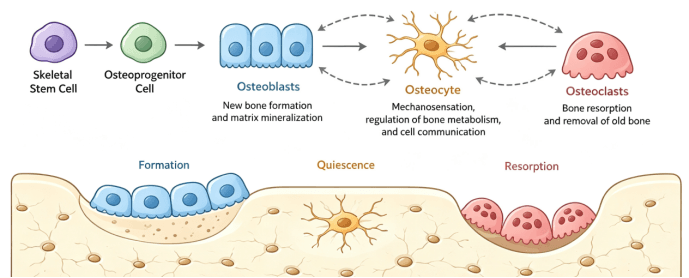
Bone Remodeling and Homeostasis. Skeletal stem cells generate bone-forming cells, while osteoblasts, osteocytes, and osteoclasts coordinate bone formation, resorption, and regulation to maintain bone homeostasis.
Key Cellular Players
Ø Skeletal Stem Cells
Skeletal stem cells are critical progenitor cell sources in bone tissue. They can differentiate into skeletal-related lineages such as osteoblasts and chondrocytes, and play essential roles in bone development, bone turnover and injury repair.
Ø Osteoblasts
Osteoblasts are primarily responsible for new bone formation. They synthesize bone matrix and promote matrix mineralization to participate in bone formation and repair, serving as important cellular models for investigating osteogenic differentiation, bone formation and bone regeneration.
Ø Osteoclasts
Osteoclasts are the principal bone-resorbing cells in bone tissue. They degrade bone matrix via mechanisms including acidification and proteolysis, and take part in bone resorption and remodeling. Their differentiation and activity are tightly associated with signaling axes such as RANK/RANKL/OPG.
Ø Osteocytes
Derived from mature osteoblasts and embedded within the bone matrix, osteocytes function as key sensory and regulatory cells of bone tissue. Osteocytes sense mechanical stimuli and regulate osteogenic and osteoclastic processes by secreting factors including sclerostin and RANKL.
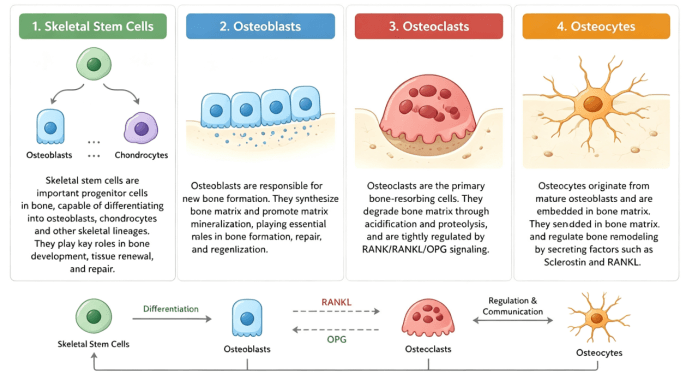
Four Key Cellular Players in Bone. Skeletal stem cells, osteoblasts, osteoclasts, and osteocytes coordinate bone formation, resorption, and regulation to maintain bone remodeling and homeostasis.
Bone Remodeling.
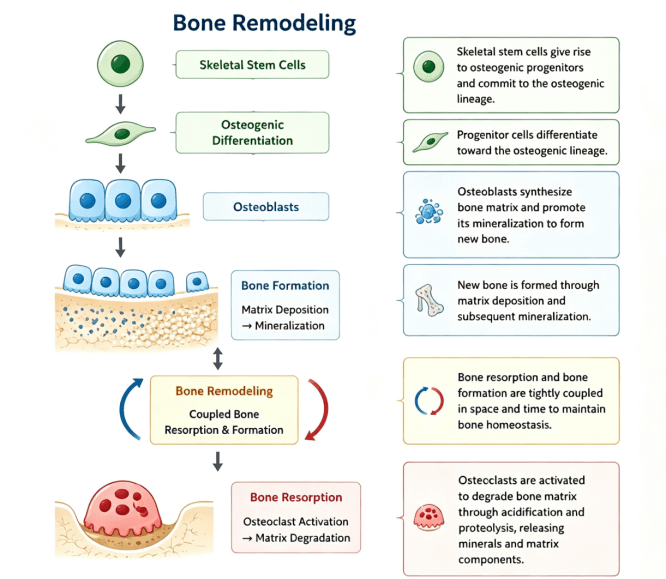
Bone Remodeling. Skeletal stem cells commit to the osteogenic lineage and differentiate into osteoblasts, which synthesize bone matrix and induce mineralization to generate new bone. Bone resorption and bone formation are tightly coupled spatially and temporally to maintain bone homeostasis. Activated osteoclasts degrade bone matrix via acidification and proteolysis, releasing minerals and matrix components.