
info@mail.ucallm.com
Bone formation is a dynamic process collectively driven by mesenchymal stem cell (MSC) lineage commitment, osteogenic differentiation, cellular maturation, extracellular matrix production and matrix mineralization. Regulated by signaling pathways including BMP, Wnt/β-catenin and TGF-β, MSCs gradually acquire osteolineage characteristics. Key transcription factors such as RUNX2 and SP7/Osterix establish the osteoblastic phenotype. Subsequently, these cells undergo bone matrix formation and maturation, ultimately generating mineral-rich bone tissue.
Therefore, research on bone development and osteogenic differentiation focuses not merely on “whether cells undergo osteogenic differentiation”, but also dissects sequential processes including cell fate determination, differentiation stage transition, bone matrix production and mineralization maturation.
1 MSC Osteogenic Differentiation
Ø MSC Fate Decision
This is the initiation phase of osteogenic differentiation, serving as a critical window during which MSCs exit pluripotency, suppress adipogenic/chondrogenic differentiation, and initiate commitment toward the osteogenic lineage. During this stage, cells complete fate commitment, cease unregulated proliferation, and trigger pre-activation of osteoblast-specific genes. It is the core step governing subsequent osteogenic differentiation efficiency and directly determines the quality of final bone formation.
Ø Osteogenic Differentiation
This phase represents functional transformation of cells. Following fate determination, MSCs fully convert into osteoprogenitor cells. Specific remodeling occurs in cellular morphology, structure and function. Cells abundantly express osteoblast-specific transcription factors and early functional proteins, gradually gaining the capacity to synthesize bone matrix, and completing phenotypic conversion from stem cells to functional osteoblasts.
Ø Matrix Formation
This is the effector phase of osteogenic function. Mature osteoblasts synthesize and secrete large quantities of bone matrix proteins such as type I collagen to build the organic framework of bone tissue. The organic matrix provides structural support for subsequent inorganic salt deposition, forming the material basis of bone tissue. It dictates the toughness, structural integrity and shaping capacity of bone.
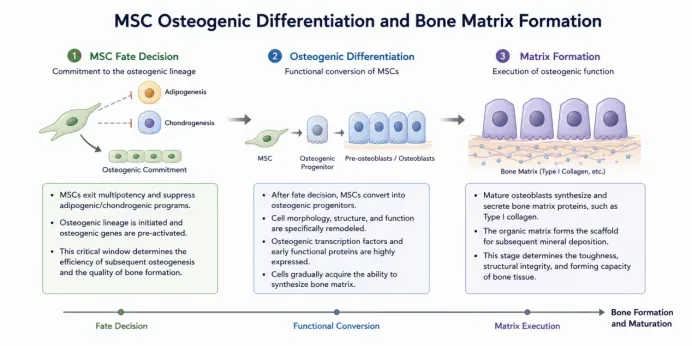
Schematic illustration of MSC osteogenic differentiation and bone matrix formation, covering fate decision, osteogenic differentiation and matrix formation for bone maturation.
2 Core Signaling Pathways – Target Gene Regulatory Network
Upstream Regulatory Pathways
Ø BMP/SMAD pathway: A core positive pathway for osteogenic differentiation. BMP ligands activate cell membrane receptors, mediating the phosphorylation and nuclear translocation of SMAD1/5/8 to directly initiate the transcription of osteogenic genes. This pathway governs the onset of MSC osteogenic fate and promotes differentiation, representing the most critical signaling axis for osteogenic induction.
Ø Wnt/β-catenin pathway: The canonical osteogenic regulatory pathway. Upon activation, it inhibits β-catenin degradation, enabling its nuclear entry to activate target genes. It maintains the osteogenic commitment of MSCs, stimulates osteoblast proliferation and differentiation, suppresses adipogenic differentiation, and synergistically boosts osteogenic efficiency.
Ø TGF-β pathway: Bidirectional temporal regulation. At the early stage, it participates in MSC stemness maintenance and fate initiation; in the middle stage, it cooperatively promotes bone matrix synthesis; at the late stage, it moderately regulates mineralization balance to prevent excessive calcification or insufficient differentiation, ensuring orderly progression of osteogenesis.
Ø YAP/TAZ pathway: A key sensor for mechanical forces and cell fate. It responds to cellular microenvironment, matrix stiffness and mechanical stimuli. Nuclear-activated YAP/TAZ can cooperate with osteogenic transcription factors to promote the osteogenic commitment of MSCs and inhibit aberrant lineage differentiation, serving as a core pathway mediating microenvironment-regulated osteogenesis.
Downstream Effector Transcription Factors (Core Hubs)
Ø RUNX2: Master switch of osteogenic differentiation. It integrates all upstream osteogenic signaling pathways and acts as the master transcription factor for MSC osteogenic fate determination and early differentiation initiation. It governs the expression of nearly all early osteogenic markers; its deletion leads to complete arrest of osteogenic differentiation.
Ø SP7 (Osterix): A specific key factor for osteogenic differentiation. Located downstream of RUNX2, it specifically regulates osteoblast maturation, bone matrix synthesis and subsequent mineralization. It is a signature core protein distinguishing the osteogenic lineage from other mesenchymal lineages.
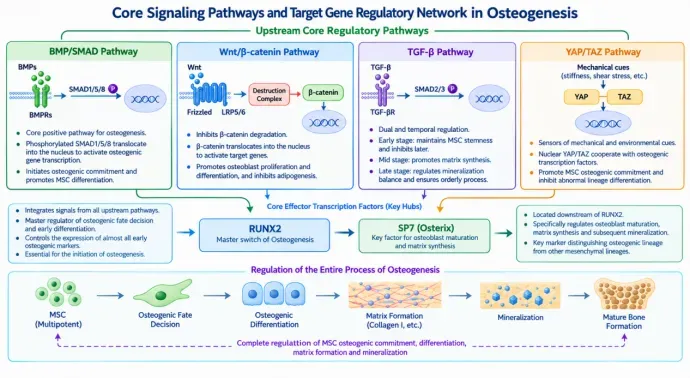
Schematic diagram illustrating core upstream signaling pathways and transcriptional regulatory network governing MSC osteogenic differentiation from fate commitment to bone mineralization.
3 Stage‑Specific Osteogenic Markers and Validation System
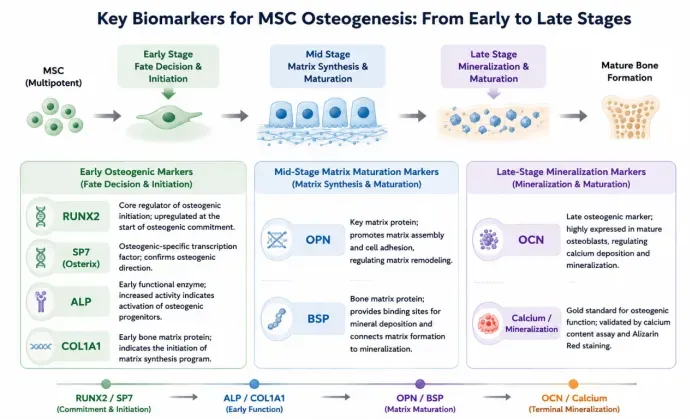
Precise qualitative and quantitative detection of the entire MSC osteogenic process can be achieved by validating early differentiation markers, mid‑stage matrix synthesis markers and late mineralization markers.
Ø Early Osteogenic Differentiation Markers (Fate Determination + Differentiation Initiation) Corresponding to MSC fate determination and the initial phase of osteogenic differentiation, these markers verify whether cells have successfully committed to the osteogenic lineage.
- RUNX2: Core marker for osteogenic initiation. Upregulated mRNA/protein expression indicates the onset of osteogenic fate.
- SP7: Specific marker for the initiation of osteogenic differentiation, confirming osteogenic lineage commitment.
- ALP (Alkaline Phosphatase): Functional enzyme at the early osteogenic stage. Increased activity indicates activation of osteoprogenitor cells and serves as the most classic functional readout for early osteogenesis.
- COL1A1 (Collagen type I alpha 1): Precursor protein of early bone matrix, signifying that cells have launched the bone matrix synthesis program.
Ø Mid‑stage Matrix Maturation Markers (Bone Matrix Formation Phase)
Corresponding to the synthesis, assembly and maturation of bone matrix, these markers reflect the functional activity of osteoblasts and the capacity for matrix formation.
- OPN (Osteopontin): Key protein for matrix maturation. It participates in bone matrix assembly and cell adhesion, and regulates matrix remodeling.
- BSP (Bone Sialoprotein): Specific bone matrix protein that provides binding sites for subsequent inorganic salt deposition, bridging matrix formation and the mineralization phase.
Ø Late Mineralization Functional Markers (Terminal Maturation Phase)
Corresponding to the maturation of bone mineralization, these markers directly reflect the terminal osteogenic function and the level of bone formation.
- OCN (Osteocalcin): Terminal specific marker of osteogenesis, highly expressed only in mature osteoblasts. It directly regulates calcium ion deposition and mineralization progression.
- Calcium / Mineralization (Calcium deposition / Mineralized nodules): Gold standard for osteogenic function. Alizarin red staining, calcium content quantification and other methods can directly visualize mineralization levels to evaluate the final outcome of osteogenic differentiation.
Full Workflow Product Portfolio for Osteogenic Research
Covers the entire experimental pipeline: cell culture, induced differentiation, mechanistic regulation, biomarker detection and functional validation. One-stop research solutions for MSC osteogenic differentiation.
Products:
Cytokines required for mesenchymal stem/stromal cell culture and differentiation
Assay Antibodies and Kits
Fluorescent Probes