
info@ucallmlabs.com
Brain organoids recapitulate multiple key features of embryonic cortical development and can differentiate into diverse cell types corresponding to distinct brain regional lineages. For example, brain organoids simultaneously generate dorsal and ventral forebrain progenitors, which further differentiate into excitatory neurons and inhibitory interneurons respectively. In addition, patient-derived human induced pluripotent stem cells (hiPSCs) can be used to establish disease-specific brain organoid models for functional genomic research on neurological disorders such as microcephaly and autism. Accordingly, brain organoids serve as an ideal experimental system for investigating how disease-associated genes regulate human brain development.
This system enables visual analysis of the migratory behavior of human cortical interneurons. It greatly improves the model complexity and physiological resemblance for developmental cell biology research on human neurological diseases, and provides a brand-new platform for disease mechanism exploration and drug screening.
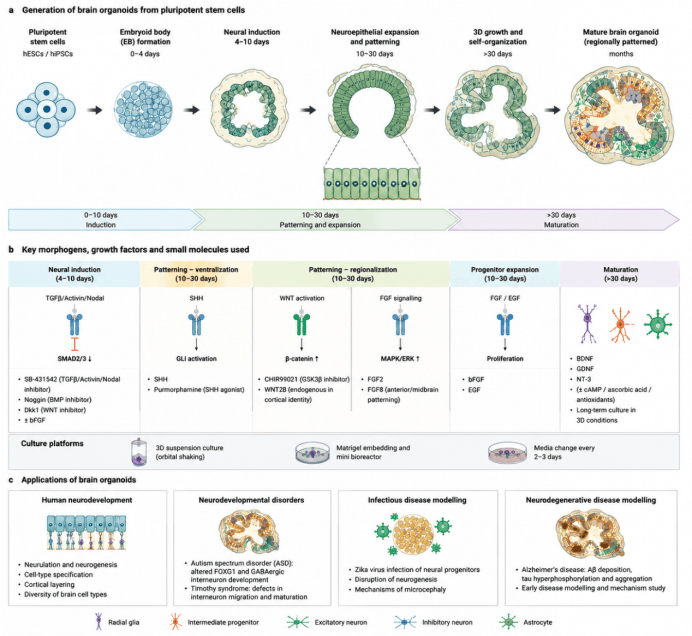
Generation, Patterning and Applications of Human Brain Organoids
Common Reagents for Brain Organoid Culture:
Recommended Markers for Brain Organoids
Data display.
(A) Organoid culture status (bright-field morphology)
(B) Multicolor immunofluorescence staining
(C) Post-translational modification proteomics
(D) Epigenetic profiling (ChIP-seq / ATAC-seq)
(E) Gene editing validation (CRISPR)