
info@mail.ucallm.com
1. Overview
Brucella spp. are Gram-negative facultative intracellular coccobacilli of the family Brucellaceae and the causative agents of brucellosis, a zoonotic disease. The genus belongs to the α-2 subgroup of Proteobacteria, sharing an evolutionary branch with Rhizobium, Agrobacterium, and Rickettsia. Brucellosis is one of the most important zoonoses globally, affecting approximately 830,000 people annually, with particularly severe impact in developing countries and livestock-rearing regions.
The genus Brucella comprises 12 recognized species, of which B. melitensis, B. abortus, B. suis, and B. canis are pathogenic to humans. B. melitensis represents a global public health challenge, while B. abortus and B. suis pose more localized concerns. Brucellae are described as “stealth pathogens” that escape recognition by the host innate immune response, modulate the acquired immune response, and evade intracellular destruction, thereby establishing long-term chronic infections.
2. Background Information
2.1 What is Brucella?
Brucella is a Gram-negative facultative intracellular coccobacillus of the family Brucellaceae. The genus belongs to the α-2 subgroup of Proteobacteria, with a genome organization characterized by the presence of two chromosomes (approximately 2.1 Mb and 1.2 Mb). The evolutionary history of Brucella involved stepwise acquisition of virulence factors from free-living soil ancestors, including a type IV secretion system (T4SS) , a perosamine-based O antigen, and metal ion sequestration systems, culminating in highly successful intracellular pathogens.
The genus Brucella currently comprises 12 recognized species with distinct host preferences. Traditionally classified based on host preference and antigenic/metabolic phenotypes, since the 1990s new Brucella strains have been isolated from marine mammals, rodents, and atypical human infections, raising the number of recognized species to over 10.
2.2 Genome & Classification
The Brucella genome is characterized by two circular chromosomes (chromosome I ~2.1 Mb, chromosome II ~1.2 Mb). The genus can be divided into two major groups: early-diverging “atypical” strains and a highly conserved “classical” core clade containing the major pathogenic species. Lateral gene transfer events introduced unique genomic regions into Brucella, differentiating them from the closest soil bacterium Ochrobactrum.
Brucella lacks classical virulence genes (such as exotoxins), and its pathogenicity relies primarily on its unique intracellular parasitic capacity and immune evasion mechanisms.
2.3 What Are Brucella Virulence Factors?
The virulence factors of Brucella primarily include the following categories:
2.3.1 Type IV Secretion System (T4SS)
The VirB T4SS is the most important virulence determinant of Brucella, consisting of 11 proteins. The T4SS injects bacterial effector proteins into host cells, subverting host signaling pathways and favoring bacterial growth and pathogenesis. The VirB system blocks the co-localization of the Brucella-containing vacuole (BCV) with lysosome markers (such as cathepsin D), preventing lysosome fusion and facilitating BCV conversion into a replication-permissive BCV (rBCV).
A 2025 study identified a novel T4SS effector RS15060; deletion of the rs15060 gene weakened Brucella's ability to replicate within host cells and establish chronic infection in mice, while altering bacterial morphology, cell wall thickness, and sensitivity to bactericidal factors.
2.3.2 T4SS Effector Proteins
Effector | Main Function |
BspF | Acetylates host autophagy protein SNAP29 at K103, disrupting SNARE assembly and blocking autophagic flux |
BspF (second mechanism) | Crotonylates TRIM38, inhibiting NF-κB and MAPK signaling pathways |
RS15060 | Affects bacterial morphology, LPS core synthesis, and host proinflammatory responses, maintaining bacterial morphology and virulence |
BPE123 | VirB-dependent effector protein, involved in secretory trafficking regulation |
2.3.3 Lipopolysaccharide (LPS)
Brucella LPS is an important virulence factor. Compared with other Gram-negative bacteria, Brucella LPS differs in its main components, spatial structure, and linkage, conferring a unique low endotoxicity that plays a key role in helping Brucella evade recognition by the host innate immune system and modulating immune responses. The atypical LPS of Brucella is a poor activator of Toll-like receptor 4 (TLR4), one of the most critical features of Brucella immune evasion.
2.4 Mechanism of Infection and Pathogenesis
2.4.1 Invasion and Intracellular Survival
Brucella pathogenicity relies primarily on its capacity to invade host cells and establish a replicative niche within a specialized organelle. After entering host cells, Brucella undergoes the following key stages:
a. Early BCV formation: Brucella is internalized to form the Brucella-containing vacuole (BCV)
b. Lysosomal escape: VirB T4SS blocks BCV co-localization with lysosome markers, preventing lysosome fusion
c. rBCV formation: BCV converts into a replication-permissive BCV (rBCV) associated with the endoplasmic reticulum
d. Autophagy manipulation: Brucella co-opts autophagy functions to complete its intracellular cycle
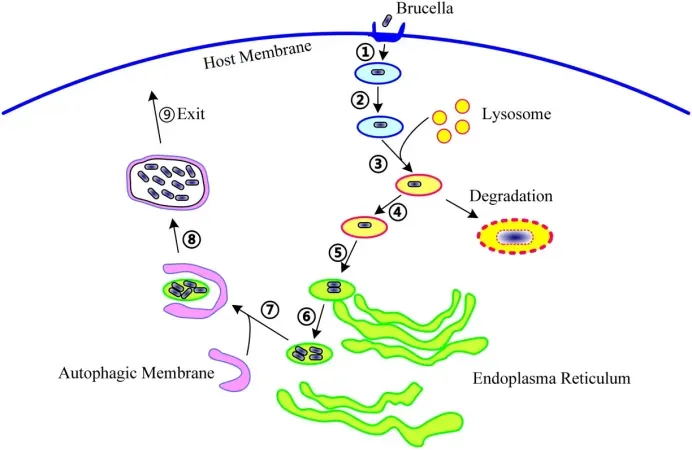
The life cycle of Brucella within host cells. During infection, Brucella first invade the host cells (①), form Brucella-containing vacuoles (BCVs) (②), and undergo fusion with the lysosome in a controlled manner (③). In this step, about 90% of the Brucella are degraded, and the remaining 10% survive (④). Then, the BCV traffic to and reach the endoplasmic reticulum (ER) (⑤), and establish the replicative site (⑥). After ER replication, the Brucella traffic toward the autophagy-like vacuoles (⑦), survive within these compartments (⑧), and finally, leave the host cells to promote cell-to-cell spreading (⑨). The following molecular events involved in these steps are potentially targeted by T4SS: excluding markers of the late endosome or lysosome, acquiring ER markers, interacting with secretory pathways, acquiring markers for autophagosomes, resisting the harsh intracellular environment, and regulating the activation of vital immune pathways. (PMID: 26528442)
2.4.2 Immune Evasion Mechanisms
Brucella has evolved multi-layered immune evasion strategies:
l Innate immune evasion: Atypical LPS poorly activates TLR4, evading innate immune recognition
l Autophagy inhibition: Effector protein BspF acetylates SNAP29, blocking autophagic flux
l Chronic-phase IFNγ signaling suppression: Brucella activates the cAMP/PKA pathway, inducing sustained CREB phosphorylation, which competitively binds transcriptional coactivators CBP/P300, preventing IFNγ-activated STAT1 from effectively recruiting them, selectively inhibiting CBP/P300-dependent IFNγ response genes
l Antimicrobial peptide resistance: The ABC transporter system YejABEF resists host antimicrobial peptide killing, maintaining cell membrane integrity
l Adaptive immunity suppression: Omp25 and Omp31 inhibit dendritic cell maturation, downregulate co-stimulatory molecules CD40, MHC-I, and MHC-II, induce anti-inflammatory cytokines IL-10 and IL-4, and simultaneously inhibit pro-inflammatory cytokines TNF-α, IFN-γ, and IL-12
l T cell immunosuppression: B. abortus recruits PD-L1+ Sca-1+ neutrophils secreting IL-1RA, causing CD4+ and CD8+ T cell immunosuppression
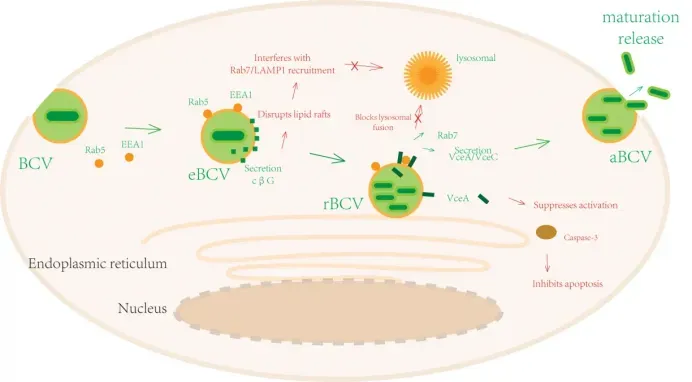
Schematic diagram of Brucella immune evasion mechanisms during the latency stage. (PMID: 41583483)
2.4.3 Metabolic Adaptation
Brucella can exploit host-derived nutrients and reprogram metabolic pathways to sustain long-term persistence. The de novo purine synthesis pathway of B. melitensis is essential for its intracellular survival; disruption of this pathway impairs membrane homeostasis, intracellular survival, and virulence.
2.5 Transmission Routes and Process
Transmission of Brucella occurs primarily through the following routes:
l Direct contact transmission: Direct contact with infected animal tissues, blood, urine, placenta, or abortion products through broken skin or mucous membranes; the primary route for occupational populations (herders, veterinarians, slaughterhouse workers, laboratory personnel)
l Foodborne transmission: Consumption of unpasteurized dairy products (raw milk, cheese) or undercooked meat; the most common foodborne route
l Inhalation transmission: Inhalation of contaminated aerosols, particularly common in laboratory and slaughterhouse settings
l Human-to-human transmission: Extremely rare; possible through sexual contact, breastfeeding, or blood transfusion
Process: Brucella enters the host through mucous membranes or broken skin → phagocytosed by macrophages and dendritic cells → establishes intracellular replicative niche (BCV→rBCV) → disseminates via lymph and blood → colonizes the reticuloendothelial system (liver, spleen, bone marrow) → establishes chronic infection.
2.6 Symptoms and Treatment
2.6.1 Clinical Symptoms
The incubation period of brucellosis is typically 1-4 weeks, but can extend to months. Clinical manifestations include:
l Acute phase: Fever (undulant fever), night sweats, fatigue, headache, myalgia, arthralgia, and weight loss
l Chronic phase: Arthralgia, arthritis, spondylitis, epididymo-orchitis, and osteoarticular disease
l Complications: Endocarditis, neurobrucellosis, hepatosplenic abscesses
2.6.2 Treatment
Standard regimen: Doxycycline + rifampicin combination therapy for 6 weeks is the current first-line regimen for acute uncomplicated brucellosis.
Alternative regimen: A 2026 multicenter randomized non-inferiority trial published in The Lancet Infectious Diseases (August 2023 to July 2025, 238 patients) showed that sitafloxacin monotherapy (100 mg once daily for 6 weeks) was non-inferior to doxycycline-rifampicin combination therapy for acute uncomplicated brucellosis. In the intention-to-treat population, the clinical response rate was 89.9% in the sitafloxacin group versus 83.2% in the combination group (risk difference 6.7%). Treatment-related adverse event incidence was numerically lower in the sitafloxacin group (10.9% vs 19.3%).
Other agents: Omadacycline demonstrates strong antibacterial activity against brucellosis.
2.7 Prevention
l Animal vaccination: Livestock vaccination is the central measure for brucellosis control in many countries
l Food safety: Avoid unpasteurized dairy products; thoroughly cook meat
l Occupational protection: Herders, veterinarians, slaughterhouse workers, and laboratory personnel should wear appropriate personal protective equipment
l Animal surveillance and quarantine: Strengthen livestock surveillance, quarantine, and culling of infected animals
l One Health strategy: Integrate human-animal-environment surveillance and implement region-specific vaccination strategies
2.8 Targets for Intervention
2.8.1 Pathogen Targets
Target | Protein/Pathway | Biological Function |
VirB T4SS | Type IV secretion system | Effector injection, lysosomal escape |
BspF | T4SS effector | Acetylates SNAP29, blocks autophagy |
RS15060 | T4SS effector | Bacterial morphology, LPS core synthesis |
De novo purine synthesis | Purine synthesis enzymes | Intracellular survival and virulence |
YejABEF | ABC transporter system | Antimicrobial peptide resistance |
2.8.2 Host Targets
Target | Type | Role in Infection |
SNAP29 | Autophagy protein | BspF acetylation target, regulates SNARE assembly |
STAT1–CBP/P300 | Transcription complex | Chronic-phase IFNγ signaling suppression target |
PD-L1 | Immune checkpoint | Mediates T cell immunosuppression |
2.9 Vaccine Types and Development Progress
Currently, no licensed human Brucella vaccine is available. Animal vaccines are the primary means of control.
2.9.1 Live-Attenuated Vaccines
A19ΔfeuPΔfeuQ double-mutant: A 2026 study published in Vaccine constructed a double-gene deletion mutant (A19ΔfeuPΔfeuQ) from the A19 strain by removing genes encoding a two-component regulatory system (TCS) located on chromosome II. The mutant exhibited a >1.5-log reduction in intracellular survival, marked attenuation in BALB/c mice, induced significantly higher IgG titers, and provided a 2.34-log greater reduction in bacterial burden at 4 weeks post-challenge. FEUP and FEUQ proteins served as specific antigens enabling serological differentiation between infected and vaccinated animals (DIVA).
A19Δbpe275: A 2026 study published in npj Vaccines developed the A19Δbpe275 live-attenuated vaccine candidate, demonstrating improved safety.
M5-90 vaccine strain: A 2026 study published in Veterinary Microbiology systematically evaluated the residual virulence and protective efficacy of the B. melitensis M5-90 vaccine strain in mice and guinea pigs, showing favorable safety and protective efficacy.
2.9.2 mRNA Vaccines
omp16 and omp19 mRNA vaccine candidates: A 2026 study published in Vaccines successfully expressed immunogenic proteins in cells based on mRNA fragments synthesized from the omp16 and omp19 genes of B. melitensis, representing a preliminary exploration for B. melitensis mRNA vaccine preparation.
Multi-epitope mRNA vaccine: A 2026 study based on network pharmacology identified novel vaccine candidates against B. melitensis, integrating 55 HLA-restricted epitopes from three immunodominant antigens (Omp25, Omp31, BP26) with 87.3% global population coverage.
2.9.3 Subunit Vaccines
Recombinant goat pox virus expressing OMP25 antigen: A 2026 study published in Vaccine evaluated the immunogenicity and protective efficacy of a recombinant goat pox virus expressing the Brucella OMP25 antigen (rGTPV-OMP25) in mice, conferring moderate protection.
Extracellular vesicle-guided multiepitope vaccine: A 2026 study published in Scientific Reports developed a rational multiepitope vaccine against B. abortus by exploiting bacterial proteins previously identified in extracellular vesicles released from infected macrophages as a source of biologically relevant vaccine antigens.
Dual-targeting oral nanoparticle mucosal vaccine: A 2026 study published in Journal of Nanobiotechnology designed a chitosan nanoparticle-based mucosal vaccine co-targeting M cells and dendritic cells, using four immunogenic outer membrane proteins (OMP10, Omp25, Omp31, BtpB).
2.10 Drugs
2.10.1 Pathogen-Targeted Drugs
Target | Drug/candidate | Mechanism | Stage |
Intracellular Brucella | Nanostructured lipid carriers (NLCs) | Co-loaded doxycycline, gentamicin, and thymol for enhanced intracellular antibacterial activity | In vitro |
Intracellular Brucella | Solid lipid nanoparticles (SLNs) | Co-delivery of gentamicin and doxycycline | In vitro |
B. canis | AuNP-AptHis-RW-BP100His | Gold nanoparticle-aptamer conjugated antimicrobial peptide | Mouse model |
2.10.2 Antimicrobial Agents
Drug | Mechanism | Clinical Status |
Doxycycline + rifampicin | Protein synthesis inhibition + RNA synthesis inhibition | Standard regimen |
Sitafloxacin | DNA gyrase inhibition | Non-inferior to standard regimen |
Omadacycline | Protein synthesis inhibition | Strong antibacterial activity |
2.11 Recent Research
2.11.1 Molecular Epidemiology
A 2025 study published in Frontiers in Cellular and Infection Microbiology integrated conventional biotyping, WGS-SNP analysis, and cgMLST to analyze 89 B. melitensis isolates from Jiangsu Province. All strains belonged to sequence type 8 (ST8) and genotype group II, clustering within the East Mediterranean lineage. Genomic resolution classified these strains into five SNP clades and 17 SNP-based genotypes, with the lack of distinct geographic clustering suggesting frequent cross-regional transmission facilitated by the movement of infected sheep and goats.
A 2026 systematic review and meta-analysis published in The Veterinary Journal showed that the overall pooled seroprevalence of Brucella in small ruminants in China was 3.0% (95% CI 2.3–3.8%), with the highest burden in North China, especially Inner Mongolia. Time-series forecasts suggested a continued upward drift (0.76% in 2026–0.84% in 2027), implying sustained One Health risks.
2.11.2 Diagnostic Technology Advances
CRISPR-Cas13a BOVDS platform: A 2026-developed CRISPR/Cas13a platform integrates ultrahigh sensitivity (10 copies/μL), screening for 10 major abortifacient pathogens, and precise strain differentiation. By incorporating mismatched spacer designs, BOVDS achieves robust discrimination between B. melitensis, B. abortus, and B. suis, and enables differentiation between vaccine and wild-type strains.
MCDA-CRISPR dual signal amplification system: A 2026 study published in Nature integrated multiple cross displacement amplification with a CRISPR-Cas12a biosensing system, achieving a minimum detection limit of 1 fg/μL, 100 times more sensitive than conventional PCR.
RAA-CRISPR differentiation platform: A 2026-constructed RAA-CRISPR detection platform can distinguish the B. abortus A19-ΔVirB12 vaccine strain from wild-type strains.
Multiplex real-time PCR: 2026-developed species-specific multiplex qPCR and genus-specific singleplex qPCR assays, based on large-scale whole-genome sequencing data analysis, enable simultaneous detection of three critical Brucella species.
2.11.3 Host-Pathogen Interactions
A 2025 study published in Journal of Integrative Agriculture was the first to report that the Brucella effector protein BspF acetylates SNAP29 at K103, inhibiting its interaction with STX17, thereby regulating autophagy and providing an environment for Brucella intracellular survival. This is the first report of a bacterial effector using acetylation to affect the SNAP29-STX17-VAMP8 complex and inhibit the host defense system.
A 2026 study published in Microbiological Research revealed that Omp25 promotes Brucella intracellular proliferation and inflammation by activating the host unfolded protein response (UPR) .
3. Related Products & Services
l Recombinant Antigens & Receptors
l Antibodies
l Detection Kits
l Recombinant Protein Expression Services
l Antibody Development Services
4. Resources
5. References
1. Pappas, G., Akritidis, N., Bosilkovski, M., et al. (2005). Brucellosis. The New England journal of medicine, 352(22), 2325–2336.
2. Seleem, M. N., Boyle, S. M., Sriranganathan, N. (2010). Brucellosis: a re-emerging zoonosis. Veterinary microbiology, 140(3-4), 392–398.
3. Lakhundi, S., Zhang, K. (2018). Methicillin-Resistant Staphylococcus aureus: Molecular Characterization, Evolution, and Epidemiology. Clinical microbiology reviews, 31(4), e00020-18.
4. Alakavuklar, M. A., Fiebig, A., Crosson, S. (2023). The Brucella Cell Envelope. Annual review of microbiology, 77, 233–253.
5. Ke, Y., Wang, Y., Li, W., et al. (2015). Type IV secretion system of Brucella spp. and its effectors. Frontiers in cellular and infection microbiology, 5, 72.
6. Celli J. (2019). The Intracellular Life Cycle of Brucella spp. Microbiology spectrum, 7(2), 10.1128/microbiolspec.bai-0006-2019.
7. Lapaque, N., Moriyon, I., Moreno, E., et al. (2005). Brucella lipopolysaccharide acts as a virulence factor. Current opinion in microbiology, 8(1), 60–66.
8. Roop, R. M., 2nd, Gaines, J. M., Anderson, E. S., et al. (2009). Survival of the fittest: how Brucella strains adapt to their intracellular niche in the host. Medical microbiology and immunology, 198(4), 221–238.
9. Marchesini, M. I., Spera, J. M., Comerci, D. J. (2024). The 'ins and outs' of Brucella intracellular journey. Current opinion in microbiology, 78, 102427.
10. Dugelay, C., Celli, J., Terradot, L. (2025). The Brucella type IV secretion system and effector proteins. microLife, 6, uqaf036.
11. Guimarães, E. S., Gomes, M. T. R., de Araujo, A. C. V. S. C., et al. (2025). Pathogenicity and virulence of Brucella: Strategies for metabolic adaptation and immune evasion. Virulence, 16(1), 2585620.
12. Roop, R. M., 2nd, Barton, I. S., Hopersberger, D., et al. (2021). Uncovering the Hidden Credentials of Brucella Virulence. Microbiology and molecular biology reviews : MMBR, 85(1), e00021-19.
13. Xiong, X., Li, B., Zhou, Z., et al. (2021). The VirB System Plays a Crucial Role in Brucella Intracellular Infection. International journal of molecular sciences, 22(24), 13637.
14. Corbel, M. J. (2006). Brucellosis in Humans and Animals. World Health Organization, Food and Agriculture Organization of the United Nations, & World Organisation for Animal Health.
15. Schurig, G. G., Sriranganathan, N., Corbel, M. J. (2002). Brucellosis vaccines: past, present and future. Veterinary microbiology, 90(1-4), 479–496.
16. Stranahan, L. W., Arenas-Gamboa, A. M. (2021). When the Going Gets Rough: The Significance of Brucella Lipopolysaccharide Phenotype in Host-Pathogen Interactions. Frontiers in microbiology, 12, 713157.
17. Su, Y., Zhang, L., Liu, R., et al. (2026). Spatiotemporal dynamics of Brucella immune evasion across infection stages. Frontiers in immunology, 16, 1707297.
18. Alirezaei, A., Khalili, M., Baseri, N., et al. (2024). Molecular detection of Brucella species among aborted small ruminants in southeast Iran. Brazilian journal of microbiology : [publication of the Brazilian Society for Microbiology], 55(1), 911–917.