
info@mail.ucallm.com
From Cell-Penetrating Phenomena to Functional Nucleic Acid Delivery
Nucleic acid therapeutics and gene regulation technologies provide important tools for gene expression studies, RNA interference (RNAi), gene editing, and disease treatment. However, nucleic acids such as DNA, RNA, siRNA, miRNA, mRNA, and oligonucleotides generally have relatively large molecular sizes, high hydrophilicity, and pronounced negative charges, making it difficult for them to directly cross the cell membrane, which is primarily composed of a lipid bilayer. Therefore, how to safely and efficiently deliver exogenous nucleic acids into cells has long been a key challenge in nucleic acid research and applications.
Non-viral nucleic acid delivery systems use various materials, including lipids, polymers, peptides, and nanomaterials, to improve cellular uptake and intracellular trafficking of nucleic acids. Among these, cell-penetrating peptides (CPPs) are a class of short peptides with cellular entry capabilities. CPPs can promote the intracellular delivery of DNA, RNA, siRNA, PNA, and other bioactive molecules by forming covalent conjugates or non-covalent complexes with nucleic acids. CPPs typically exhibit strong cationic, amphiphilic, or membrane-interacting properties and can be further engineered to incorporate functions such as nucleic acid binding, endosomal escape, targeting, and environmental responsiveness.
The development of CPP technology was not initially focused on nucleic acid delivery. It originated from cell-penetrating phenomena observed in natural proteins and subsequently progressed through several stages, including functional sequence identification, short-peptide development, nucleic acid complexation, siRNA delivery, endosomal escape optimization, and nanostructure assembly. After more than three decades of development, CPPs have gradually evolved from “membrane-penetrating peptides” in the original sense into delivery platforms capable of participating in nucleic acid loading, cellular uptake, intracellular trafficking, and functional release.
History of CPP Technology Development
1988: Discovery of Cell-Penetrating Activity in Natural Proteins
The history of CPP technology can generally be traced back to 1988. During studies of HIV-1, researchers discovered that the viral transcriptional transactivator protein Tat (Trans-Activator of Transcription) had the ability to enter cells. Research groups led by Frankel and Pabo, as well as Green and Loewenstein, independently reported Tat-associated cellular uptake phenomena. These discoveries provided the first evidence that certain natural proteins or protein domains could help macromolecules cross the cell membrane and enter the intracellular environment. Therefore, 1988 is considered an important starting point in the field of CPP research.
This discovery led to an important technological concept: if a particular sequence within a natural protein could mediate cellular entry, could this functional region be isolated from the full-length protein to create a smaller peptide that would be easier to synthesize and modify? This concept subsequently drove the development of CPPs from studies of natural proteins toward artificially designed functional peptides.
1990s: From Natural Proteins to Short CPPs
Subsequently, researchers identified similar cellular entry capabilities in natural proteins such as the Drosophila Antennapedia homeoprotein and further identified the key structural region responsible for its cell-penetrating activity. In 1994, Derossi et al. reported that the third α-helical region of the Antennapedia homeodomain could cross biological membranes, leading to the development of the widely used peptide Penetratin. This finding demonstrated that cell-penetrating activity could be independently mediated by a relatively short sequence derived from a natural protein.
Meanwhile, studies of Tat gradually shifted from the full-length protein toward its functional region enriched in basic amino acids. In 1997, Vives, Brodin, Lebleu, and colleagues further identified a short sequence within Tat that could promote cellular uptake, making Tat-derived CPPs one of the most widely studied and applied types of CPPs. The arginine and lysine residues within the Tat transduction domain provided an important foundation for the subsequent design of arginine-rich CPPs.
During this period, CPP technology underwent its first major transition, evolving from the observation that “natural proteins possess membrane-penetrating activity” to the use of “synthetic short peptides to achieve cellular entry.” CPPs began to transform from a biological phenomenon into delivery materials that could be designed, optimized, and engineered.
1997: CPPs Entered the Field of Nucleic Acid Delivery
If Tat and Penetratin established the foundation for CPP-mediated cellular penetration, studies of MPG in 1997 represented an important milestone in the development of CPP-based nucleic acid delivery.
Morris et al. reported a novel peptide-based nucleic acid delivery carrier, MPG, and demonstrated that it could facilitate the entry of oligonucleotides into mammalian cells. Rather than relying solely on the peptide's own cellular entry, MPG could form complexes with nucleic acids, thereby combining the cell-entry capability of peptides with nucleic acid delivery. This study represented an important transition of CPPs from “cell-penetrating tools” to “nucleic acid delivery carriers.”
This stage established the basic model that would later become fundamental to peptide-based nucleic acid delivery systems: CPP + nucleic acid → nucleic acid–peptide complex → cellular uptake → intracellular trafficking → nucleic acid release. In other words, the function of CPPs was no longer simply to facilitate their own entry into cells, but to carry nucleic acids into cells.
1998 and Beyond: From PNA to Different Types of Nucleic Acids
As CPP technology continued to develop, researchers began exploring its application to different types of nucleic acids. In 1998, Pooga et al. combined CPPs with PNA (Peptide Nucleic Acid) and demonstrated that CPP–PNA constructs could enter cells and produce gene-regulatory effects. These studies showed that CPPs could not only enhance cellular uptake of nucleic acids but also facilitate the functional intracellular delivery of nucleic acid analogues that are otherwise difficult to introduce into cells.
Subsequently, CPPs were widely used for the delivery of plasmid DNA, oligonucleotides, PNA, siRNA, and other nucleic acid molecules. The application of CPPs gradually expanded from fundamental cell biology research to gene expression regulation, RNA interference, and potential nucleic acid therapeutics.
2000s: Engineering and Rational Design of CPPs
Entering the 2000s, CPP research gradually evolved from naturally derived peptides toward artificial design and structural optimization. Researchers began systematically analyzing the amino acid composition, charge density, hydrophobicity, amphiphilicity, and spatial conformation of CPPs, and attempted to improve cellular uptake and cargo delivery efficiency by modifying these parameters.
Arginine-rich CPPs became an important research direction. The guanidinium groups of arginine side chains can strongly interact with anionic components on the cell surface and with nucleic acids, providing strong cell-binding and nucleic acid-binding capabilities. Polyarginine, Tat-derived peptides, and other basic sequences consequently became important foundations for CPP design.
At the same time, different types of CPPs, including MPG, Pep-1, and Transportan, were used for the delivery of DNA, oligonucleotides, and RNA, promoting the development of non-covalent nucleic acid–peptide complexes. CPPs gradually evolved from naturally derived peptides with a single function into delivery materials whose structures could be optimized for different nucleic acids and cellular models.
Late 2000s: From “Cellular Entry” to “Productive Delivery”
With the development of fluorescence imaging, intracellular localization, and cellular trafficking studies, an important issue was gradually recognized: cellular uptake of CPPs does not necessarily mean that the nucleic acid cargo can exert its intended function. After entering cells, many CPP–nucleic acid complexes undergo endocytosis and enter early endosomes, followed by endosomal maturation. If they cannot be released from the endosomes in a timely manner, the nucleic acids may proceed to late endosomes and lysosomal compartments, where they may ultimately be degraded or processed through cellular recycling pathways. Therefore, there is a significant difference between cellular uptake and functional delivery.
This realization became an important turning point in CPP development. Research gradually shifted from simply increasing “cellular uptake” toward improving “productive delivery,” namely, ensuring that nucleic acids with genuine biological activity reach their sites of action.
Late 2000s to 2010s: Endosomal Escape Became a Central Challenge
For nucleic acids such as siRNA that need to function in the cytoplasm, release from endosomes into the cytoplasm is a critical step in the delivery process. Studies showed that although many CPPs could increase RNA cellular uptake, a considerable proportion of the RNA remained trapped within endosomes. Therefore, promoting endosomal escape became an important research direction in CPP–siRNA delivery.
During this period, researchers began improving intracellular release through strategies such as increasing membrane activity, introducing amphiphilic structures, designing pH-responsive regions, and incorporating sequences capable of disrupting endosomal membranes. The goal of CPP design gradually evolved from “being able to cross the cell membrane” to “being able to release nucleic acids at the appropriate intracellular location.” This also established a central concept in modern CPP design: cellular uptake does not necessarily equal functional delivery.
2010s: Development of Multifunctional CPPs
With a deeper understanding of the nucleic acid delivery process, researchers gradually recognized that an efficient CPP system needs to address multiple challenges, including nucleic acid binding, cellular uptake, endosomal escape, intracellular trafficking, and nucleic acid release. Therefore, a single “cell-penetrating function” was no longer sufficient to explain the overall efficiency of a CPP-based nucleic acid delivery system.
During this period, more multifunctional CPP designs began to emerge. For example, cationic structures could be used to enhance nucleic acid binding, hydrophobic regions could strengthen membrane interactions, pH-responsive structures could regulate conformational changes in the endosomal environment, and targeting structures could be incorporated to enhance uptake by specific cell types.
Thus, CPPs began to evolve from single-function “cell-penetrating peptides” toward multifunctional “functional peptide delivery systems.” Studies on siRNA have characterized CPP functions in terms of cellular membrane penetration, endosomal disruption, targeting, and combinations of these functions.
2015 to Present: From CPPs to Peptide-Based Nanodelivery Systems
In recent years, CPP development has become increasingly integrated with self-assembly and nanodelivery technologies. Researchers have begun using CPPs or modified functional peptides to form nanoscale complexes with nucleic acids, allowing peptides to participate not only in cellular penetration but also in nucleic acid condensation, protection, assembly, and intracellular trafficking.
These peptide-based nanoparticles can be formed through the self-assembly of CPPs with nucleic acids such as pDNA, mRNA, siRNA, or ASO. Depending on peptide structure and formulation conditions, nanocomplexes with different sizes and surface properties can be generated, which can subsequently achieve functional delivery through cellular uptake, endosomal escape, and nucleic acid release.
Therefore, modern peptide-based nucleic acid delivery systems have gradually evolved from the simple combination of CPP + nucleic acid into a comprehensive delivery platform integrating peptide + nucleic acid + self-assembly + targeting + endosomal escape + intracellular release.
2020s: From “High Uptake” to “Precise, Responsive, and Functional Delivery”
In recent years, CPP and peptide-based nucleic acid delivery research has further evolved toward targeting, stimulus responsiveness, and integration with nanocarriers. Researchers have attempted to combine CPPs with lipids, polymers, inorganic nanomaterials, and other targeting structures to address challenges related to tissue barriers, cell selectivity, stability, and intracellular release.
Current CPP research increasingly emphasizes “productive delivery,” meaning that nucleic acids must not only enter cells but also be released from the delivery carrier, escape from endosomes, and reach the appropriate intracellular location where they can exert their biological functions. For siRNA, the nucleic acid ultimately needs to reach the cytoplasm and participate in gene silencing mediated by the RNA-induced silencing complex (RISC). For mRNA, it needs to reach the cytoplasm and undergo protein expression. For DNA, further nuclear delivery and gene expression are required. Therefore, modern CPP technology has gradually evolved from the initial concept of “cellular penetration” into a comprehensive delivery strategy centered on nucleic acid loading → cellular uptake → endosomal escape → intracellular release → functional expression.
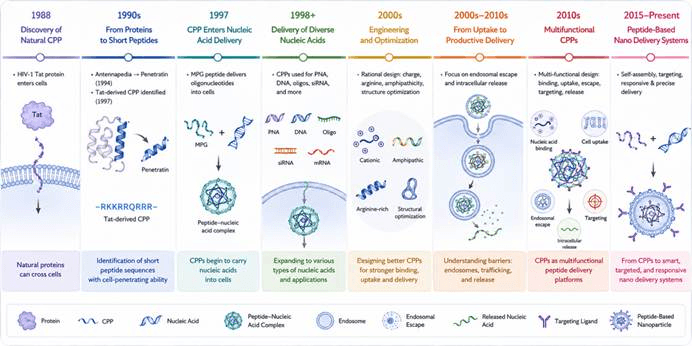
History of CPP Technology Development
What Are Cell-Penetrating Peptides?
Cell-penetrating peptides (CPPs), also known as protein transduction domains (PTDs), are generally short peptides composed of several to several dozen amino acids. Different CPPs vary considerably in length, sequence, and structure, but many CPPs exhibit pronounced cationic, amphiphilic, or membrane-interacting properties that can promote the entry of the peptides themselves and their cargoes into cells.
In terms of origin, CPPs can be classified into naturally derived CPPs and artificially designed CPPs. Naturally derived CPPs include HIV Tat-derived peptides and Penetratin, whereas artificially designed CPPs can be optimized in sequence and structure according to requirements such as nucleic acid binding, membrane interaction, endosomal escape, and cellular compatibility.
From a functional perspective, CPPs are not a single material with a fixed sequence, but rather a class of short peptides that share common delivery functions. Therefore, different CPPs may differ substantially in cellular uptake pathways, nucleic acid binding capacity, endosomal escape ability, and cytotoxicity.
Why Are CPPs Needed for Nucleic Acid Delivery?
The molecular structures of DNA and RNA determine their inherently low membrane permeability. Nucleic acid molecules contain numerous phosphate groups and therefore carry a pronounced negative charge. At the same time, nucleic acids are highly hydrophilic, whereas the interior of the cell membrane is primarily composed of hydrophobic lipids. These physicochemical properties make naked nucleic acids difficult to directly cross the cell membrane.
CPPs can interact electrostatically with the negative charges of nucleic acids through their cationic amino acids, thereby helping to condense and stabilize nucleic acids and altering the way nucleic acids interact with the cell membrane. Meanwhile, the membrane-interacting properties of CPPs themselves can promote the binding of nucleic acid complexes to the cell surface and facilitate cellular entry.
Therefore, the role of CPPs in nucleic acid delivery is not simply to “carry nucleic acids across the cell membrane,” but rather to improve intracellular nucleic acid delivery through multiple sequential processes: nucleic acid binding → complex formation → cell surface binding → cellular uptake → intracellular trafficking → endosomal escape → nucleic acid release → functional activity.
Structural Characteristics of CPPs
The delivery performance of CPPs is closely associated with their amino acid composition and spatial structure. Cationic amino acids, particularly arginine and lysine, are important components of many CPPs. The guanidinium group of arginine can interact with the phosphate backbone of nucleic acids through electrostatic and hydrogen-bonding interactions, while also participating in the recognition of anionic components on the cell membrane surface. Therefore, arginine-rich structures play an important role in CPP design.
However, the efficiency of CPPs cannot simply be explained by the principle that “more positive charge is better.” Excessive cationic character may result in overly strong nucleic acid binding and may also increase non-specific interactions with the cell membrane and cellular toxicity. Therefore, efficient CPPs generally need to achieve a balance among charge, hydrophobicity, amphiphilicity, conformation, and nucleic acid release capacity.
Formation of Nucleic Acid–Peptide Complexes
CPP-mediated nucleic acid delivery can generally be achieved through two main approaches: covalent and non-covalent delivery. In covalent delivery, CPPs are chemically linked to nucleic acids to form CPP–nucleic acid conjugates. This approach allows precise control over the ratio between CPPs and nucleic acids, but requires additional chemical conjugation steps. In non-covalent delivery, CPPs and nucleic acids form complexes through electrostatic interactions, hydrophobic interactions, and other non-covalent interactions. Cationic CPPs can bind negatively charged nucleic acids, condensing them into complexes that are more suitable for cellular uptake. Early studies using peptides such as MPG demonstrated the feasibility of this non-covalent nucleic acid–peptide complexation strategy.
In recent years, studies on CPP-mediated siRNA delivery have generally classified these systems into three major forms: covalent conjugation of CPPs to siRNA, non-covalent CPP/siRNA complexes, and functionalized nanocomplexes in which CPPs are incorporated into other nanodelivery systems.
From Nucleic Acid Binding to Cellular Uptake
After nucleic acid–peptide complexes are formed, the complexes need to interact with the cell surface. The cationic regions of CPPs can interact with anionic molecules on the cell membrane surface, increasing the local concentration of the complexes at the cell surface.
The complexes can then enter cells through different cellular uptake pathways. The predominant entry mechanisms may vary depending on the CPP, nucleic acid cargo, and cell type. Therefore, not all CPPs can be simply attributed to a single fixed membrane-crossing mechanism.
Early CPP studies emphasized direct translocation across the cell membrane. However, as research progressed, the importance of endocytic pathways became increasingly recognized in many CPP systems. The cellular uptake mechanisms of CPPs are highly system-dependent and are influenced by factors including peptide structure, cargo properties, cell type, and experimental conditions.
Endosomes: A Key Intracellular Barrier in CPP-Based Nucleic Acid Delivery
When CPP–nucleic acid complexes enter cells through endocytosis, they typically first enter the endosomal system. Endosomes subsequently undergo maturation and gradually develop a more acidic environment. If nucleic acids cannot escape from the endosomes, they may eventually enter late endosomes and lysosomal compartments, where they can be degraded or undergo intracellular trafficking.
Therefore, for nucleic acids such as siRNA, miRNA, and mRNA that primarily exert their functions in the cytoplasm, endosomal escape is an important step determining the efficiency of final functional delivery. Numerous studies have shown that although CPP–nucleic acid complexes can achieve high levels of cellular uptake, nucleic acids may still remain largely trapped within endosomes. This is why simply measuring intracellular fluorescence does not fully represent the true functional delivery efficiency of a CPP-based delivery system.
Endosomal Escape: From “Cellular Entry” to “Functional Activity”
Endosomal escape is one of the central challenges in modern CPP-based nucleic acid delivery research. To promote the release of nucleic acids from endosomes into the cytoplasm, researchers have developed various membrane-active peptide structures, including amphiphilic peptides, hydrophobic peptides, pH-responsive peptides, and other functional structures capable of altering endosomal membrane stability. Some peptides can undergo protonation or conformational changes in the acidic endosomal environment, enhancing their interaction with the endosomal membrane and thereby promoting membrane disruption or other forms of nucleic acid release. Other systems improve the proportion of nucleic acids reaching the cytoplasm by incorporating membrane-active structures or combining CPPs with other endosomal escape materials. It should be emphasized that the endosomal escape mechanisms of different CPPs are not identical, and “promoting cellular uptake” should not be simply equated with “directly promoting endosomal escape.” Recent studies continue to emphasize the need for experimental methods that directly evaluate endosomal escape rather than inferring functional cytoplasmic release solely from total cellular fluorescence or colocalization results.
pH Responsiveness: Using the Endosomal Environment to Promote Nucleic Acid Release
One of the most prominent environmental changes during endosomal maturation is the decrease in pH. Therefore, pH responsiveness has become an important design strategy for peptide-based nucleic acid delivery systems. Researchers can introduce amino acids or structural elements with pH-responsive properties into peptides, allowing the peptides to exhibit different charge states, conformations, or self-assembly behaviors in extracellular and acidic endosomal environments. For example, peptides containing protonatable side chains, such as histidine, can respond to acidic conditions. When the peptides enter acidified endosomes, changes in the degree of side-chain protonation can alter their interactions with nucleic acids and membranes. This environmental responsiveness can be used to regulate nucleic acid complex stability and interactions with endosomal membranes. Therefore, the core concept of pH-responsive design is: stable nucleic acid binding in the extracellular environment → response to acidification after entering the endosome → changes in peptide structure or membrane interactions → promotion of nucleic acid release.
Hydrophobicity and Amphiphilicity
In addition to cationic character, hydrophobicity is also an important factor influencing CPP function. Both the cell membrane and endosomal membrane consist of lipid bilayers, allowing hydrophobic regions of peptides to participate in membrane interactions. Appropriate hydrophobicity can enhance peptide association with lipid membranes and may promote localized changes in membrane structure. Amphiphilic CPPs contain both hydrophilic/cationic regions and hydrophobic regions, enabling them to perform different functions in different environments. The cationic regions can participate in nucleic acid binding, while the hydrophobic regions can participate in membrane interactions. However, excessive hydrophobicity may increase non-specific membrane disruption and cellular toxicity. Therefore, CPP design requires identifying an appropriate range of hydrophobicity rather than simply maximizing membrane activity.
Peptide Conformation and Self-Assembly
The function of CPPs is determined not only by their primary amino acid sequence but also by their spatial conformation and self-assembly behavior. Some functional peptides can form α-helices, β-sheets, or other higher-order structures and can further form higher-order assemblies through intermolecular interactions. After peptides bind to nucleic acids, these structures may undergo additional changes, affecting the size, stability, surface charge, and cellular uptake of the complexes.
In recent years, peptide self-assembly has evolved from being simply a structural phenomenon observed in CPP delivery research into an actively exploited nanodelivery strategy. Under appropriate conditions, CPPs and nucleic acids can self-assemble into nanoscale complexes, allowing the peptides to simultaneously contribute to nucleic acid condensation, protection, cellular uptake, and intracellular trafficking.
Nucleic Acid Release: Balancing Stable Binding and Effective Release
An ideal nucleic acid delivery peptide needs to possess two seemingly contradictory properties: it should be able to stably bind and protect nucleic acids extracellularly while also allowing appropriate release of the nucleic acids after entering cells. If the peptide binds too weakly to the nucleic acid, the complex may be unstable in the culture medium or extracellular environment, resulting in premature nucleic acid release, degradation, or loss of delivery capacity. If the binding is too strong, the nucleic acids may be difficult to release after entering cells, thereby limiting their functional activity. Therefore, the goal of CPP design is not to achieve the “strongest possible nucleic acid binding,” but rather to establish an appropriate dynamic balance throughout the delivery process: stable binding → nucleic acid protection → cellular uptake → response to the intracellular environment → appropriate dissociation → functional nucleic acid release.
CPP-Mediated siRNA Delivery
siRNA is one of the most important applications in CPP-based nucleic acid delivery research. siRNA is highly hydrophilic and negatively charged, making it difficult to cross the cell membrane directly. Therefore, it requires delivery materials to facilitate its entry into cells. CPP-siRNA delivery systems can be constructed through three main strategies: covalent conjugation of CPPs to siRNA, formation of CPP/siRNA complexes through non-covalent interactions, or integration of CPPs as functional components into nanodelivery systems.
Among these approaches, the non-covalent complexation strategy offers relatively good experimental flexibility. Cationic peptides can condense siRNA through electrostatic interactions and form complexes that facilitate cellular uptake. After entering cells, the system must further overcome endosomal escape and enable the release of siRNA into the cytoplasm.
Ultimately, effective siRNA delivery should be demonstrated by a reduction in the mRNA and/or protein levels of the target gene, rather than simply by an increase in intracellular fluorescent siRNA.
CPP-Mediated mRNA and DNA Delivery
In addition to siRNA, CPPs have also been used for mRNA and DNA delivery. The primary goal of mRNA delivery is to deliver intact RNA into the cytoplasm while maintaining its integrity, allowing subsequent protein translation by ribosomes. Therefore, mRNA delivery systems need to effectively address nucleic acid protection, cellular uptake, endosomal escape, and cytoplasmic release. The delivery of plasmid DNA, in contrast, requires not only cellular uptake and endosomal escape but also subsequent availability within the nucleus. Therefore, its intracellular trafficking requirements differ from those of siRNA and mRNA. In recent years, studies on peptide-based nanoparticles have covered a variety of nucleic acid types, including pDNA, mRNA, siRNA, and ASO, indicating that peptide-based materials have gradually evolved from the single function of traditional CPPs into broader nucleic acid delivery platforms.
How to Evaluate a CPP-Based Nucleic Acid Delivery System?
Evaluating the efficiency of CPP-mediated nucleic acid delivery should not focus on a single parameter, but should cover multiple stages from complex formation to final functional expression. First, it is necessary to evaluate whether the CPP can form stable and uniform complexes with nucleic acids. Second, the particle size, surface charge, and stability of the complexes should be analyzed. Cellular uptake, intracellular localization, and endosomal colocalization should then be evaluated. Furthermore, it is necessary to determine whether the nucleic acids can be released from endosomes. Finally, functional experiments, such as gene expression, gene silencing, or protein expression assays, should be performed to determine whether true functional delivery has been achieved. Therefore, a comprehensive evaluation system for CPP-mediated nucleic acid delivery can be summarized as: peptide structure → nucleic acid binding → complex formation → cellular uptake → intracellular localization → endosomal escape → nucleic acid release → functional expression → cellular compatibility. For peptide-based nanoparticles, additional physicochemical parameters, including particle size, dispersity, surface charge, and assembly stability, should also be evaluated. Relevant studies have shown that the formation conditions and properties of peptide-based nanoparticles, such as particle size and surface charge, are closely associated with their cellular delivery performance.
Cellular Uptake and Functional Delivery Should Be Evaluated Separately
In CPP research, an important concept is that high cellular uptake does not necessarily mean high transfection efficiency. After fluorescently labeled nucleic acids enter cells, if they are mainly distributed within endosomes, even strong fluorescence observed under a microscope does not indicate that the nucleic acids have successfully reached the cytoplasm and exerted their intended function. Therefore, for siRNA, the levels of the target gene mRNA or protein need to be further evaluated; for mRNA, the expression of the target protein needs to be assessed; and for DNA, reporter gene or target gene expression needs to be measured. This is also why modern CPP research has gradually shifted its focus from “cellular uptake” to “productive delivery.” Endosomal escape is considered a key limiting step in many nucleic acid delivery systems.
Overall Process of CPP-Based Nucleic Acid Delivery
From the perspective of the complete delivery pathway, CPP-mediated nucleic acid delivery can be summarized as the following sequential processes:
Nucleic Acid Binding. Cationic or functional peptides interact with negatively charged nucleic acids.
Complex Formation. The nucleic acids are condensed to form nucleic acid–peptide complexes suitable for cellular uptake.
Cell Surface Binding. CPPs interact with anionic components on the cell membrane surface.
Cellular Uptake. The complexes enter cells through one or more cellular internalization pathways.
Intracellular Trafficking. The complexes enter the endosomal system and undergo intracellular trafficking.
Endosomal Escape. CPPs or other functional modules promote the release of nucleic acids from endosomes.
Nucleic Acid Release. The nucleic acids appropriately dissociate from the delivery materials.
Functional Activity. The nucleic acids reach their sites of action and produce corresponding gene silencing, protein expression, or other biological effects.
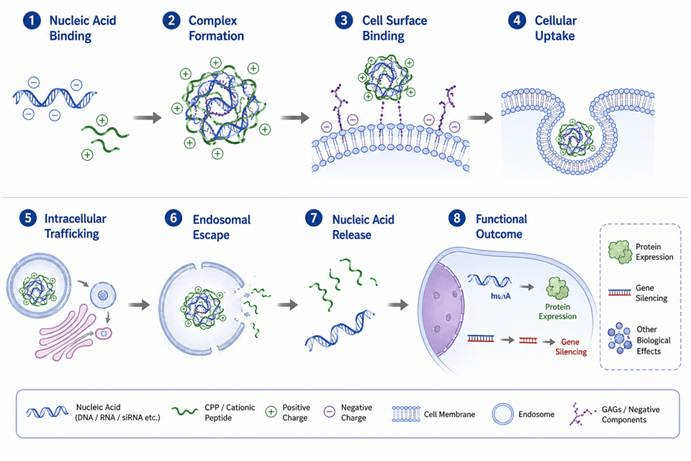
Overall Process Diagram of CPP-Based Nucleic Acid Delivery.
CPP-based nucleic acid delivery is not simply a “membrane penetration process” but rather an intracellular delivery process determined by multiple sequential steps.
From CPPs to Peptide-Based Nanodelivery Platforms
With the development of peptide self-assembly and nanomaterial research, CPPs have gradually evolved from simple cell-penetrating molecules into important components of nanodelivery systems.
CPPs can directly form nanocomplexes with nucleic acids, or they can be modified with PEG, lipids, targeting sequences, and other components to form more complex multifunctional nanostructures. Peptide-based nanoparticles can compress and protect multiple nucleic acid molecules within nanostructures through self-assembly, while using surface peptide structures to promote cellular uptake and intracellular trafficking. This trend means that modern peptide-based nucleic acid delivery is no longer limited to “one peptide responsible for membrane penetration.” Instead, modular design can be used to assign different functions to different structural modules: a nucleic acid-binding module → a cell-penetrating module → an endosomal escape module → a targeting module → an intracellular release module. This multifunctional integration represents an important direction in the development of modern peptide-based delivery systems.
The Relationship Between CPPs and Lipid- and Polymer-Based Delivery Systems
CPPs represent an important strategy for non-viral nucleic acid delivery, but they are not the only strategy. Lipid nanoparticles, cationic liposomes, polymers, and other nanomaterials can also be used for nucleic acid delivery. Compared with traditional lipid and polymer materials, peptide-based materials have distinct sequence designability. Researchers can regulate nucleic acid binding, cellular uptake, membrane interactions, endosomal escape, and targeting capabilities by modifying amino acid sequences and structures. On the other hand, lipid and polymer systems have established advantages in nucleic acid encapsulation, stability, and large-scale delivery. Therefore, recent research has not simply focused on replacing lipids or polymers with CPPs, but has increasingly explored combinations of peptides with lipids, polymers, and nanomaterials to leverage the advantages of different materials. Discover Our Lipid Nanoparticle Products.
Advantages of CPP-Based Nucleic Acid Delivery
CPP-mediated nucleic acid delivery has several important characteristics. First, peptides have a high degree of structural designability, and their physicochemical properties can be regulated by modifying their amino acid composition and sequence. Second, CPPs can bind to different types of nucleic acids and can form either covalent conjugates or non-covalent complexes. Third, CPPs can be further engineered to incorporate functions such as targeting, pH responsiveness, membrane activity, and cleavable structures. Fourth, peptide-based materials can participate in self-assembly, thereby forming nucleic acid nanocomplexes with defined structures and sizes. These characteristics make CPPs an important platform connecting “molecular design” with “nucleic acid delivery functions,” enabling efficient nucleic acid delivery even in some difficult-to-transfect primary cells.
Challenges in CPP-Based Nucleic Acid Delivery
Although CPPs have been studied for several decades, several important challenges remain. First, different CPPs may perform significantly differently across different cell types. Cell membrane composition, endocytic capacity, intracellular trafficking, and endosomal maturation can all affect the final delivery efficiency. Second, there remains a significant gap between cellular uptake and functional delivery. Many CPPs can increase the amount of nucleic acid entering cells, but the proportion that actually reaches the cytoplasm and exerts its function may be limited. Third, endosomal escape remains a key limiting step in many CPP-based delivery systems. Recent studies have also pointed out that although numerous CPPs have been designed to promote endosomal escape, the actual escape mechanisms and efficiencies in different systems still need to be validated through direct experiments. Fourth, a balance needs to be maintained between delivery efficiency and cellular toxicity. Excessive membrane activity may enhance endosomal membrane disruption, but it may also damage the cell membrane. Therefore, an ideal CPP needs to achieve a balance between “sufficient delivery activity” and “good cellular compatibility.” Fifth, for in vivo applications, issues including blood stability, tissue distribution, targeting specificity, and immune-related responses still need to be further addressed. Overall, achieving more effective systemic delivery with CPPs will require further optimization of properties such as endosomal escape, tissue targeting, and in vivo stability.
Future Directions of Peptide-Based Nucleic Acid Delivery
In the future, CPP-based nucleic acid delivery systems will further develop toward multifunctionality, precision, and intelligence. On the one hand, optimizing amino acid sequences, charge density, hydrophobicity, and spatial conformation can improve the binding of peptides to nucleic acids as well as cellular uptake. On the other hand, the introduction of pH-responsive, redox-responsive, or cleavable structures can enable delivery materials to undergo structural changes in response to the intracellular environment, thereby achieving more controlled nucleic acid release. In addition, combining CPPs with lipids, polymers, nanoparticles, and targeting ligands may further improve tissue specificity and intracellular delivery efficiency. Recent studies on peptide-assisted nucleic acid delivery have shown that peptides are gradually evolving from single delivery components into key functional modules within complex nanodelivery systems.
Summary
After more than three decades of development, cell-penetrating peptides (CPPs) have gradually evolved from the initial discovery of cell-penetrating phenomena in natural proteins into an important non-viral nucleic acid delivery technology.
In 1988, the discovery of the cell-penetrating phenomenon of Tat laid the foundation for CPP research. Subsequently, the discovery of naturally derived short peptides such as Penetratin demonstrated that cell-penetrating activity could be condensed into relatively short functional sequences. In 1997, studies on peptide-based carriers such as MPG further promoted the development of CPPs from “cell-penetrating tools” into “nucleic acid delivery carriers.” Subsequently, different types of nucleic acids, including PNA, DNA, siRNA, and mRNA, were gradually incorporated into CPP-based delivery systems.
As research progressed, it became increasingly clear that cellular uptake is only the beginning of nucleic acid delivery. Endosomal retention, nucleic acid release, and intracellular localization emerged as key factors determining the efficiency of functional delivery. Consequently, CPP research further developed amphiphilic, pH-responsive, endosomal escape-promoting, and multifunctional peptides, and gradually expanded to combinations with self-assembling nanoparticles, lipids, polymers, and targeting structures.
Today, CPP-based nucleic acid delivery has evolved from simple “cell penetration” into a comprehensive functional nucleic acid delivery platform. The focus is no longer simply on enabling nucleic acids to enter cells, but on continuously optimizing the entire process—from nucleic acid binding, complex formation, and cellular uptake to intracellular trafficking, endosomal escape, nucleic acid release, and functional expression—while maintaining cellular compatibility.
This technological evolution has provided an important theoretical foundation for peptide-based in vitro transfection systems for DNA, RNA, and siRNA, and has established peptide-based materials as an important and continually evolving technology platform in the field of non-viral nucleic acid delivery.
References
1. Frankel AD, Pabo CO. Cellular uptake of the Tat protein from human immunodeficiency virus. Cell. 1988;55(6):1189–1193.
2. Green M, Loewenstein PM. Autonomous functional domains of chemically synthesized human immunodeficiency virus Tat trans-activator protein. Cell. 1988;55(6):1179–1188.
3. Derossi D, Joliot AH, Chassaing G, Prochiantz A. The third helix of the Antennapedia homeodomain translocates through biological membranes. J Biol Chem. 1994.
4. Vives E, Brodin P, Lebleu B. A truncated HIV-1 Tat protein basic domain rapidly translocates through the plasma membrane and accumulates in the cell nucleus. J Biol Chem. 1997;272:16010–16017.
5. Morris MC, Vidal P, Chaloin L, Heitz F, Divita G. A new peptide vector for efficient delivery of oligonucleotides into mammalian cells. Nucleic Acids Res. 1997;25(14):2730–2736.
6. Pooga M, Soomets U, Hällbrink M, et al. Cell penetrating PNA constructs regulate galanin receptor levels and modify pain transmission in vivo. Nat Biotechnol. 1998;16:857–861.
7. Futaki S, Suzuki T, Ohashi W, et al. Arginine-rich peptides. An abundant source of membrane-permeable peptides having potential as carriers for intracellular protein delivery. J Biol Chem. 2001;276:5836–5840.
8. Magzoub M, Gräslund A. Cell-penetrating peptides: from inception to application. Q Rev Biophys. 2004;37(2):147–195.
9. Brooks H, Lebleu B, Vivès E. Tat peptide-mediated cellular delivery: back to basics. Adv Drug Deliv Rev. 2005;57(4):559–577.
10. Morris MC, et al. Efficient intracellular delivery of nucleic acid pharmaceuticals using cell-penetrating peptides. Acc Chem Res. 2012.
11. Trabulo S, Cardoso AL, Cardoso AMS, et al. Cell-penetrating peptide-based systems for nucleic acid delivery: a biological and biophysical approach. Methods Enzymol. 2012;509:277–300.
12. Lehto T, Kurrikoff K, Langel Ü. Cell-penetrating peptides for the delivery of nucleic acids. Expert Opin Drug Deliv. 2012;9(7):823–836.
13. Erazo-Oliveras A, Muthukrishnan N, Baker R, et al. Improving the Endosomal Escape of Cell-Penetrating Peptides and Their Cargos: Strategies and Challenges. Pharmaceuticals. 2012;5:1177–1209.
14. Gait MJ, et al. Cationic cell-penetrating peptides as vehicles for siRNA delivery. Adv Drug Deliv Rev. 2015.
15. Boisguérin P, Konate K, Josse E, Vivès E, Deshayes S. Peptide-Based Nanoparticles for Therapeutic Nucleic Acid Delivery. Biomedicines. 2021;9(5):583.
16. Falato L, Gestin M, Langel Ü. Cell-Penetrating Peptides Delivering siRNAs: An Overview. Methods Mol Biol. 2021;2282:329–352.
17. Peptide-Assisted Nucleic Acid Delivery Systems on the Rise. Int J Mol Sci. 2021.
18. LeCher JC, Nowak SJ, McMurry JL. Breaking in and busting out: cell-penetrating peptides and the endosomal escape problem. Biomolecules. 2017;8(3–4):131–141.
19. Get out or die trying: Peptide- and protein-based endosomal escape of RNA therapeutics. Adv Drug Deliv Rev. 2023;115047.