
info@mail.ucallm.com
1. Overview
Chlamydia psittaci is a Gram-negative, obligate intracellular zoonotic pathogen belonging to the family Chlamydiaceae and genus Chlamydia, and is the causative agent of psittacosis (also known as ornithosis or parrot fever). The bacterium exhibits a unique biphasic developmental cycle, including the metabolically inactive elementary body (EB) and the metabolically active reticulate body (RB).
Psittacosis is a globally underappreciated and frequently undiagnosed zoonotic disease. C. psittaci is estimated to cause approximately 1% of community-acquired pneumonias. A 2025 global systematic review and meta-analysis showed that among 4,158 exposed individuals in outbreaks, the pooled prevalence of psittacosis was 27.7% (95% CI: 20.9-34.9), with a hospitalization rate of 42.3%, a pneumonia rate of 59.7%, and a mortality rate of 1.8%. In recent years, increasing evidence indicates that C. psittaci can be transmitted between individuals, including transmission by asymptomatic carriers and even tertiary human-to-human transmission.
2. Background Information
2.1 What is Chlamydia psittaci?
C. psittaci is a Gram-negative, obligate intracellular bacterium of the family Chlamydiaceae with a unique biphasic life cycle. The infectious form (EB) is inhaled, invades respiratory tract cells, transforms into the replicative form (RB), and utilizes host resources to proliferate extensively. By evading the host immune response and establishing an inclusion body within the cell, it ultimately leads to local tissue damage and systemic infection through cell lysis and systemic dissemination. The bacterium infects nearly 500 bird species (e.g., parrots, pigeons, poultry) and livestock species (e.g., sheep, goats, pigs, cattle, horses).
2.2 Genome & Classification
The C. psittaci genome is a circular chromosome of approximately 1.2 Mb. A 2023 study published in BMC Genomics comparatively analyzed 61 C. psittaci strains, 47 of which carried a 7.6-kbp plasmid. Phylogenetic analysis revealed four major clades (Clade 1–4) within this species:
l Clade 1: the most recent lineage, comprising 40/61 strains, containing 9/10 of the psittacine strains (including type strain 6BC) and 10/13 of human isolates
l Clades 2–4: strains from different non-psittacine hosts clustered here
Clade membership correlates with SNP types, ompA genotypes, multilocus sequence typing (MLST), and plasticity zone (PZ) structure. Genome analysis also revealed that sequence variation in MOMP can result in 3D structural changes of immunogenic domains; past host change of Clade 3 and 4 strains could be associated with loss of MAC/perforin in the PZ; and the distinct phylogeny of atypical strains is reflected in their repertoire of inclusion proteins (Inc family) and polymorphic membrane proteins (Pmps).
Based on ompA gene sequences, C. psittaci isolates can be classified into nine classical genotypes (A to F, E/B, M56, and WC) and several atypical genotypes. In China, human infections are commonly associated with genotypes A, B, and E/B. A 2025 study reported complete genome sequences of two C. psittaci strains isolated from ducks and pigeons in China; the duck strain CPS-QD/LS was identified as ompA genotype A, while the pigeon strain CPS-BY/JY was identified as genotype B.
2.3 What Are C. psittaci Virulence Factors?
The virulence factors of C. psittaci primarily include:
Virulence Factor | Major Function |
MOMP (Major Outer Membrane Protein) | Major outer membrane porin, mediates adhesion and immune evasion; 3D structural changes in immunogenic domains can affect host immune recognition |
T3SS (Type III Secretion System) | Injects effector proteins directly into host cells, mediating invasion and intracellular replication |
Inclusion Membrane Proteins (Inc family) | Modify the inclusion membrane, participating in host-pathogen interactions |
Polymorphic Membrane Proteins (Pmps) | Adhesion, immune modulation, and host cell interaction |
Plasmid Proteins | Involved in pathogenesis but suffer from toxicity |
SINC (T3SS effector) | Targets the inner nuclear membrane of infected cells and uninfected neighboring cells |
2.4 Mechanism of Infection and Pathogenesis
2.4.1 Invasion and Intracellular Replication
C. psittaci infects humans primarily through inhalation of contaminated aerosols or direct contact with infected bird droppings, feathers, and respiratory secretions. After the elementary body (EB) enters the respiratory tract, it transforms into the reticulate body (RB) and proliferates extensively using host resources. The bacterium utilizes a Type III Secretion System (T3SS) to transfer effector molecules directly into host cells, mediating invasion and intracellular replication. The T3SS effector IncA of C. psittaci is an important component of the inclusion membrane.
2.4.2 Immune Response and Inflammation
A 2026 study published in Veterinary Microbiology revealed that C. psittaci infection induces IFN-I and IL-1β production through the cGAS-STING-IRF3/NLRP3 pathway via mitochondrial oxidative stress. The C. psittaci inclusion membrane protein CPSIT_0844 elicits inflammatory IL-6 and IL-8 production in human monocytes via TLR2/TLR4 signaling pathways.
2.4.3 Immune Evasion Mechanisms
C. psittaci copes better than other chlamydial strains with proinflammatory effectors produced during the early immune reaction of infected hosts. The pathogen upregulates essential chlamydial genes when facing the host immune response to enhance its survival. Sequence variation in MOMP can result in 3D structural changes of immunogenic domains, thereby evading host immune recognition.
2.5 Transmission Routes and Process
Transmission of C. psittaci occurs primarily through the following routes:
l Inhalation: Inhalation of contaminated aerosols is the primary route of transmission
l Direct contact: Contact with contaminated bird droppings, feathers, and respiratory secretions
l Human-to-human transmission: Increasing evidence indicates human-to-human transmission, including transmission by asymptomatic carriers and even tertiary human-to-human transmission. A 1977 outbreak suggested possible nosocomial transmission of psittacosis pneumonia; in a 2002 Japanese case, the patient's sister developed C. psittaci infection without any bird contact; in the 2011 Scottish outbreak, 4 family members and 1 healthcare worker in contact with a psittacosis patient also developed infection
l Household cluster transmission: In March 2025, a married couple in Jiaxing City, Zhejiang Province, China, presented with fever and pneumonia; epidemiological investigation revealed exposure to a pet budgerigar purchased one month prior
Process: Inhalation of EB-containing aerosols → EB invades respiratory cells → transforms into RB and proliferates extensively → forms inclusion bodies → local tissue damage → systemic dissemination → causes pneumonia and multi-system symptoms.
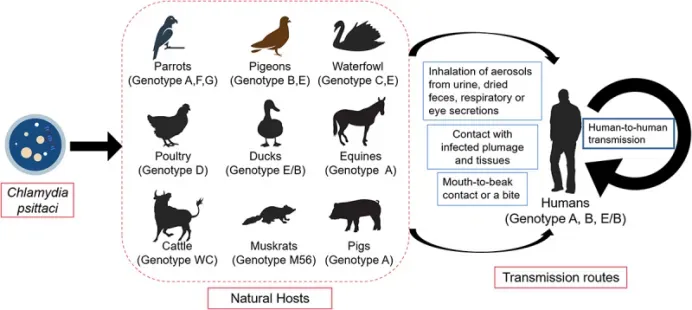
The natural hosts and transmission routes of C. psittaci. (PMID: 39541409)
2.6 Symptoms and Treatment
2.6.1 Clinical Symptoms
The incubation period of psittacosis is typically 5-14 days. The predominant clinical presentation is pneumonia (59.7%), with severe cases progressing to acute respiratory distress syndrome (ARDS) and multi-organ dysfunction. A 2025 study including 33 patients with C. psittaci pneumonia found that 72.7% had a clear history of poultry exposure. The main clinical manifestations included high fever (90.9%), cough (84.8%), chill (72.7%), expectoration (66.7%), fatigue (60.6%), poor appetite (60.6%), dyspnea (39.4%), and myalgia (30.3%). Common imaging findings included flake high-density shadows (87.9%), consolidation (60.6%), pleural effusion (51.5%), bronchial inflation signs (45.5%), and ground-glass exudation (60.6%) .
2.6.2 Treatment
Drug | Recommendation Level | Considerations |
Doxycycline | First-line | Preferred targeted backbone for most non-pregnant adults with confirmed disease; recommended dose: 200 mg loading, then 100 mg once daily for 7–14 days |
Moxifloxacin | Alternative/Combination | Can be used alone for non-severe cases; can be combined with doxycycline for severe cases |
Minocycline | Alternative | Can be chosen for non-severe cases |
Macrolides (Azithromycin) | First-line in pregnancy | Clearest targeted role in pregnancy; but severe gestational disease may deteriorate despite macrolide therapy |
Omadacycline | Alternative | Most consistently described renal-sparing tetracycline-class alternative |
Key principle: β-lactam antibiotics (e.g., cephalosporins) are ineffective against C. psittaci because the bacterium is an obligate intracellular pathogen. Empirical antibiotic treatment including cephalosporins and quinolones is usually ineffective, requiring structured reassessment at 48–72 hours.
2.7 Prevention
l Avoid contact: Avoid close contact with sick birds or birds of unknown health status, especially for immunocompromised individuals
l Personal protection: Wear gloves and masks when handling birds or their droppings; thoroughly wash hands after contact
l Bird management: Newly acquired birds should be quarantined; keep bird cages clean and avoid accumulation of droppings and feathers
l Environmental cleaning: Use wet cleaning methods to avoid raising pathogen-containing dust
l Occupational protection: High-risk occupations such as pet shop employees, veterinarians, and poultry processing workers should wear appropriate personal protective equipment
l Surveillance and reporting: Strengthen psittacosis case surveillance and outbreak investigation, implementing a One Health strategy
l Vaccines: No licensed human C. psittaci vaccine is currently available
2.8 Targets for Intervention
2.8.1 Pathogen Targets
Target | Protein/Pathway | Biological Function |
MOMP | Major outer membrane protein | Adhesion, immune evasion |
T3SS | Type III secretion system | Effector protein injection |
Inc proteins | Inclusion membrane proteins | Inclusion modification |
Plasmid proteins | Plasmid-encoded proteins | Pathogenesis |
2.8.2 Host Targets
Target | Type | Role in Infection |
cGAS-STING-IRF3/NLRP3 | Innate immune pathway | Mediates IFN-I and IL-1β production |
TLR2/TLR4 | Pattern recognition receptors | CPSIT_0844 induces IL-6 and IL-8 production |
2.9 Vaccine Types and Development Progress
Currently, no approved human or veterinary C. psittaci vaccine is available, and past efforts to devise a safe and effective preventive measure have failed.
2.9.1 LNP-mRNA Vaccine
A 2025 study published in Microbiology Spectrum developed a lipid nanoparticle (LNP)-encapsulated MOMP mRNA vaccine (LNP-Opt-mRNAMOMP). The vaccine was produced via an in vitro transcription system encoding the major outer membrane protein (MOMP) and encapsulated in LNPs. Immunization of BALB/c mice:
l Induced strong humoral and cellular immune responses
l Significantly decreased pulmonary C. psittaci burden (compared with PBS group)
l Reduced lung concentrations of IFN-γ, TNF-α, and IL-6
l Histopathological analysis and indirect immunofluorescence demonstrated that the vaccine effectively reduced chlamydial infection and shedding
This study provides a basis for designing mRNA vaccines against C. psittaci and similar respiratory pathogens.
2.9.2 mRNA Galsomes Vaccine
A 2025 study published in PMC evaluated the protective efficacy of mRNA Galsomes (mRNA lipid nanoparticles containing galactosylated lipids) and mRNA LNPs against C. psittaci challenge in budgerigars. mRNA Galsomes appeared to induce slightly enhanced protection, significantly reducing fecal excretion 14 days post-challenge.
2.9.3 Multi-Epitope Vaccine (Reverse Vaccinology Design)
A 2026 study published in International Journal of Biological Macromolecules used reverse vaccinology to design a multi-epitope subunit vaccine targeting C. psittaci plasmid proteins. The final multi-epitope subunit vaccine incorporated eight B cell epitopes, five cytotoxic T lymphocyte (CTL) epitopes, and two helper T lymphocyte (HTL) epitopes along with linkers. Molecular docking and dynamic simulations validated the interaction between the vaccine and adjuvant. In a mouse model, the vaccine induced a strong humoral immune response (high levels of antigen-specific serum IgG antibodies, including IgG1, IgG2a, and IgG3) and a Th1-biased cytokine profile (elevated IFN-γ and TNF-α).
2.9.4 Multi-PmpGs + MOMP Intranasal Vaccine
A 2025 study evaluated multiple polymorphic membrane proteins (PmpGs) combined with MOMP as antigen candidates via intranasal inoculation with chitosan gel and VCG adjuvant, generating robust immune protection against C. psittaci infection.
2.10 Drugs
2.10.1 Pathogen-Targeted Drugs
Current treatment for C. psittaci primarily relies on tetracyclines, macrolides, and quinolones. Tetracyclines (particularly doxycycline) are the preferred treatment, although comparative evidence across therapeutic strategies remains limited.
Drug | Mechanism | Clinical Status |
Doxycycline | Protein synthesis inhibition | Preferred targeted backbone |
Moxifloxacin | DNA gyrase inhibition | Effective alternative/combination |
Minocycline | Protein synthesis inhibition | Effective for non-severe cases |
Azithromycin | Protein synthesis inhibition | First-line in pregnancy |
Omadacycline | Protein synthesis inhibition | Renal-sparing alternative |
2.11 Recent Research
2.11.1 Molecular Epidemiology and Genomics
A 2026 scoping review published in ScienceDirect systematically analyzed psittacosis research in China from 1985 to 2025, including 424 studies. Research interest showed recent sharp increases, concentrated in Eastern and Central China. Reported cases were most often documented in middle-aged and older adults with avian exposure, showing a winter-spring pattern. Pneumonia was the predominant clinical presentation, with severe cases progressing to ARDS and multi-organ dysfunction.
A 2025 study published in ScienceDirect used targeted next-generation sequencing (tNGS) to reveal silent outbreaks of psittacosis in China, identifying 5,839 cases (0.29%) positive for C. psittaci across all 31 provinces.
A 2025 study published in ScienceDirect conducted a molecular prevalence survey of Chlamydia spp. in wild birds from Qinghai Lake, China, with an overall infection rate of 28.8% (36/125) , of which C. psittaci infection rate was 13.9% . A 2025 survey of pet parrots in Xining, China, showed an overall prevalence of 14.3% (26/182) , with budgerigars having the highest infection rate (21.8%) .
2.11.2 Diagnostic Technology Advances
Ultra-fast real-time PCR: A 2025 group standard (T/GDAAV 0611-2025) describes an ultra-fast real-time PCR detection method for C. psittaci, based on rapid temperature control module technology (heating/cooling rate above 40°C/s), capable of completing 45 cycles in 8–15 minutes.
RPA-CRISPR/Cas12a detection: A 2025 study published in Letters in Applied Microbiology designed RPA primers and crRNA based on the highly conserved CPSIT_0429 gene and established a C. psittaci nucleic acid detection method using the RPA-CRISPR/Cas12a system. The two-step assay achieved a detection limit of 2×10⁰ copies/μL, and the one-tube assay (with 20% glycerol) achieved 2×10² copies/μL, showing high consistency with qPCR results.
mNGS and tNGS: Metagenomic next-generation sequencing (mNGS) and targeted next-generation sequencing (tNGS) play important roles in detecting difficult-to-culture or rare pathogens. A meta-analysis showed that 87.4% of psittacosis pneumonia patients were diagnosed via mNGS. tNGS provides a more cost-saving and rapid alternative.
2.11.3 Human-to-Human Transmission Research
A 2025 review noted that increasing evidence indicates human-to-human transmission of C. psittaci, including transmission by asymptomatic carriers and even tertiary human-to-human transmission. A 2026 report of a household cluster of C. psittaci ST388 in Jiaxing City, Zhejiang Province, China, detected C. psittaci through environmental sampling, with genomic analysis confirming household transmission.
3. Related Products & Services
l Recombinant Antigens & Receptors
l Antibodies
l Detection Kits
l Recombinant Protein Expression Services
l Antibody Development Services
4. Resources
5. References
1. Wang, J., Wang, B., Xiao, J., et al. (2024). Chlamydia psittaci: A zoonotic pathogen causing avian chlamydiosis and psittacosis. Virulence, 15(1), 2428411.
2. Sachse, K., Hölzer, M., Vorimore, F., et al. (2023). Genomic analysis of 61 Chlamydia psittaci strains reveals extensive divergence associated with host preference. BMC genomics, 24(1), 288.
3. Wang, X., Wang, Y., Wang, Y., et al. (2025). Complete genomes of two Chlamydia psittaci isolated from ducks and pigeons in China. Microbiology resource announcements, 14(11), e0060625.
4. Yan, X., Wang, B., Zheng, K., et al. (2026). Chlamydia psittaci inclusion membrane protein CPSIT_0844 elicits inflammatory IL-6 and IL-8 production in human monocytes via TLR2/TLR4 signaling pathways. Immunobiology, 231(2), 153160.
5. Wang, Y., Fu, X., Liu, Y., et al. (2026). Household cluster of psittacosis caused by Chlamydia psittaci ST388 in China: a case report and genomic analysis. BMC infectious diseases, 10.1186/s12879-026-13940-0. Advance online publication.
6. Liang, Z., Ba, T., Liang, L. (2025). Detection of Chlamydia psittaci in pet parrots sold in Xining, China. Comparative immunology, microbiology and infectious diseases, 121, 102368.
7. Wu, X., Lei, F., Niu, Y., et al. (2025). Molecular prevalence of Chlamydia spp. in wild birds from Qinghai Lake, China. Irish veterinary journal, 78(1), 28.
8. Sheng, Y., Jin, L. Y., Li, N., et al. (2025). Global prevalence of psittacosis in outbreaks: a systematic review and meta-analysis. BMC public health, 25(1), 2010.
9. Wang, B., Xiao, J., Wang, J., et al. (2025). Lipid nanoparticle-delivered mRNA vaccine encoding the MOMP of Chlamydia psittaci elicits protective immune responses in BALB/c mice. Microbiology spectrum, 13(12), e0143825.
10. De Meyst, A., Van Mieghem, J., Chiers, K., et al. (2025). mRNA Galsomes Vaccine Protects Budgerigars Against Virulent Chlamydia psittaci Challenge. Vaccines, 13(2), 206.
11. Xu, L., Liang, M., Chen, Z., et al. (2026). Design a multi-epitope vaccine targeting Chlamydia psittaci plasmid proteins through reverse vaccinology. International journal of biological macromolecules, 350, 150954.
12. Li, Q., Xu, J., Jiang, J., et al. (2025). Nucleic acid detection method for Chlamydia psittaci based on RPA-CRISPR/Cas12a. Letters in applied microbiology, 78(12), ovaf138.
13. Li, Q., Chen, S., Yan, Z., et al. (2022). A Novel Intranasal Vaccine With PmpGs + MOMP Induces Robust Protections Both in Respiratory Tract and Genital System Posting Chlamydia psittaci Infection. Frontiers in veterinary science, 9, 855447.