
info@mail.ucallm.com
1. Overview
Clostridium perfringens is a Gram-positive, anaerobic, spore-forming bacillus of the family Clostridiaceae and genus Clostridium, and is the causative agent of several severe infectious diseases in humans and animals, including gas gangrene, food poisoning, necrotic enteritis, and enterotoxemia. As an obligate anaerobe, it forms endospores and is widely distributed in the environment as a common member of soil, dust, and animal and human gut microbiota.
C. perfringens is one of the leading causes of foodborne illness in humans, estimated to cause nearly 1 million foodborne illnesses annually in the United States. C. perfringens is currently classified into seven toxinotypes (A–G) based on the presence of six major toxin genes: cpa, cpb, etx, iap, cpe, and netB. Type A primarily causes gas gangrene and food poisoning in humans, Type F strains are defined by the presence of the cpe gene together with the alpha-toxin gene (cpa), in the absence of the other typing toxin genes. Type F strains are major causes of human food poisoning and non-foodborne gastrointestinal disease. Type G produces NetB toxin, the major virulence factor for avian necrotic enteritis.
In recent years, significant progress has been made in mRNA vaccines, small-molecule toxin inhibitors, and CRISPR-based point-of-care testing for C. perfringens. A 2026 mRNA vaccine study showed that a vaccine targeting the C-terminal domain of alpha-toxin provided complete protection against lethal alpha-toxin challenge in mice and induced high-titer neutralizing antibodies in cattle. A 2026 drug repurposing study found that caspofungin significantly reduced lethality in mice infected with C. perfringens type A.
2. Background Information
2.1 What is Clostridium perfringens?
C. perfringens is a Gram-positive, anaerobic, spore-forming bacillus of the family Clostridiaceae. The bacterium is widely distributed in nature and is a common component of soil, dust, and the animal and human gut microbiota. C. perfringens can grow rapidly under anaerobic conditions, with a doubling time of only approximately 8 minutes, making it one of the fastest-growing bacteria known.
The pathogenicity of C. perfringens relies primarily on its ability to produce multiple exotoxins. More than 20 toxins and enzymes have been identified. Based on the combination of major toxins produced (alpha, beta, epsilon, iota, CPE, and NetB), strains are classified into seven toxinotypes (A–G) .
2.2 Genome & Classification
Taxonomic Level | Content |
Domain | Bacteria |
Phylum | Bacillota |
Class | Clostridia |
Order | Eubacteriales |
Family | Clostridiaceae |
Genus | Clostridium |
Species | Clostridium perfringens |
The C. perfringens genome consists of a circular chromosome and up to six extrachromosomal elements. Chromosome size varies from 2.9–3.5 Mb, containing an average of approximately 2,800 ± 187.8 genes. Plasmid sizes range from 2.4 kb to 404 kb. For example, the C. perfringens Del1 strain isolated from chickens contains a 3,559,163 bp chromosome and four plasmids (pDel1_1 to pDel1_4).
A 2025 whole-genome sequencing study analyzed 86 C. perfringens strains from different geographical locations, identifying 49 sequence types (STs) , of which 33 were novel, previously uncharacterized STs; 30.23% of STs were grouped into 6 clonal complexes (CCs) . Notably, foodborne isolates harbored more abundant toxin genes (12/13 known toxin-associated genes) . The phage SD72 exhibited broad inhibitory activity against all tested strains at a rate of 80.1% (74/86), independent of ST type and antimicrobial resistance.
2.3 What Are C. perfringens Virulence Factors?
The virulence factors of C. perfringens are primarily its secreted exotoxins, classified by toxinotype as follows:
Toxinotype | Major Toxins | Major Diseases |
Type A | Alpha-toxin (CPA) | Human gas gangrene, food poisoning, animal enterotoxemia |
Type B | Alpha, beta, epsilon toxins | Lamb dysentery, sheep enterotoxemia |
Type C | Alpha, beta toxins | Human necrotic enteritis, swine hemorrhagic enteritis |
Type D | Alpha, epsilon toxins | Sheep and goat enterotoxemia |
Type E | Alpha, iota toxins | Calf and lamb enterotoxemia |
Type F | Alpha-toxin, CPE | Human foodborne diarrhea, antibiotic-associated diarrhea |
Type G | Alpha-toxin, NetB | Avian necrotic enteritis |
Alpha-toxin (CPA/PLC) is a key virulence factor produced by all toxinotypes. It is a zinc metallophospholipase C with phospholipase C and sphingomyelinase activities. Alpha-toxin causes disease by increasing capillary permeability, inducing platelet aggregation, hemolysis, and myonecrosis. NetB toxin is a β-pore-forming toxin belonging to the aerolysin family and is the major virulence factor for avian necrotic enteritis. CPE (C. perfringens enterotoxin) is produced by Type F strains and is the major toxin causing foodborne diarrhea in humans.
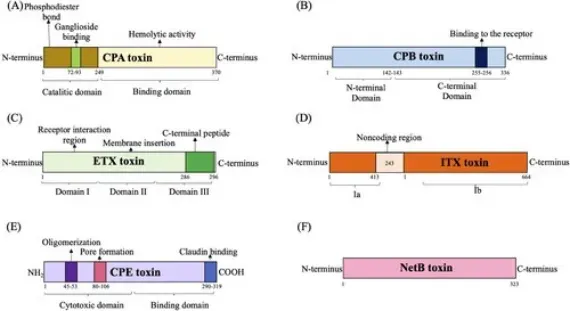
Schematic representation showing domain structure of Clostridium pefringens main toxins (PMID: 38590276)
2.4 Mechanism of Infection and Pathogenesis
2.4.1 Spore Germination and Toxin Production
Spores of C. perfringens are ingested via contaminated food (especially meat and meat products). In the host intestine, spores germinate into vegetative cells and produce toxins. The spores are highly heat-resistant and can survive cooking, which is a key factor in foodborne outbreaks.
2.4.2 Molecular Mechanism of Action of Alpha-Toxin
Alpha-toxin is the major virulence factor of C. perfringens type A and plays three major roles in the pathogenesis of gas gangrene:
a. Neutrophil mistrafficking: Alpha-toxin causes mistrafficking of neutrophils, preventing them from entering infected tissues
b. Vasoconstriction and platelet aggregation: Alpha-toxin causes vasoconstriction and platelet aggregation, reducing blood supply to infected tissues
c. Tissue destruction: Alpha-toxin directly lyses cell membranes through its phospholipase C activity, causing myonecrosis, hemolysis, and increased capillary permeability
Mutation of the alpha-toxin structural gene (plc or cpa) completely abrogates the ability of the bacterium to cause clostridial myonecrosis in a murine model.
2.4.3 NetB Toxin and Necrotic Enteritis
NetB toxin is the major virulence factor for avian necrotic enteritis. All 22 netB-positive strains isolated from chickens with clinical necrotic enteritis produced NetB toxin. NetB is a pore-forming toxin that lyses susceptible cells by forming heptameric pores.
2.4.4 CPE and Foodborn Diarrhea
CPE (C. perfringens enterotoxin) is the key toxin causing foodborne diarrhea in humans by Type F strains. When C. perfringens proliferates extensively in the intestine and forms spores, CPE is released and disrupts tight junctions of intestinal epithelial cells, causing diarrhea and abdominal cramps.
2.4.5 Immune Evasion Mechanisms
C. perfringens evades host immune responses through rapid growth and toxin production. Its extremely short doubling time (approximately 8 minutes) allows it to cause severe tissue damage before the immune system can mount an effective response. Furthermore, alpha-toxin impairs phagocyte function and induces local vasoconstriction, weakening the host's ability to clear the bacteria.
2.5 Transmission Routes and Process
Transmission of C. perfringens occurs primarily via the foodborne route:
l Foodborne transmission: Ingestion of contaminated food is the primary route, especially meat and meat products (stews, casseroles, gravies, and carved meats). Most outbreaks are linked to poor temperature control of food.
l Traumatic infection: Spores enter through broken skin and germinate in deep soft tissues, causing gas gangrene.
l Nosocomial transmission: Foodborne outbreaks can occur in nursing homes and healthcare facilities.
Process: Ingestion of contaminated food → spores germinate in the intestine → vegetative cells produce toxins → toxins damage intestinal epithelial cells (CPE) or invade tissues (alpha-toxin) → causing diarrhea or gas gangrene.
2.6 Symptoms and Treatment
2.6.1 Clinical Symptoms
Foodborne diarrhea (Type F) : Incubation period is typically 6–24 hours, primarily manifesting as watery diarrhea and abdominal cramps, with symptoms usually lasting less than 24 hours.
Gas gangrene (Type A) : Caused by traumatic infection, presenting with severe pain, swelling, skin discoloration, crepitation (subcutaneous emphysema), and systemic toxicity. The disease progresses rapidly and can lead to septic shock, multi-organ failure, and death.
Necrotic enteritis (Type C) : Presents with bloody diarrhea, severe abdominal pain, and intestinal necrosis.
2.6.2 Treatment
Foodborne diarrhea: Usually self-limiting; supportive treatment (fluid and electrolyte management) is sufficient.
Gas gangrene: Requires emergency surgical debridement, high-dose antibiotics (penicillin G combined with clindamycin, the latter having antitoxin properties), and hyperbaric oxygen therapy.
Drug | Recommendation Level | Considerations |
Penicillin G | First-line | High-dose use |
Clindamycin | Combination therapy | Has antitoxin activity |
Metronidazole | Alternative | Can be combined with penicillin |
Amoxicillin-clavulanate | Alternative | Effective against Clostridium isolates |
Linezolid | Alternative | Effective against Clostridium isolates |
Resistance: A 2025 study showed that C. perfringens had a 39.5% resistance rate to clindamycin and a 32.6% resistance rate to tetracycline, with 29.1% of strains resistant to at least two classes of commonly used antibiotics. tetA(P) and tetB(P) were the most frequently identified resistance genes, present in 93.0% and 79.0% of strains, respectively. According to 2024 China CDC data, Type F C. perfringens had a 47.1% resistance rate to metronidazole, and all strains showed intermediate resistance to erythromycin.
2.7 Prevention
l Food safety: Thoroughly cook meat and meat products; food should be stored above 60°C or below 7°C after preparation and consumed promptly; leftovers should be promptly refrigerated and thoroughly reheated.
l Temperature control: Strict temperature control during cooling and hot-holding of food is key to preventing C. perfringens multiplication.
l Natural antimicrobials: Chitosan (0.2%) effectively inhibits C. perfringens spore growth in cooked chicken meat; the combination of 0.025% chitosan and 0.075% nisin is most effective for inhibiting spore germination and outgrowth in laboratory medium. Clove and peppermint oils (0.5%) show the most potent action against C. perfringens spore germination. Litsea cubeba essential oil liposomes exhibit inhibitory effects on C. perfringens and its exotoxin activity.
l Taxifolin: A 2026 study found that taxifolin (dihydroquercetin) significantly inhibits C. perfringens growth and mucin adhesion through iron limitation-related physiological stress.
l Food service management: Provide food safety training and certification programs, conduct routine maintenance on food equipment, and train workers on proper equipment use.
2.8 Targets for Intervention
2.8.1 Pathogen Targets
Target | Protein/Pathway | Biological Function |
Alpha-toxin (CPA) | Phospholipase C | Tissue destruction, hemolysis |
NetB | Pore-forming toxin | Avian necrotic enteritis |
CPE | Enterotoxin | Foodborne diarrhea |
Collagenase (ColA) | Tissue degradation | Bacterial spread |
2.8.2 Host Targets
Target | Type | Role in Infection |
Neutrophils | Immune cells | Alpha-toxin causes their mistrafficking |
Platelets | Blood cells | Alpha-toxin induces aggregation |
Endothelial cells | Vascular cells | Alpha-toxin induces cell death and cytokine release |
2.9 Vaccine Types and Development Progress
2.9.1 CPA-CTD mRNA Vaccine (2026 New Development)
A 2026 study published in Frontiers in Immunology developed a lipid nanoparticle-encapsulated CPA-CTD mRNA vaccine targeting the conserved C-terminal domain of C. perfringens alpha-toxin.
l Immunogenicity: Induced strong humoral and cellular immune responses in mice, particularly promoting rapid production of specific IgG and mucosal IgA antibodies, as well as enhancing T cell immune responses, surpassing conventional subunit vaccines.
l Protective efficacy: In dual challenge models of enterotoxemia and gas gangrene, the vaccine provided complete protection against lethal doses of alpha-toxin and C. perfringens infection.
l Bovine model: Induced high-titer IgG antibodies and toxin-neutralizing antibodies in cattle. Notably, immunization of pregnant cows led to efficient transfer of these antibodies via colostrum to newborn calves, providing passive protection.
2.9.2 Quadrivalent Fusion Protein Vaccine (2025 New Development)
A 2025 study published in Poultry Science developed a novel quadrivalent fusion protein vaccine that achieved a 96% reduction in lesions against C. perfringens-caused necrotic enteritis in chickens.
2.9.3 Novel Subunit Vaccines (2025 New Development)
A 2025 study published in Veterinary Microbiology identified and evaluated PykA, CPE1060, and Mbp as potential G-type C. perfringens subunit vaccines. Among them, CPE1060 and Mbp proteins showed superior protective effects to PykA protein.
2.9.4 RMCP Adjuvanted Subunit Vaccine (2025 New Development)
A 2025 study published in ScienceDirect developed the biomimetic mineralization material RMCP as an adjuvant to enhance the immunogenicity of C. perfringens subunit vaccines. The RMCP-adjuvanted vaccine effectively resisted C. perfringens infection in mice while mitigating C. perfringens-induced intestinal pathological damage.
2.9.5 Multi-Epitope Vaccine (2026 New Development)
A 2026 study published in Europe PMC used immunoinformatics approaches to design a multi-epitope vaccine against C. perfringens in yaks, incorporating epitopes from multiple prevalent toxinotypes (A, C, and E).
2.10 Drugs
2.10.1 Pathogen-Targeted Drugs
Target | Drug/candidate | Mechanism | Stage |
Alpha-toxin | Caspofungin | Inhibits alpha-toxin PLC activity; reduces lethality and mitigates muscle damage | Mouse model |
Micafungin | Inhibits alpha-toxin-induced cell death and cytokine production | In vitro | |
annic acid (TA) and pentagalloyl glucose (PGG) | Bind alpha-toxin; TA shows stronger inhibitory activity and binding | In vitro & in vivo | |
Artemisinin | Mediates protective effects via liver-microbiome axis | Animal model |
Caspofungin: A 2026 study published in Communications Medicine screened 764 FDA-approved drugs and identified that caspofungin significantly reduces alpha-toxin-induced lethality and improves survival while mitigating muscle damage in mice infected with C. perfringens type A, likely through its inhibitory action on alpha-toxin activity. This study supports the development of new classes of small-molecule therapeutics that directly target bacterial toxins.
Tannins: A 2025 study published in Journal of Animal Science and Biotechnology integrated transcriptomics and metabolomics to reveal the multi-target mechanisms of tannic acid (TA) and pentagalloyl glucose (PGG) against C. perfringens and necrotic enteritis. Both PGG and TA bind alpha-toxin, with TA exhibiting stronger antibacterial activity and alpha-toxin binding capacity.
2.10.2 Phage Therapy
A 2025 genomic study showed that phage SD72 exhibited broad-spectrum inhibitory activity against C. perfringens isolates at a rate of 80.1% (74/86), independent of ST type and antimicrobial resistance. Phages represent a promising avenue as bio-antimicrobial agents for controlling the transmission of C. perfringens from animal sources to humans.
2.10.3 Antimicrobial Agents
Drug | Mechanism | Clinical Status |
Penicillin G | Cell wall synthesis inhibition | First-line (gas gangrene) |
Clindamycin | Protein synthesis inhibition | Combination therapy (antitoxin) |
Metronidazole | DNA damage | Alternative |
Amoxicillin-clavulanate | Cell wall synthesis inhibition | Alternative |
Linezolid | Protein synthesis inhibition | Alternative |
2.11 Recent Research
2.11.1 Molecular Epidemiology and Genomics
A 2025 study published in China CDC Weekly analyzed 2,068 stool samples collected from 11 provincial hospitals in China in 2024. The prevalence of Type F C. perfringens was 2.38%, predominantly isolated from human clinical samples, with higher detection rates in gastroenterology departments. Phylogenetic analysis showed high similarity among isolates from patients within the same province (SNP<100), and genetic environment analysis indicated potential horizontal gene transfer between animal and human strains.
A 2025 whole-genome sequencing study analyzed 86 C. perfringens strains and found that foodborne isolates harbored more abundant toxin genes (12/13 known toxin-associated genes); cgSNP analysis showed that the abundance of the virulence gene cpe was higher in globally circulating isolates than in clinical strains.
2.11.2 Diagnostic Technology Advances
Multiplex RPA-CRISPR/Cas12a Typing Platform: A 2025 study published in ScienceDirect developed a detection platform integrating multiplex recombinase polymerase amplification (RPA) with CRISPR/Cas12a for simultaneous detection of 6 key toxin genes (cpa, cpb, etx, iap, cpe, netB) in 2 reaction tubes, enabling discrimination of all 7 toxinotypes (A–G) .
l Detection limit: ≤10 copies/μL for all targets.
l Accuracy: In validation testing with 12 naturally contaminated food samples, typing accuracy reached 100%, surpassing commercial qPCR kits.
l Field applicability: When coupled with a portable detection device, the entire diagnostic workflow was completed within 50 minutes while maintaining laboratory-level accuracy.
One-Pot LAMP-CRISPR/Cas12b Platform: A 2026 study published in ScienceDirect developed a one-pot LAMP-CRISPR/Cas12b platform for rapid on-site detection of C. perfringens. CRISPR/Cas12b-mediated secondary sequence verification effectively suppressed false-positive signals arising from non-specific LAMP amplification, and the closed-tube format significantly reduced the risk of aerosol contamination.
2.11.3 Epidemiological Updates
In 2025, the UK reported a restaurant outbreak affecting 43 people, linked to meat products (stews, casseroles, and carveries); most outbreaks are linked to poor temperature control of food.
In May 2024, a C. perfringens-related foodborne diarrhea outbreak occurred in an elderly care center in Beijing, with 98 cases aged 22–99 years; all patients experienced diarrhea.
In 2025, Spain reported a school F-type C. perfringens outbreak affecting 526 people, with a unimodal epidemic curve; the likely source was meat in Bolognese sauce.
In 2025, Busan, South Korea reported foodborne outbreak pathogen distribution, with C. perfringens ranking second (71 cases) , following norovirus (156 cases).
2.11.4 Natural Product Inhibition Research
A 2025 study published in Microorganisms found that chitosan (0.2%) effectively inhibits C. perfringens spore growth in cooked chicken meat. The combination of 0.025% chitosan and 0.075% nisin was most effective for inhibiting spore germination and outgrowth in laboratory medium. Clove and peppermint oils (0.5%) showed the most potent action against C. perfringens spore germination.
A 2026 study published in Microbiology Spectrum found that taxifolin significantly inhibits C. perfringens growth and mucin adhesion through iron limitation-related physiological stress.
A 2026 study on Litsea cubeba essential oil liposomes showed that this natural plant-based antimicrobial agent has an inhibitory effect on C. perfringens and its exotoxin activity, with potential for enhancing beef safety.
3. Related Products & Services
l Recombinant Antigens & Receptors
l Antibodies
l Detection Kits
l Recombinant Protein Expression Services
l Antibody Development Services
4. Resources
5. References
1. McClane, B. A., Li, J., Uzal, F. A., et al. (2025). Milestones in Clostridium perfringens research since 1995. Anaerobe, 96, 103011.
2. Camargo, A., Ramírez, J. D., Kiu, R., et al. (2024). Unveiling the pathogenic mechanisms of Clostridium perfringens toxins and virulence factors. Emerging microbes & infections, 13(1), 2341968.
3. Shrestha, A., Mehdizadeh Gohari, I., Li, J., et al. (2024). The biology and pathogenicity of Clostridium perfringens type F: a common human enteropathogen with a new(ish) name. Microbiology and molecular biology reviews : MMBR, 88(3), e0014023.
4. Ou, L., Ye, B., Sun, M., et al. (2024). Mechanisms of intestinal epithelial cell damage by Clostridiumperfringens. Anaerobe, 87, 102856.
5. Xu, C., She, Y., Fu, F., et al. (2024). Review of advances in molecular structure and biological function of alpha toxin of Clostridium perfringens. Canadian journal of veterinary research = Revue canadienne de recherche veterinaire, 88(4), 138–144.
6. Abdel-Glil, M. Y., Thomas, P., Linde, J., et al. (2021). Comparative in silico genome analysis of Clostridium perfringens unravels stable phylogroups with different genome characteristics and pathogenic potential. Scientific reports, 11(1), 6756.
7. Li, C., Yan, X., Lillehoj, H. S. (2017). Complete genome sequences of Clostridium perfringens Del1 strain isolated from chickens affected by necrotic enteritis. Gut pathogens, 9, 69.
8. Keyburn, A. L., Boyce, J. D., Vaz, P., et al. (2008). NetB, a new toxin that is associated with avian necrotic enteritis caused by Clostridium perfringens. PLoS pathogens, 4(2), e26.
9. Nagarajan, S. K., Weber, J., Roderer, D., et al. (2024). C. perfringens enterotoxin-claudin pore complex: Models for structure, mechanism of pore assembly and cation permeability. Computational and structural biotechnology journal, 27, 287–306.
10. Awad, M. M., Ellemor, D. M., Boyd, R. L., et al. (2001). Synergistic effects of alpha-toxin and perfringolysin O in Clostridium perfringens-mediated gas gangrene. Infection and immunity, 69(12), 7904–7910.
11. Wu, L., Yu, Z., Li, P., et al. Genome MLST scheme for tracing genetic diversity and multidrug resistance of food animal-derived Clostridiumperfringens. Current research in food science, 11, 101149.
12. Yan, Z., Wang, H., Zhu, Y., et al. (2025). Molecular Epidemiology of Type F Clostridium perfringens Among Diarrheal Patients and Virulence-Resistance Dynamics - 11 Provinces, China, 2024. China CDC weekly, 7(3), 69–76.
13. Wang, W., Zheng, Y., Zhang, L., et al. (2026). A multiplex RPA-CRISPR/Cas12a platform for rapid and accurate toxinotyping of Clostridium perfringens. Talanta, 298(Pt B), 128998.
14. Valdezate, S., Medina-Pascual, M. J., Rodríguez-García, C., et al. (2026). Beyond the plate: Genomic characterization of an extensive school Clostridium perfringens type F outbreak. International journal of infectious diseases : IJID : official publication of the International Society for Infectious Diseases, 162, 108179.
15. Jia, Q., Xiang, H., Le, T., et al. (2026). A lipid nanoparticle encapsulated CPA-CTD mRNA vaccine provides protection against Clostridium perfringens-driven diseases. Frontiers in immunology, 16, 1748171.
16. Chen, Y., Li, Z., Xie, H., et al. (2026). Identification and evaluation of novel antigens PykA, CPE1060 and Mbp as G-type Clostridium perfringens subunit vaccines. Veterinary microbiology, 312, 110806.
17. Takehara, M., Homma, Y., Ishihara, T., et al. (2026). Repurposing caspofungin as a small-molecule inhibitor of Clostridium perfringens α-toxin for treatment of gas gangrene. Communications medicine, 6(1), 225.
18. Alhabeeb, R. S., Almatrafi, R., Banawas, S. S., et al. (2025). Inhibition of Clostridium perfringens Spore Germination by the Synergistic Effects of the Natural Products Chitosan and Nisin. Microorganisms, 13(9), 2116.
19. Fadhilatunnur, H., Gong, W., Sato, H., et al. (2026). Taxifolin impairs colonization of Clostridium perfringens in association with iron limitation-related physiological stress. Microbiology spectrum, e0130126. Advance online publication.