
info@mail.ucallm.com
1. Overview
Clostridium tetani is a Gram-positive, anaerobic, spore-forming bacillus of the family Clostridiaceae and genus Clostridium, and is the causative agent of tetanus. As an obligate anaerobe, it is widely distributed in soil, dust, and animal feces, and its spores can survive in the environment for years. C. tetani causes disease by producing a potent neurotoxin—tetanospasmin, also known as tetanus neurotoxin (TeNT).
Tetanus is a vaccine-preventable but potentially fatal disease. Although global vaccination efforts have substantially reduced mortality, tetanus still causes 30,000–50,000 deaths annually. Neonatal tetanus is the second leading cause of death from vaccine-preventable diseases among children worldwide. Tetanus remains a serious public health threat in low- and middle-income countries, conflict-affected areas, and among unvaccinated or under-vaccinated populations. According to WHO, 85% of infants worldwide received three doses of tetanus toxoid-containing vaccine in 2025.
2. Background Information
2.1 What is Clostridium tetani?
C. tetani is a Gram-positive, anaerobic, spore-forming bacillus of the family Clostridiaceae. It is an obligate anaerobe; in low-oxygen environments (such as deep puncture wounds or necrotic tissue), spores germinate and produce toxin. The C. tetani E88 genome consists of a 2,799,250-bp chromosome encoding 2,372 ORFs and a 74,082-bp virulence plasmid pE88 containing 61 ORFs.
The chromosome is highly conserved, whereas the toxin-encoding plasmid exhibits substantial heterogeneity. The C. tetani population is distributed in two phylogenetic clades—a major and a minor one—with no evidence for clade separation based on geographical origin or time of isolation. The TeNT gene tent is highly conserved among all strains; the most relevant difference is an insertion of four amino acids in the C-terminal receptor-binding domain in four strains, which might impact receptor-binding properties. A Japanese research team isolated 151 strains of C. tetani from 33 of 46 soil sampling sites in Kumamoto Prefecture (positivity rate 71.7%). Comparative genomic analysis subdivided the major clade into clades 1-1, 1-2, and 1-3, with partial clade 1-3 strains producing over sevenfold more TeNT than the reference strain. RNA-Seq analysis supported the elevated tetX gene expression. Additionally, five strains acquired the tetracycline resistance gene tet(M) in the tetX plasmid, resulting in significantly reduced susceptibility to tetracycline.
2.2 What Are C. tetani Virulence Factors?
C. tetani produces two major exotoxins: tetanospasmin (TeNT) and tetanolysin O.
Virulence Factor | Encoding Location | Main Function |
Tetanospasmin (TeNT) | tent gene on plasmid pE88 | Potent neurotoxin causing spastic paralysis |
Tetanolysin O | Chromosome | Cholesterol-dependent pore-forming toxin of the cholesterol-dependent cytolysin family; possibly involved in tissue damage |
Collagenase (ColT) | colT gene on plasmid pE88 | Involved in tissue degradation, promoting bacterial spread |
2.3 Mechanism of Infection and Pathogenesis
2.3.1 Spore Germination and Toxin Production
Spores of C. tetani enter the host through contaminated wounds (puncture wounds, burns, neonatal umbilical stumps, etc.). Under anaerobic conditions, spores germinate into vegetative cells and produce TeNT. TeNT is one of the most toxic proteins known to man, second only to botulinum neurotoxins.
2.3.2 Molecular Structure and Mechanism of Action of TeNT
TeNT is a 150 kDa A-B type neurotoxin composed of a heavy chain (HC) and a light chain (LC) linked by a single disulphide bond. It consists of three modules: the N-terminal light chain (LC, a 50-kDa zinc-dependent metalloprotease), the N-terminal translocation domain (H_N), and the C-terminal receptor-binding domain (H_C).
The mechanism of action of TeNT involves the following key steps:
a. Binding and endocytosis: TeNT binds to receptors such as gangliosides and nidogens via its H_C domain and enters peripheral motor neurons.
b. Retrograde axonal transport: TeNT is sorted into non-acidifying endosomes and undergoes retrograde axonal transport along the motor neuron axon to the spinal cord anterior horn. This process is driven by molecular motors including cytoplasmic dynein and myosin Va.
c. Trans-synaptic transfer: Upon reaching the spinal cord, TeNT is released and trans-synaptically transferred to inhibitory interneurons.
d. SNARE protein cleavage: In inhibitory interneurons, the LC acts as a zinc-dependent metalloprotease that specifically cleaves the Gln76-Phe77 bond of synaptobrevin-2 (VAMP-2) , disrupting SNARE complex assembly and blocking inhibitory neurotransmitter release.
e. Spastic paralysis: Blockade of inhibitory neurotransmission leads to hyperactive motor neurons that cause the typical spastic paralysis of tetanus.
A 2025 crystal structure study of the TeNT holotoxin revealed pH-mediated domain rearrangements that may give TeNT the ability to adapt to the multiple environments encountered during intoxication and facilitate binding to distinct receptors.
2.3.3 Immune Evasion and Immune Response
TeNT itself is not an immune evasion factor; rather, it evades host immune recognition through its extreme neurospecificity and potency. TeNT is so potent that even minute amounts can cause disease, and the immune system struggles to effectively neutralize the toxin before it reaches the central nervous system. Furthermore, the retrograde transport of TeNT allows it to “hide” within neurons, avoiding contact with circulating antibodies. The host immune response to TeNT relies primarily on neutralizing antibodies, which bind the toxin before it can engage nerve terminals and prevent its entry into neurons.
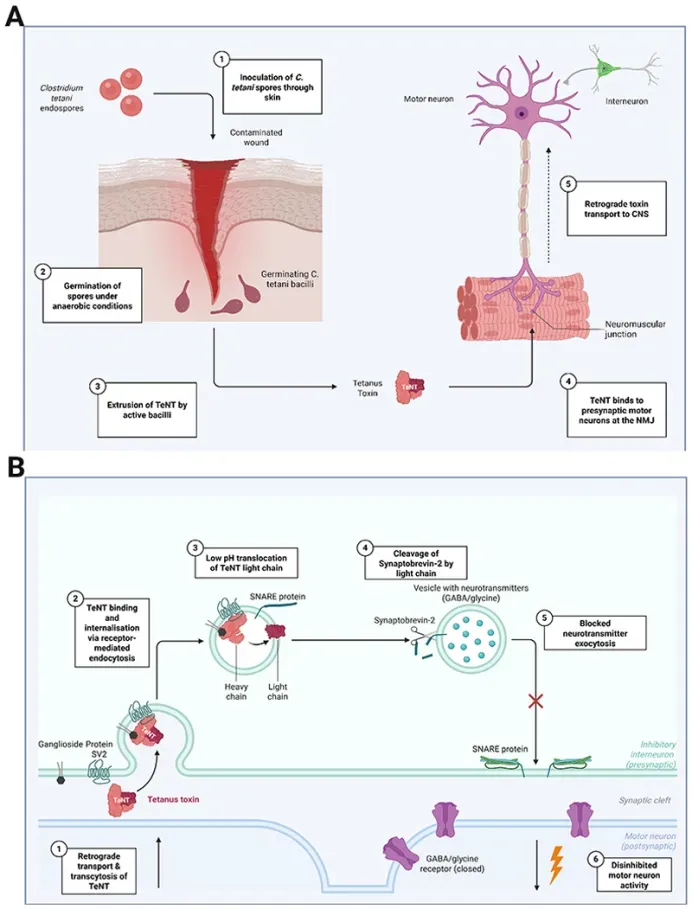
Pathophysiology of Tetanus from spore inoculation through toxin production and transport to CNS inhibitory interneurons(A). Toxin pathophysiology in CNS interneurons leading to disinhibition of motor neurons(B). (PMID: 40543524)
2.4 Transmission Routes and Process
The transmission route of C. tetani is traumatic infection, not person-to-person transmission:
l Wound contamination: Spores enter through puncture wounds, lacerations, burns, frostbite, surgical wounds, etc.
l Neonatal umbilical infection: Unhygienic delivery and umbilical cord care lead to neonatal tetanus
l Injection site infection: Among people who inject drugs, subcutaneous or intramuscular injection of contaminated spores can cause tetanus
l Other routes: Dental infection, chronic otitis media, abortion, animal bites, etc.
Process: Spores enter wound → germinate under anaerobic conditions → vegetative cells produce TeNT → toxin spreads via blood and lymph → binds motor nerve terminals → retrograde axonal transport to spinal cord → trans-synaptic transfer to inhibitory interneurons → cleaves VAMP-2 → blocks inhibitory neurotransmission → spastic paralysis.
2.5 Symptoms and Treatment
2.5.1 Clinical Symptoms
The incubation period of tetanus is typically 3–21 days, with shorter incubation periods indicating more severe disease. Clinical manifestations include:
l Trismus (lockjaw) : the most common early symptom
l Risus sardonicus
l Opisthotonus: rigid spasm of back muscles causing arching of the body
l Muscle rigidity and spasms: involving skeletal muscles throughout the body
l Autonomic dysfunction: blood pressure fluctuations, heart rate abnormalities, sweating
l Autonomic instability: now defined early in the disease course, affecting prognosis
Neonatal tetanus presents with difficulty sucking, trismus, and generalized spasms within 3–28 days after birth.
2.5.2 Treatment
Wound management: Debridement to remove necrotic tissue and foreign bodies, reducing the anaerobic environment.
Antimicrobial therapy: Metronidazole is the preferred antibiotic; penicillin G is an alternative. However, antibiotics cannot neutralize toxin already produced.
Antitoxin therapy: Human tetanus immune globulin (HTIG) is the preferred passive immunizing agent, used to neutralize toxin not yet bound to neural tissue. Recent trials suggest human and equine antitoxin perform equally, but shortages and high costs persist. Recombinant anti-tetanus toxin monoclonal antibodies (e.g., Sintetol, GR2001, SNA02-48) have been approved or entered clinical trials, offering faster onset, longer-lasting protection, and the potential to replace HTIG and TAT, alleviating global plasma-derived shortages.
Muscle spasm control: Benzodiazepines (e.g., diazepam) and baclofen.
Autonomic dysfunction management: Magnesium sulfate, beta-blockers, etc.
Supportive care: Mechanical ventilation, nutritional support, prevention of complications (e.g., nosocomial infections).
2.6 Prevention
l Vaccination: Tetanus toxoid-containing vaccine (TTCV) is the most reliable means of preventing tetanus. WHO recommends at least 6 doses for lifelong protection, including 3 in infancy and 3 subsequent boosters
l Primary immunization: 3-dose primary series (dose 1–2 interval 4–8 weeks, dose 2–3 interval 6–12 months); routine booster every 10 years, or every 5 years for contaminated wounds
l Maternal immunization: At least 2 doses of TTCV during pregnancy prevent neonatal tetanus; maternal antibodies are transferred to the fetus via the placenta
l Wound management: Thorough debridement, removal of foreign bodies and necrotic tissue
l Neonatal care: Clean delivery and umbilical cord care
l High-risk populations: People who inject drugs, diabetics, and immunocompromised individuals should ensure their vaccination status is up to date
2.7 Targets for Intervention
2.7.1 Pathogen Targets
Target | Protein/Pathway | Biological Function |
TeNT LC | Zinc-dependent metalloprotease | Cleaves VAMP-2 |
TeNT H_C | Receptor-binding domain | Ganglioside/nidogen binding |
Tetanolysin O | Cholesterol-dependent pore-forming toxin | Tissue damage |
ColT | Collagenase | Tissue degradation |
2.7.2 Host Targets
Target | Type | Role in Infection |
Nidogen | Extracellular matrix protein | Mediates TeNT binding to and internalization into neurons |
p75NTR | Neurotrophin receptor | Shares retrograde carriers with TeNT H_C |
SNARE complex | Synaptic vesicle fusion machinery | TeNT cleaves VAMP-2, blocking inhibitory neurotransmission |
2.8 Vaccine Types and Development Progress
2.8.1 Tetanus Toxoid Vaccine (TTCV)
TTCV is the cornerstone of tetanus prevention, prepared from formaldehyde-treated tetanus toxin that retains immunogenicity but has lost toxicity. Antibodies produced after vaccination maintain protective levels for at least 5 years, and approximately 10 years after a booster. According to China CDC data, protective immunity persists for 5–10 years in most individuals after 5 doses.
2.8.2 Recombinant Tetanus Vaccine
Recombinant tetanus vaccine induced persistent and superior antibody titers compared with commercially available toxoid vaccine in animal models.
2.8.3 mRNA Vaccine
The mRNA platform shows potential in tetanus vaccine development, but remains in early research stages.
2.9 Drugs
2.9.1 Pathogen-Targeted Drugs
Target | Drug/candidate | Mechanism | Stage |
Tetanus toxin | Recombinant anti-tetanus toxin monoclonal antibodies (Sintetol/GR2001/SNA02-48) | Neutralizes toxin, preventing neuronal entry | Approved/Phase III |
C. tetani | Metronidazole | Inhibits bacterial growth | Clinical standard |
Penicillin G | Inhibits bacterial growth | Clinical standard |
Sintetol (Siltartoxatug): The world's first recombinant anti-tetanus toxin monoclonal antibody, approved by China's NMPA in February 2025. Clinical trials first demonstrated its significant superiority over conventional plasma-derived human tetanus immune globulin (HTIG) in passive immunotherapy for tetanus, providing a novel solution for global tetanus prevention and treatment.
GR2001 Injection: Phase I clinical trial showed good safety and tolerability in Chinese adult participants, with linear pharmacokinetics, rapid onset, and long duration; the impact on active immunization when combined with adsorbed tetanus vaccine was manageable.
SNA02-48 Injection: Sinovac's fully human anti-tetanus monoclonal antibody, which launched Phase III clinical research in June 2026. Previous studies showed that a single intramuscular injection rapidly increased serum tetanus antibody levels.
2.9.2 Host-Targeted Drugs
Current host-targeted drug research for tetanus focuses primarily on magnesium sulfate (autonomic dysfunction management) and benzodiazepines (muscle spasm control).
2.10 Recent Research
2.10.1 Molecular Epidemiology and Genomics
A 2023 study in Japan, research team isolated 151 strains of C. tetani from soil in Kumamoto Prefecture and found that partial clade 1-3 strains produced over sevenfold more TeNT than the reference strain, and five strains acquired the tetracycline resistance gene tet(M) , resulting in significantly reduced susceptibility to tetracycline. This finding suggests that C. tetani is acquiring antimicrobial resistance in the soil environment, posing a potential threat to tetanus treatment.
A 2019 study published in Scientific Reports performed whole-genome sequencing of 26 C. tetani strains, revealing two phylogenetic clades and confirming that the chromosome is highly conserved while the toxin-encoding plasmid is highly heterogeneous. TeNT itself is highly conserved among all strains, with only four strains showing a four-amino-acid insertion in the C-terminal receptor-binding domain.
2.10.2 Toxin Structure and Function Research
A 2025 crystal structure study of the TeNT holotoxin revealed pH-mediated domain rearrangements that may give TeNT the ability to adapt to multiple environments encountered during intoxication and facilitate binding to distinct receptors. This finding provides a structural basis for designing inhibitors targeting TeNT translocation and receptor binding.
2.10.3 Diagnostic Technology Advances
Diagnosis of tetanus currently remains primarily clinical, with laboratory confirmation relying on toxin detection or bacterial isolation, which has limited sensitivity. In recent years, rapid detection methods based on CRISPR-Cas and isothermal amplification technologies are being developed, with the potential to improve early diagnosis of tetanus.
2.10.4 Autonomic Dysfunction Research
A 2026 review published in The Lancet noted that autonomic instability is now defined as an early manifestation of tetanus rather than a late-stage complication, affecting prognosis. This shift in understanding has important implications for the clinical management of tetanus.
2.10.4 Global Elimination Strategy
The WHO Maternal and Neonatal Tetanus Elimination (MNTE) initiative continues, aiming to achieve fewer than 1 neonatal tetanus case per 1,000 live births in all countries. In 2025, 85% of infants worldwide received three doses of DTP-containing vaccine, but immunization gaps persist in conflict-affected areas and marginalized populations, requiring targeted public health interventions.
3. Related Products & Services
l Recombinant Antigens & Receptors
l Antibodies
l Detection Kits
l Recombinant Protein Expression Services
l Antibody Development Services
4. Resources
5. References
1. Sudarshan, R., Sayo, A. R., Renner, D. R., et al. (2025). Tetanus: recognition and management. The Lancet. Infectious diseases, 25(11), e645–e657.
2. Ergönül, Ö., Kolsuz, S., Figueroa, J. P. (2026). Tetanus. Lancet (London, England), 407(10529), 716–727.
3. World Health Organization. (2026). Tetanus. WHO Fact Sheet, 15 July 2026.
4. Bruggemann, H., Baumer, S., Fricke, W. F., et al. (2003). The genome sequence of Clostridium tetani, the causative agent of tetanus disease. Proceedings of the National Academy of Sciences of the United States of America, 100(3), 1316–1321.
5. Chapeton-Montes, D., Plourde, L., Bouchier, C., et al. (2019). The population structure of Clostridium tetani deduced from its pan-genome. Scientific reports, 9(1), 11220.
6. Shitada, C., Sekizuka, T., Yamamoto, A., et al. (2023). Comparative pathogenomic analysis reveals a highly tetanus toxin-producing clade of Clostridium tetani isolates in Japan. mSphere, 8(6), e0036923.
7. Masuyer, G., Conrad, J., Stenmark, P. (2017). The structure of the tetanus toxin reveals pH-mediated domain dynamics. EMBO reports, 18(8), 1306–1317.
8. Wilson, E. A., Bevans, A. N., Baldwin, M. R. (2025). The Role of a Conserved Arg-Asp Pair in the Structure and Function of Tetanus Neurotoxin. Toxins, 17(6), 273.
9. Schenck, S., Laeremans, T., Steyaert, J., et al. (2025). Structures of native SV2A reveal the binding mode for tetanus neurotoxin and anti-epileptic racetams. Nature communications, 16(1), 4172.
10. Yeh, F. L., Dong, M., Yao, J., et al. (2010). SV2 mediates entry of tetanus neurotoxin into central neurons. PLoS pathogens, 6(11), e1001207.
11. Deinhardt, K., Berninghausen, O., Willison, H. J., et al. (2006). Tetanus toxin is internalized by a sequential clathrin-dependent mechanism initiated within lipid microdomains and independent of epsin1. The Journal of cell biology, 174(3), 459–471.
12. Lalli, G., Gschmeissner, S., Schiavo, G. (2003). Myosin Va and microtubule-based motors are required for fast axonal retrograde transport of tetanus toxin in motor neurons. Journal of cell science, 116(Pt 22), 4639–4650.
13. Bercsenyi, K., Schmieg, N., Bryson, J. B., et al. (2014). Tetanus toxin entry. Nidogens are therapeutic targets for the prevention of tetanus. Science (New York, N.Y.), 346(6213), 1118–1123.
14. Surana, S., Villarroel-Campos, D., Rhymes, E. R., et al. (2024). The tyrosine phosphatases LAR and PTPRδ act as receptors of the nidogen-tetanus toxin complex. The EMBO journal, 43(16), 3358–3387.
15. Liang, Z., Liu, S., Guo, W., et al. (2025). Recombinant monoclonal antibody siltartoxatug versus plasma-derived human tetanus immunoglobulin for tetanus: a randomized, double-blind, active-controlled, phase 3 trial. Nature medicine, 31(8), 2673–2681.
16. Yu, R., Fang, T., Liu, S., et al. (2016). Comparative Immunogenicity of the Tetanus Toxoid and Recombinant Tetanus Vaccines in Mice, Rats, and Cynomolgus Monkeys. Toxins, 8(7), 194.
17. World Health Organization. Electronic address: sageexecsec@who.int (2018). Tetanus vaccines: WHO position paper, February 2017 - Recommendations. Vaccine, 36(25), 3573–3575.