
info@mail.ucallm.com
1. Stroke
Stroke is a major neurological disorder caused by an interruption of cerebral blood flow and is broadly classified as ischemic or hemorrhagic stroke. Ischemic stroke, accounting for approximately 80% of cases, primarily results from cerebral vessel occlusion, whereas hemorrhagic stroke is caused by vessel rupture and intracranial bleeding.
Stroke remains a leading cause of death and long-term disability worldwide. Beyond acute neuronal injury, stroke initiates complex pathological responses involving oxidative stress, neuroinflammation, blood-brain barrier disruption, metabolic dysfunction, and cell death, contributing to persistent neurological deficits, cognitive impairment, and depression. Although conventional risk factors such as hypertension, dyslipidemia, atrial fibrillation, diabetes, smoking, and physical inactivity are well established, they cannot fully explain the molecular complexity and heterogeneity of stroke.
Understanding the molecular mechanisms that drive stroke pathogenesis and recovery is therefore critical for identifying new therapeutic targets and biomarkers. PTMs, which dynamically regulate protein function, stability, localization, and signaling, represent an important regulatory layer linking metabolic, inflammatory, and cellular stress responses to stroke pathology.
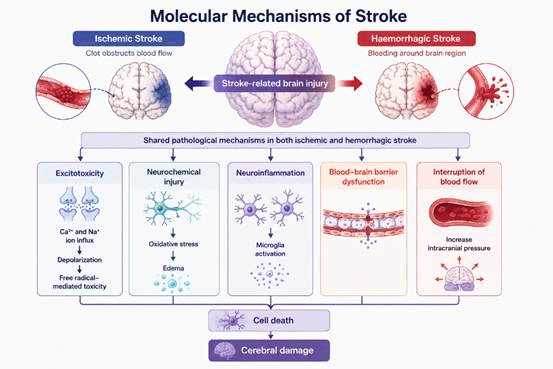
Figure 1. Molecular mechanism of stroke.
2. The Growing Landscape of PTMs in Stroke
With growing recognition of PTMs as an important regulatory layer in stroke pathogenesis, increasing research attention has been directed toward PTM dysregulation in stroke. These studies have expanded beyond well-characterized modifications such as phosphorylation and ubiquitination to encompass a diverse range of PTM types, revealing an increasingly complex PTM landscape in stroke.
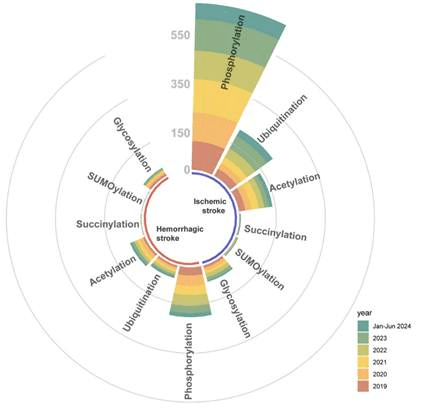
Figure 2. Number of PubMed-indexed publications investigating different types of PTMs in stroke from January 2019 to June 2024 (PMID: 39277050)
3. Key PTMs and Molecular Targets in Stroke
Accumulating evidence indicates that diverse PTMs paly important regulatory roles in stroke pathogenesis by modulating the activity, stability, localization and interactions of key molecular targets. Importantly, individual PTM types can regulate multiple pathological processes, including neuroinflammation, oxidative stress, cell death, and blood-brain barrier dysfunction. The major PTM types and their representative molecular targets implicated in stroke are summarized below.
PTM Type | Representative Target Proteins | Biological Processes | Journal Article |
Phosphorylation | PKM2, STAT3, NKCC1, NLRP3, NF-κB | Neuroinflammation; BBB dysfunction; Thromboinflammation; Cell death | PMID:34529778 PMID:35729645 |
Ubiquitination | TRIM67, IκBα, PA2G4/EBP1 | Neuroinflammation; Mitophagy; Cell death | PMID:37248543 PMID:37712850 |
SUMOylation | ANXA1, SENP6, TPRC1, MLK3 | Neuroinflammation; Cell death; BBB dysfunction | PMID:34158860 PMID:35869493 PMID:39921112 |
Acetylation | HDAC3, p65, c-Myc, H4K16 | Neuroinflammation; Cell death; Autophagy | PMID:32863951 PMID:38546874 PMID:37130066 |
O-GlcNAcylation | XBP1, Drp1 | Oxidative stress; Mitochondrial dysfunction | PMID:28487326 PMID:34705256 |
Succinylation | ANXA1, SIRT5 | Neuroinflammation; Cell death | PMID:36517900 |
Lactylation | LRP1, ARF1 | Metabolic reprogramming; Mitochondrial function; Neuroinflammation | PMID:38906140 PMID:39113798 |
4. Targeting PTMs: Emerging Therapeutic Opportunities in Stroke
Beyond their roles in disease mechanisms, PTMs are emerging as potential therapeutic targets in stroke. Pharmacological modulation of specific PTM events has been shown to influence neuroinflammation, neuronal survival, proteostasis, and axonal integrity in experimental stroke models.
PTM Type | Therapeutic Agent | Molecular Target | Stroke Model | Journal Articl |
Phosphorylation | PTE | NF-κB p65 | Cerebral ischemia | PMID: 31681297 |
Phosphorylation | 7,8-DHF | TrkB/Akt | Cerebral ischemia | PMID: 31307481 |
SUMOylation | Tat-NTS | ANXA1 | Ischemic stroke | PMID: 37908731 |
Acetylation | SAHA | HSP70/TDP-43 | Subarachnoid hemorrhage | PMID: 35501375 |
Ubiquitination | Luteolin | TRAF6 | Intracerebral hemorrhage | PMID: 32114357 |
5. Representative PTM Research Cases in Stroke
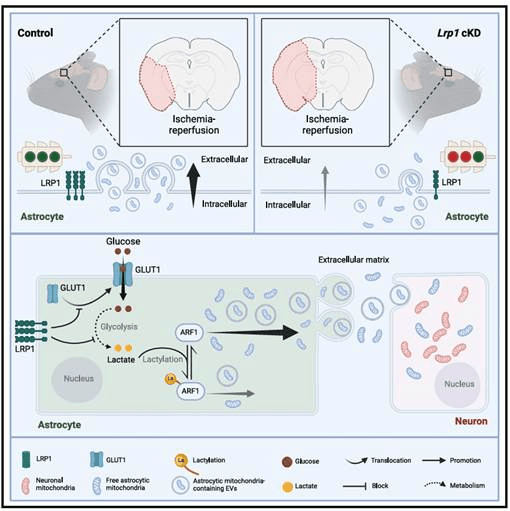
Figure 3. The Summary of Key Finding in This Study (PMID: 38906140)
Title: Astrocytic LRP1 enables mitochondria transfer to neurons and mitigates brain ischemic stroke by suppressing ARF1 lactylation.
Introduction:
Acute ischemic stroke is a major cause of death and long-term disability worldwide, yet effective therapeutic strategies remain limited. Low-density lipoprotein receptor-related protein 1 (LRP1) is a multifunctional transmembrane receptor highly expressed in the brain, with established roles in neuronal homeostasis, blood-brain barrier integrity, and energy metabolism. Although LRP1 has been implicated in ischemic stroke, its role in the cellular response to ischemic injury remains poorly understood. Cerebral ischemic disrupts cellular energy metabolism and mitochondrial function, contributing to progressive neuronal damage. Astrocytes can support injured neurons by transferring functional mitochondria, but how this protective intercellular communication is regulated under ischemic conditions remains unclear.
Biological Questions:
How does LRP1 regulate cellular responses to ischemic injury and contribute to brain homeostasis?
Key Findings:
1) Astrocytic LRP1 promotes healthy mitochondrial transfer from astrocytes into injured neurons and protected against brain ischemia-reperfusion injury. Suppression of astrocytic LRP1 impairs mitochondria transfer and exacerbates ischemic stroke.
2) Astrocytic LRP1 suppresses glucose uptake, glycolysis, and lactate production, thereby reducing lactylation of ARF1 and promoting mitochondrial transfer.
3) LRP1 links metabolic remodeling to mitochondrial transfer through ARF1 lactylation. By suppressing glycolysis and lactate production, astrocytic LRP1 reduces ARF1 lactylation, thereby facilitating mitochondrial transfer to injured neurons and protecting against ischemic injury. Elevated cerebrospinal fluid (CSF) lactate in stroke patients further supports the clinical relevance of this metabolic-PTM axis.
Research Strategy:
To elucidate the role of LRP1 in ischemic brain injury, the study adopted a stepwise strategy integrating mitochondrial transfer, metabolic profiling, lactylation proteomics, and in vivo and clinical validation.
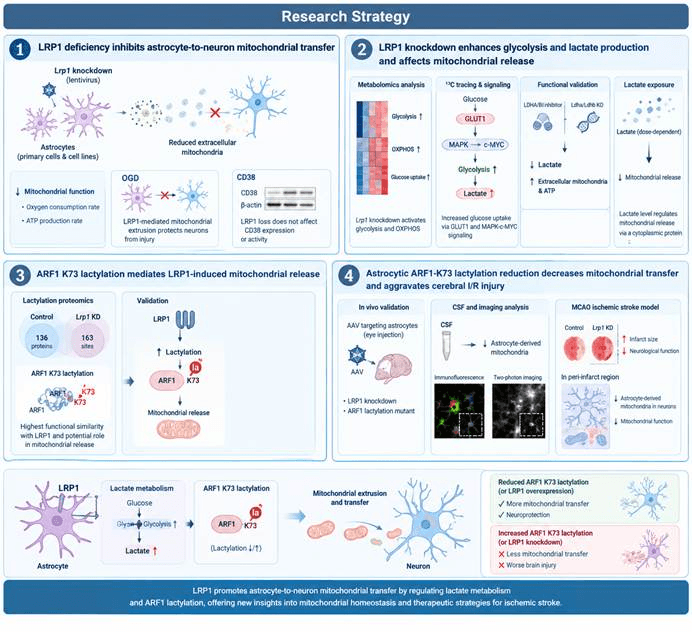
Summary:
This study identifies an astrocytic LRP1–lactate–ARF1 lactylation axis that regulates mitochondria transfer to injured neurons during ischemic stroke. Astrocytic LRP1 restrains glycolytic reprogramming and lactate production, thereby limiting ARF1 K73
lactylation and facilitating the release and transfer of functional mitochondria to neurons. Loss of LRP1 disrupts this metabolic–PTM axis, impairs mitochondrial transfer, and exacerbates ischemic brain injury. These findings reveal a previously unrecognized link between metabolic remodeling, protein lactylation, and intercellular mitochondrial communication, highlighting the LRP1–ARF1 lactylation axis as a potential therapeutic target for ischemic stroke.
6. PTM Research Solutions for Stroke
PTM Type | Research Applications | Recommended Research Solutions |
Phosphorylation |
|
|
Ubiquitination |
|
|
Acetylation |
|
|
Lactylation |
|
|
O-GlcNAcylation |
|
|
7. Key References
1) Kuriakose D, Xiao Z. Pathophysiology and Treatment of Stroke: Present Status and Future Perspectives. Int J Mol Sci. 2020;21(20):7609.
2) Shakir, R. The struggle for stroke reclassification. Nat. Rev. Neurol. 2018, 14, 447–448.
3) GBD 2016 Stroke Collaborators. Global, regional, and national burden of stroke, 1990-2016: A systematic analysis for the Global Burden of Disease Study 2016. Lancet Neurol. 2019, 18, 439–48.
4) Tao J, Li J, Fan X, et al. Unraveling the protein post-translational modification landscape: Neuroinflammation and neuronal death after stroke. Ageing Res Rev. 2024;101:102489.
5) Zhou J, Zhang L, Peng J, et al. Astrocytic LRP1 enables mitochondria transfer to neurons and mitigates brain ischemic stroke by suppressing ARF1 lactylation. Cell Metab. 2024;36(9):2054-2068.e14.