
info@mail.ucallm.com
As critical carriers for intercellular information transfer, exosomes are released into the extracellular space. They can be recognized and internalized by recipient cells through multiple pathways, delivering bioactive molecules including proteins, nucleic acids and lipids to target cells, thereby regulating gene expression, signaling pathways and functional status of recipient cells. Currently, exosome-mediated cell communication mainly includes receptor-ligand interaction, membrane fusion and endocytic uptake.
1 Receptor-Ligand Interaction
After exosomes are released into the extracellular environment, their surface is enriched with diverse functional membrane proteins, including tetraspanins (e.g., CD9, CD63, CD81), integrins, immune-related molecules and cellular adhesion proteins. These surface molecules serve as "recognition signals" and interact with specific receptors on the plasma membrane of recipient cells. Protein–protein binding mediates targeted localization of exosomes and selective intercellular communication.
Among them, integrins are key molecules determining the organotropism of exosomes. Studies have shown that exosomes secreted by different cell types possess distinct integrin repertoires, which influence their in vivo distribution and targeting capacity. For instance, Hoshino et al. published a study in *Nature* in 2015 demonstrating that the integrin expression patterns on the surface of tumor-derived exosomes dictate organ tropism. Exosomes expressing αvβ5 integrin tend to be taken up by hepatic Kupffer cells, whereas exosomes carrying α6β4 and α6β1 integrins preferentially localize to lung tissue and facilitate the formation of the pre-metastatic niche. This finding reveals the pivotal role of exosomal surface proteins in organ-specific tumor metastasis.
In addition to integrins, tetraspanins CD9, CD63 and CD81 also participate in the recognition between exosomes and target cells. CD81 can form complexes with other membrane proteins to modulate exosome membrane stability and cellular uptake efficiency; CD63 is involved in exosome biogenesis and secretion and affects the interaction between exosomes and recipient cells. Therefore, CD9/CD63/CD81 not only serve as important markers for exosome identification, but also participate in the functional regulation of exosomes.
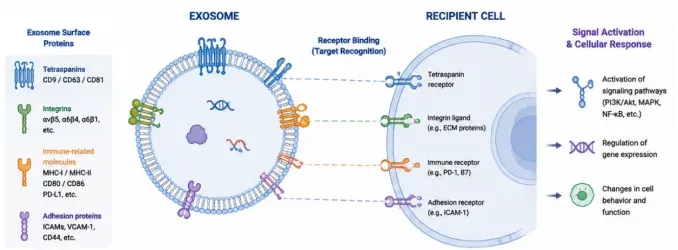
Exosomal surface proteins mediate target cell recognition and intracellular signal activation. A variety of signature proteins are distributed on the exosomal membrane: tetraspanins CD9/CD63/CD81; integrins (αvβ5, α6β4, α6β1, etc.); immune-associated molecules MHC‑I/MHC‑II, CD80/CD86, PD‑L1; adhesion proteins ICAMs, VCAM‑1, CD44. These proteins bind to their corresponding receptors on recipient cells to accomplish target cell recognition, and further activate signaling pathways including PI3K/Akt, MAPK and NF‑κB, regulating gene expression and altering cellular behaviors and functions of recipient cells.
In the field of immune regulation, immune-related molecules on the exosome surface can directly affect the behavior of immune cells. For example, exosomes derived from antigen-presenting cells (APCs) can carry MHC-I/MHC-II molecules together with co-stimulatory molecules CD80/CD86, and transfer antigenic information to T cells to promote or modulate immune responses. In addition, tumor cell-derived exosomes may carry immunosuppressive molecules such as PD-L1. By binding to PD-1 on the surface of T cells, they inhibit T cell activation and facilitate tumor immune escape.
During tissue repair and regeneration, surface proteins on stem cell-derived exosomes also play critical roles. For instance, mesenchymal stem cell (MSC)-derived exosomes can be selectively taken up by cells in injured tissues via interactions between surface adhesion molecules and receptors. They deliver functional RNA and protein cargo to promote angiogenesis, anti-inflammatory responses and tissue repair.
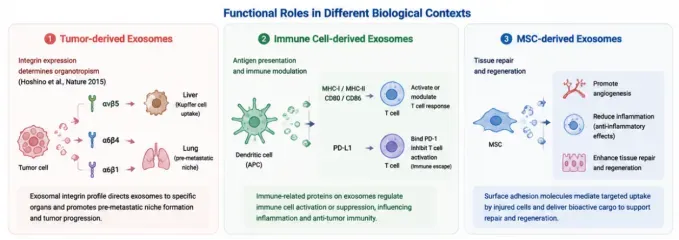
Functions of exosomes derived from different cell types in diverse biological scenarios. ① Tumor-derived exosomes: The integrin expression profile of exosomes determines organotropism. αvβ5 mediates exosome targeting to the liver and uptake by Kupffer cells; α6β4 and α6β1 guide exosome homing to the lung to establish the pre-metastatic niche. Exosomal integrins direct vesicle colonization in specific organs, promoting pre-metastatic niche formation and tumor progression. ② Immune cell-derived exosomes: Exosomes secreted by antigen-presenting cells such as dendritic cells carry MHC‑I/MHC‑II and CD80/CD86, which can activate or modulate T cell responses. Meanwhile, surface PD‑L1 on exosomes binds to PD‑1 on T cells to suppress T cell activation and mediate immune escape. Immune-related proteins on exosomes regulate the activation or inhibition of immune cells and affect inflammation and anti-tumor immunity. ③ MSC-derived exosomes: They mainly exert tissue repair and regenerative effects, promoting angiogenesis and alleviating inflammation. Surface adhesion molecules mediate targeted uptake of exosomes by injured cells and deliver bioactive cargo to support tissue repair and regeneration.
Therefore, exosomal surface proteins not only determine exosome stability and biodistribution profiles, but also serve as important functional modules mediating precise intercellular communication. Through recognition between specific membrane proteins and recipient cells, exosomes function like a “biological mail delivery system”, selectively transferring information from donor cells to target cells and participating in a variety of physiological and pathological processes including tumor metastasis, immune regulation, inflammatory responses and tissue regeneration.
2 Membrane Fusion
Exosome Membrane Fusion Enables Direct Cargo Delivery
After exosomes are recognized by target cells, functional cargo can be delivered directly via membrane fusion. This process relies on the fusion between the exosomal lipid bilayer and the plasma membrane or endosomal membrane of recipient cells, releasing RNAs, proteins and other bioactive molecules stored inside exosomes into recipient cells to achieve intercellular information transfer. Lipid components in the exosomal membrane such as cholesterol, sphingomyelin and ceramide, together with membrane proteins, participate in membrane rearrangement and fusion. Rab GTPases, SNARE-related proteins and acidic conditions within the endosomal compartment are also considered to regulate exosome fusion and cargo release.
In recent years, multiple imaging and functional studies have directly demonstrated cargo release mediated by exosome membrane fusion. For example, Joshi et al. reported that after entering recipient cells, exosomes can undergo membrane fusion within late endosome/multivesicular body (MVB) compartments and release functional protein cargo. Using fluorescent labeling, the study visualized fusion events between exosomal membranes and endosomal membranes, proving that late endosomes are key sites for exosomal cargo release.
Studies on viral infection and immune regulation also reveal that exosomes employ mechanisms analogous to viral envelope fusion to facilitate nucleic acid delivery. For instance, Liu et al. published work in Journal of Virology showing that after macrophage-derived exosomes enter hepatocytes, membrane fusion occurs in Rab7-positive late endosomes, releasing cargo such as GFP protein into the cytoplasm. This study demonstrates that exosomes can achieve transmembrane delivery through membrane fusion and bypass lysosomal degradation pathways.
Furthermore, the exosome membrane fusion mechanism has been widely applied to develop engineered exosome delivery systems. As reported by Sato et al. in Scientific Reports, hybrid exosomes can be constructed via membrane fusion between exosomes and liposomes, altering exosomal membrane properties and enhancing their capacity as drug delivery carriers. Studies indicate that fused hybrid exosomes retain the targeting features of naturally derived vesicles while enabling loading of exogenous functional molecules.
For therapeutic applications, researchers further adopt membrane fusion strategies to improve cargo loading efficiency into exosomes. For example, recent studies have fused fusogenic lipid nanomaterials with exosomes to achieve efficient delivery of macromolecules including doxorubicin, proteins and mRNA, providing new technical routes for exosomes as delivery platforms for nucleic acid drugs and biomacromolecules.
In summary, membrane fusion is not only a natural mechanism for exosomes to execute intercellular communication, but also a critical technical foundation advancing exosome-based drug delivery and precision therapeutics. Through membrane fusion, exosomes cross cellular membrane barriers and enable efficient transfer of functional cargo between cells, thereby regulating gene expression, signaling pathways and cell fate.
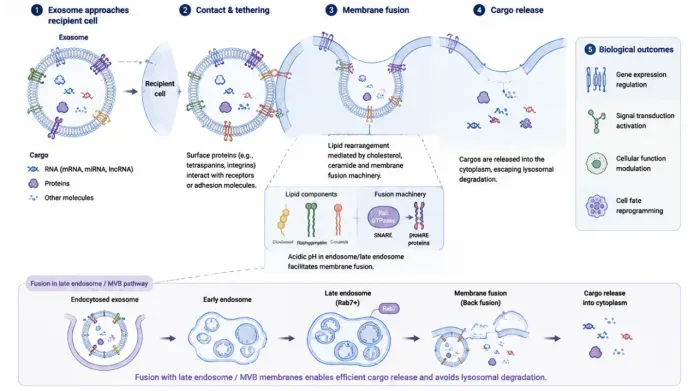
Exosome recognition, membrane fusion, cargo release and downstream biological effects. Exosomes carry nucleic acid and protein cargo, and anchor to recipient cells via surface proteins binding to their receptors. Under the mediation of lipid components and the SNARE/Rab fusion machinery, membrane fusion occurs and cargo is released into the cytoplasm, bypassing lysosomal degradation. This ultimately regulates gene expression, activates signaling pathways, and alters cell functions and cell fate.
3 Endocytosis
Endocytosis and Intracellular Trafficking Enable Functional Cargo Delivery
After being recognized by recipient cells, exosomes can enter cells through multiple endocytic pathways, including clathrin-mediated endocytosis, macropinocytosis and lipid raft-dependent endocytosis. Upon entry, exosomes are first transported to early endosomes, then undergo intracellular sorting. They may further progress to late endosomes or multivesicular bodies (MVBs), or be delivered to specific organellar compartments. During this process, the RNA, protein and lipid cargo carried by exosomes can avoid rapid degradation and be released into the cytoplasm via endosomal escape or membrane fusion, thereby exerting biological functions.
Once inside recipient cells, exosomes do not simply release cargo; rather, they regulate cellular status through a complex intracellular trafficking network. For example, exosomal miRNAs can enter the cytoplasm and bind to target mRNAs, altering gene expression through post-transcriptional regulation. Exosome-delivered proteins and signaling molecules can directly activate relevant signaling pathways, affecting cell proliferation, migration, immune responses and differentiation. Therefore, the intracellular trafficking of exosomes following endocytosis is a crucial step for converting intercellular information.
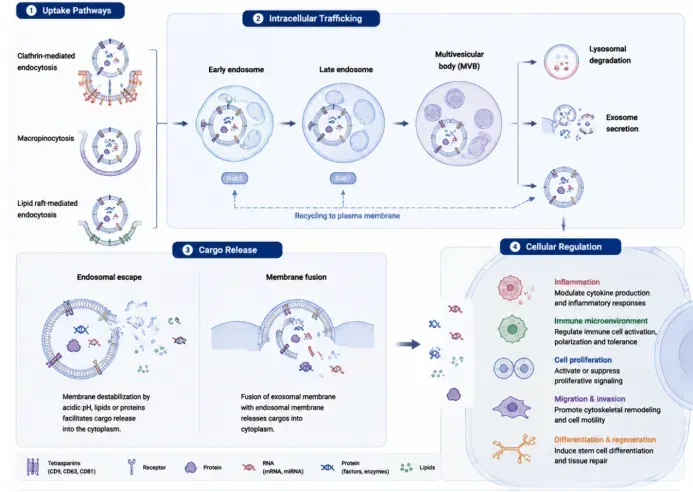
Exosome endocytic uptake, intracellular vesicle trafficking, cargo release and downstream cellular effects. Exosomes are internalized by target cells via multiple endocytic pathways. The vesicles sequentially pass through early endosomes, late endosomes and multivesicular bodies. Cargo is released through endosomal escape or membrane fusion, further regulating inflammation, immunity, cell proliferation and migration, stem cell differentiation and tissue repair.