
info@mail.ucallm.com
G Protein-Coupled Receptors (GPCRs) are essential signal-transducing receptors located on cell membranes and represent one of the most widely investigated target families in drug discovery. Upon binding to agonists or antagonists, GPCRs modulate intracellular levels of the second messenger cAMP (cyclic AMP) via G proteins and downstream signaling molecules such as Adenylyl Cyclase (AC). Accordingly, dynamic changes in cAMP serve as a critical cellular signaling readout to assess the functional activity of selected GPCRs and drug responses.
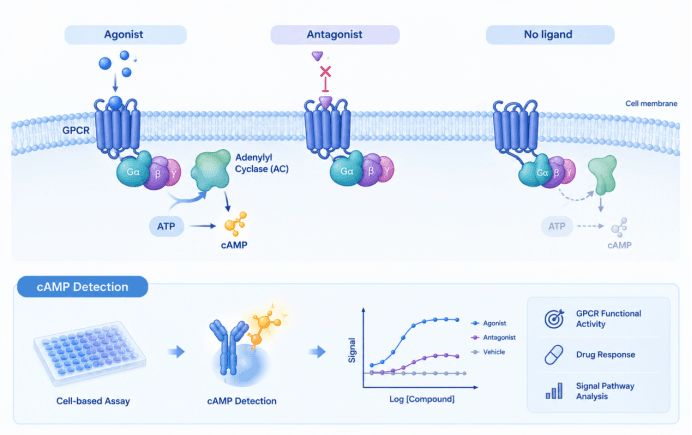
GPCR-Mediated cAMP Signaling and Functional Detection. Agonist or antagonist binding to GPCRs modulates G protein signaling and Adenylyl Cyclase (AC) activity, leading to changes in intracellular cAMP levels. Quantitative cAMP detection provides a functional readout for evaluating GPCR activity, compound responses, and downstream signaling effects.
KeyTec® cAMP TR-FRET Assay adopts a competitive detection principle. It quantifies intracellular cAMP levels by measuring competition between sample cAMP and labeled cAMP for binding to the detection antibody. When the cAMP concentration in the sample varies, the competitive binding relationship shifts and triggers changes in TR-FRET signals. A standard curve generated with cAMP standards converts assay signals into cAMP concentrations within samples, enabling quantitative measurement of cellular cAMP levels.
1 Quantitative cAMP Detection Based on Competitive TR-FRET
Within the cAMP TR-FRET assay system, endogenous cAMP from samples competes with labeled cAMP for binding to the matched detection antibody. Given the well-defined competitive relationship between assay signal and sample cAMP concentration, quantification of cAMP in unknown samples can be achieved via a standard curve.
This detection method is particularly suited for cellular assays in GPCR functional research. Researchers can measure intracellular cAMP levels after treatment with agonists, antagonists or other drugs, and evaluate GPCR-mediated functional responses via changes in cAMP signals under different treatment conditions.
2 Coverage of Distinct cAMP Detection Ranges
Different cell types, receptor expression levels and stimulation conditions may yield cAMP responses spanning varied concentration ranges. To meet assay requirements of diverse experimental systems, multiple cAMP TR-FRET assay products are available, including:
- cAMP TR-FRET Kit: For routine measurement of cAMP levels;
- cAMP HiRange Detection Kit: Suitable for samples with elevated cAMP concentrations;
- cAMP Higher Range Detection Kit: Designed for assays requiring detection of even higher cAMP levels.
By selecting products with appropriate detection ranges, researchers can build matched assay systems according to sample cAMP levels and anticipated signal windows, improving compatibility for various GPCR functional experiments.
3 From GPCR Activation to cAMP Functional Response
In GPCR pharmacological studies, cells can be treated with agonists or antagonists at serial concentrations, followed by measurement of resulting intracellular cAMP level changes.
For agonist studies, cAMP responses induced by graded concentrations are used to construct dose‑response curves for subsequent EC₅₀ analysis. For antagonist studies, alterations in GPCR-driven cAMP responses before and after antagonist treatment are compared to assess the modulatory effects of candidate compounds on receptor functional signaling.
Therefore, cAMP detection bridges GPCR ligand action and cellular functional signaling responses, providing quantitative cellular assay tools for GPCR pharmacological research and candidate drug screening.
4 Supporting Reagents for Complete cAMP Assay Workflow
In addition to cAMP TR-FRET Detection Kits with different detection ranges, we also supply matching standards and experimental reagents for the assay system, including cAMP Standard, HiRange Standard, Stimulation Buffer, Lysis & Detection Buffer and Detection Buffer.
The standards are used to generate quantitative cAMP standard curves. Stimulation Buffer is applied in cellular stimulation setups. Lysis & Detection Buffer and Detection Buffer are used for sample processing and establishment of the TR-FRET assay system. Combination of assay kits and supporting reagents enables the full experimental workflow from cellular stimulation and sample processing to quantitative cAMP analysis.
5 GPCR Drug Screening and Functional Evaluation
Based on measurement of cAMP level changes, KeyTec® cAMP TR-FRET Assay can be applied in multiple GPCR research scenarios, including:
- GPCR activation research: Analysis of intracellular cAMP level changes following receptor activation;
- Agonist screening: Evaluation of cAMP functional responses induced by candidate agonists;
- Antagonist screening: Analysis of modulatory effects of candidate antagonists on GPCR-mediated cAMP responses;
- Dose-response analysis: Generation of cAMP response curves via treatment with serial concentrations;
- EC₅₀ determination: Assessment of concentration-effect relationships for functional responses triggered by agonists;
- Cellular-level drug screening: Integration of GPCR functional responses with candidate compound evaluation.
6 KeyTec® cAMP Assay Product Portfolio
Product Type | Product | Main Application |
cAMP Detection | cAMP TR-FRET Kit | Routine quantitative detection of cAMP |
cAMP Detection | cAMP HiRange Detection Kit | High-range cAMP detection |
cAMP Detection | cAMP Higher Range Detection Kit | Extended high-range cAMP detection |
Standard | cAMP Standard | Standard curve for cAMP quantification |
Standard | HiRange Standard | Standard curve for high-range cAMP assay |
Cell Stimulation | Stimulation Buffer | Cellular stimulation setup |
Sample Processing | Lysis & Detection Buffer | Cell lysis and sample detection |
Detection | Detection Buffer | TR-FRET assay system |
KeyTec® cAMP TR-FRET Assay uses cAMP, a critical cellular second messenger, as the functional readout. Covering multiple detection ranges and complete supporting reagents, the assay enables GPCR activation studies, agonist/antagonist screening, dose-response analysis, EC₅₀ determination and cellular-level drug screening, delivering flexible TR-FRET assay solutions for GPCR drug discovery.
Explore Products | Get Technical Support | Custom TR-FRET Assay