
info@mail.ucallm.com
Extracellular vesicles (EVs) serve as vital mediators for intercellular communication within the immune system. Extracellular vesicles derived from immune cells transport bioactive cargo including proteins, lipids, mRNAs and miRNAs to regulate the activation, differentiation and functional status of recipient immune cells, thereby modulating inflammatory responses, immune tolerance and tissue homeostasis.
1.1 Macrophage Regulation
Macrophage-derived extracellular vesicles participate in signal crosstalk between macrophages and other immune cells, and can regulate inflammatory responses as well as functional polarization of macrophages. Depending on the activation state of donor cells and cargo composition of vesicles, such vesicles can either promote or suppress inflammatory signaling pathways, making them an ideal model for investigating macrophage-mediated immune regulation.
1.2 T Cell Regulation
Extracellular vesicles modulate T cell activation, proliferation and differentiation by delivering regulatory proteins and non-coding RNAs. Vesicle-mediated cell communication governs the responses of CD4⁺ and CD8⁺ T cells, including effector cell functions and regulatory T cell-associated immunosuppression.
1.3 Dendritic Cell Regulation and Antigen Presentation
Dendritic cell-derived extracellular vesicles carry MHC class I/II molecules, antigenic peptides and co-stimulatory molecules, participating in antigen presentation and T cell activation. Depending on the maturation and functional state of donor dendritic cells, DC-derived vesicles can mediate immune activation or immune tolerance.
1.4 Immunomodulation by Mesenchymal Stem Cell-Derived EVs
Mesenchymal stem cell-derived extracellular vesicles (MSC-EVs) have been extensively studied as cell-free immunomodulatory mediators. MSC-EVs interact with macrophages, dendritic cells, NK cells and T cells. Studies have confirmed that they can induce macrophages to switch toward an anti-inflammatory phenotype, inhibit excessive immune activation, and regulate the secretion of inflammatory cytokines.
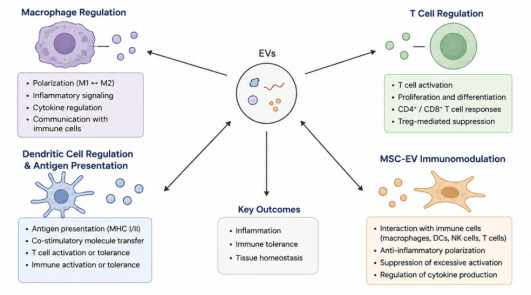
Extracellular vesicles (EVs) mediate immune regulation and inflammatory responses. EVs can modulate macrophage polarization, inflammatory signaling and cytokine secretion; regulate T cell activation, proliferation, differentiation, and Treg-mediated immunosuppression; participate in dendritic cell antigen presentation and co-stimulatory molecule transport to trigger T cell activation or immune tolerance. MSC-derived EVs act on multiple types of immune cells, inducing anti-inflammatory polarization and suppressing excessive immune activation. Collectively, they modulate inflammation levels, immune tolerance and tissue homeostasis.
1.5 Main Application Directions
EV Characterization → Immune Cell Uptake → Cellular Functional Response → Molecular Mechanism Dissection

The complete technical workflow for the study of EV-mediated immune regulation consists of four sequential stages: extracellular vesicle characterization, detection of vesicle uptake by immune cells, evaluation of cellular functional responses, and dissection of molecular mechanisms. This workflow enables systematic investigation into EV-mediated immune and inflammatory regulation.
Recommended Products:
Category | Product Name | Cat.No. | Specification | Key Application |
MSC-EV Research Reference Material | ContExo® High-Purity HuMSC Exosomes | CTE‑052 | 2E11 Particles/1 mL | For studies of MSC-EV immunomodulation, macrophage polarization and inflammation |
Isolation of Immune Cell-Derived EVs | Exosupur® Rapid Cell Supernatant Purification Kit | ESS0500 / ESS050 | 500 mL / 50 mL | Isolation and purification of EVs derived from T cells, macrophages, dendritic cells and other immune cells |
EV Characterization | ExosuperQC® Exosome 4-Positive-1-Negative WB Characterization Kit | EQC‑AP‑01 | 5T | Multi-marker EV characterization using CD9, CD63, CD81, ALIX and Calnexin |
MSC-EV Characterization | ExosuperQC® MSC-Specific Protein Exosome WB Characterization Kit | EQC‑SAP‑01 | 5T | Combined detection of CD13 and CD73 to verify MSC-derived EVs |
EV Fluorescent Tracing | FluoExo® Exosome Tracing Kit | FE‑01 / FE‑02 / FE‑03 Series | Green / Red / Near-Infrared | Investigation of EV uptake, intercellular trafficking and EV-immune cell interactions |
EV Cell Culture System | ExoCCM® Exosome-Free FBS | EDFBS50 / EDFBS5 | 50 mL / 5 mL | Reduce interference from exogenous EVs in immune cell and EV functional assays |