
info@mail.ucallm.com
1. Overview
Junin virus (JUNV) is a member of the genus Mammarenavirus within the family Arenaviridae and is the causative agent of Argentine hemorrhagic fever (AHF). It is an enveloped, negative-sense, single-stranded, bisegmented RNA virus with pleomorphic virions. JUNV was first discovered in 1958 in remote agricultural areas of Argentina and is a zoonotic virus endemic to South America, with its natural reservoir being Calomys rodents (primarily Calomys musculinus), widely distributed across the Pampas region of Argentina. JUNV belongs to clade B of the New World arenaviruses (NWAs) , along with Machupo virus (MACV), Guanarito virus (GTOV), and Sabia virus (SABV).
Argentine hemorrhagic fever is an endemic infectious disease of central Argentina with potentially lethal outcomes. Before the introduction of vaccination in 1990, up to 600 cases were diagnosed each year in the grassland areas of Argentina. The case fatality rate of untreated AHF can reach 30%. Currently, the Candid#1 live-attenuated vaccine is the primary preventive tool for high-risk populations in Argentina's national immunization program, but no specific antiviral drug is approved, and treatment relies primarily on supportive care and convalescent plasma.
2. Background Information
2.1 What is Junin Virus?
JUNV is an enveloped, negative-sense, single-stranded, bisegmented RNA virus belonging to the family Arenaviridae and genus Mammarenavirus. The genome consists of a large (L) segment (approximately 7.2 kb) and a small (S) segment (approximately 3.5 kb), both employing an ambisense coding strategy.
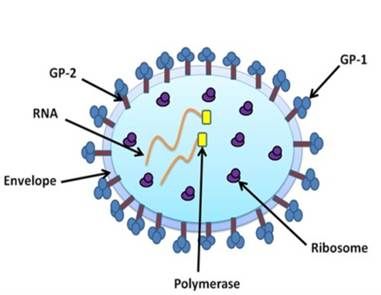
Structure of a JUNV particle (PMID: 23202466)
2.2 JUNV Genome & Classification
JUNV belongs to the genus Mammarenavirus in the family Arenaviridae, clade B of the New World arenaviruses. The genome is bisegmented negative-sense RNA; the L segment (7.2 kb) encodes Z and L proteins, and the S segment (3.5 kb) encodes GPC and NP proteins. Both segments employ an ambisense coding strategy, with each segment containing two open reading frames at opposite ends separated by an intergenic region.
2.3 What Are JUNV Proteins?
JUNV encodes four major viral proteins: GPC and NP from the S segment, and Z and L from the L segment.
Protein | Encoded by | Main Function |
GPC (Glycoprotein precursor) | S segment | Cleaved by host proteases to produce GP1, GP2, and SSP, forming the surface spike trimer |
NP (Nucleoprotein) | S segment | Binds viral RNA to form ribonucleoprotein complexes (RNPs) |
Z (Matrix protein) | L segment | Zinc-binding matrix protein; regulates viral RNA synthesis, mediates assembly and budding, antagonises interferon |
L (Large protein) | L segment | RNA-dependent RNA polymerase (RdRp); catalyses genome replication and transcription |
2.4 Mechanism of Cell Entry and Replication
JUNV, like other pathogenic New World arenaviruses, uses transferrin receptor 1 (TfR1) as its host cell receptor. Studies confirm that guinea pig TfR1 (gpTfR1) is the principal receptor for JUNV, whereas hamster and mouse TfR1 orthologs fail to support viral entry/infection. Use of human TfR1 (hTfR1) for host cell entry is a feature shared by pathogenic New World arenaviruses.
Viral entry: The virus enters cells via clathrin-mediated endocytosis. Endosomal acidification triggers pH-dependent conformational changes in the spike protein, exposing GP2 and mediating fusion of the virus with the host cell membrane.
Viral RNA replication: After RNP release into the cytoplasm, the L protein (RdRp) initiates genome transcription and replication. The Z protein regulates viral RNA synthesis as a switch via its interaction with the L protein. Replication occurs entirely in the host cell cytoplasm.
Viral assembly and release: The Z protein recruits RNPs to the cell membrane, and the virus acquires its envelope by budding from the host cell membrane, releasing new virions.
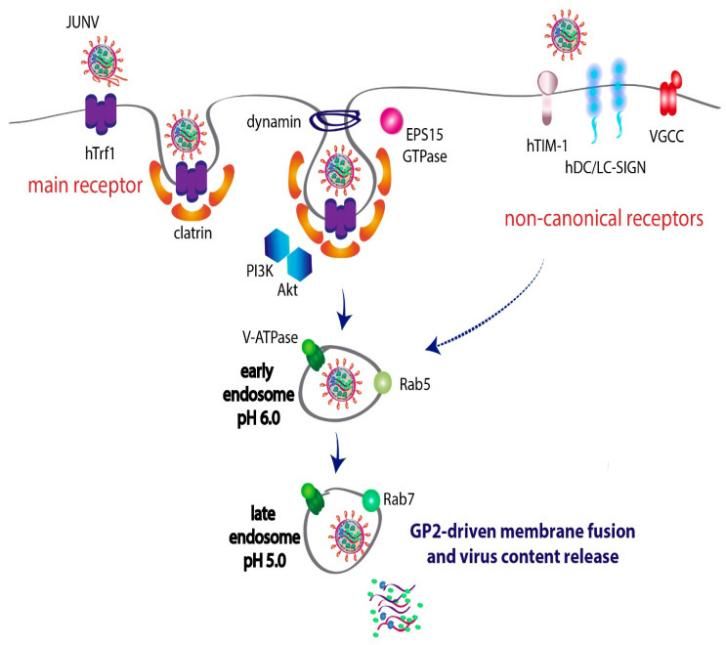
JUNV entry to the cell. (PMID: 35746604)
2.5 Symptoms and Treatment
2.5.1 Clinical Symptoms
The incubation period of AHF is typically 5–14 days, up to 21 days. Initial symptoms are similar to many infectious diseases and include fever, muscle aches and pains, fatigue, anorexia, chills, and headache. Approximately 20% of patients recover from the initial illness, while 80% progress to a haemorrhagic fever syndrome.
The prodromal phase lasts approximately 1 week and may include eye pain, conjunctivitis and periorbital oedema, dizziness, photosensitivity, constipation or mild diarrhoea, petechial rash, bleeding gums, swollen neck glands, and blistering rash in the mouth. 20%–30% of patients then progress to the neurological-haemorrhagic phase, with haemorrhagic manifestations ranging from petechiae, bruising, bleeding gums, nosebleeds, haematomas, gastrointestinal bleeding, vaginal bleeding, haemoptysis, and haematuria; neurological manifestations include confusion, tremors, seizures, and coma. The case fatality rate of untreated cases can reach 30%. In survivors, the convalescent phase can last for months, with possible generalised weakness, irritability, poor memory, and hair loss.
2.5.2 Antiviral Treatment
Currently, no specific antiviral drug is approved for JUNV. Treatment is primarily supportive, including fluid resuscitation, symptomatic treatment, and management of complications.
2.6 Targets for Intervention
2.6.1 Viral Targets
Target | Protein | Biological Role |
GPC | Glycoprotein precursor (GP1/GP2) | Receptor binding & membrane fusion |
L (RdRp) | RNA polymerase | RNA transcription & replication |
Z | Matrix protein | RNA synthesis regulation, assembly & budding |
NP | Nucleoprotein | RNP formation |
2.6.2 Host Receptors & Entry Factors
Host Target | Type | Role in Infection |
TfR1 (Transferrin receptor 1) | Receptor | Primary receptor for JUNV entry |
hDC-SIGN/L-SIGN | Lectin receptors | Mediate JUNV entry into host cells |
2.7 Vaccine Types and Development Progress
2.7.1 Candid#1 (Live-Attenuated Vaccine)
Candid#1 is a live-attenuated vaccine against JUNV, included in Argentina's national immunization program and recommended for individuals at risk of occupational exposure to JUNV (e.g., agricultural workers and laboratory personnel). It is the primary preventive tool for AHF. In 2025, the Córdoba Ministry of Health reiterated that the Candid#1 vaccine is the main preventive measure for those living or working in rural areas.
2.7.2 Novel Vaccine Candidate Based on Baculovirus Surface Display
A 2025 study published in Current Microbiology developed a novel vaccine candidate based on recombinant baculovirus (rBV) expressing JUNV GP1–GP2. Guinea pigs immunised with rBV and challenged with JUNV showed partial protection, compared with the Candid#1 vaccine.
2.7.3 Other Vaccine Directions
The Coalition for Epidemic Preparedness Innovations (CEPI) announced in 2023 that it is developing a novel JUNV vaccine.
2.8 Drugs
No JUNV-specific antiviral drug has been approved to date.
2.8.1 Virus-Targeted Drugs
Target | Drug/candidate | Mechanism | Stage |
GPC | J199 monoclonal antibody | nduces symmetric GPC reorientation, stabilises prefusion state, inhibits infection | Mouse model |
CR1-28 monoclonal antibody | Candid#1 vaccine-elicited neutralising antibody | In vitro | |
RNA synthesis | Ribavirin | Nucleoside analog, inhibits arenaviral RNA synthesis | Off-label use |
Viral entry | AJLec (galactose-specific lectin) | Inhibits JUNV propagation, dependent on galactose recognition | In vitro |
ST-193 / LHF-535 | Viral entry inhibitors | In vitro | |
Host target | A771726 (leflunomide active metabolite) | Host-targeted compound; combination with ribavirin shows significantly more potent antiviral activity | In vitro |
2.8.2 Host-Targeted Drugs
Target | Drug/candidate | Mechanism | Stage |
Pyrimidine synthesis | A771726 | Leflunomide active metabolite; combination with ribavirin shows synergistic antiviral activity | In vitro |
CRM1/XPO1 | CRM1 inhibitors | Broad-spectrum anti-arenaviral target | Screening studies |
2.9 Epidemiology
l First identified: 1958, remote agricultural areas of Argentina
l Geographic distribution: the Pampas region of Argentina, covering the provinces of Buenos Aires, Córdoba, Santa Fe, and La Pampa
l Natural reservoir: Calomys musculinus (corn mouse), living along the margins of cultivated fields
l Transmission routes:
Ø Animal to human: through mucosal exposure, aerosolised rodent excretions or secretions, or direct contact of broken skin with infectious material
Ø Human to human: very rare, may occur via direct contact with blood, tissues, or body fluids from an infected individual; nosocomial transmission has been documented
l Seasonality: human exposure most commonly occurs during the harvest season (April to July)
l 2025 outbreak data:
Ø As of 13 September 2025: 373 suspected cases, 49 confirmed cases, 3 deaths; confirmed cases reported in Buenos Aires, Córdoba, and Santa Fe
Ø Buenos Aires Province (as of 27 July 2025): 15 confirmed cases, 106 suspected cases, 1 death
Ø Buenos Aires Province (1 January to 31 May 2025): 13 confirmed cases, 87 suspected cases
Ø Buenos Aires Province (full year 2025): 238 suspected cases, 13 confirmed, 174 discarded, 51 under investigation
l Trend: Confirmed cases in Argentina in 2022 were approximately three times the number five years earlier; in 2024 and 2025, the disease caused new outbreaks with at least 9 deaths
2.10 Diagnosis
Diagnosis of JUNV infection relies on laboratory testing:
l Virus isolation: isolation of JUNV from clinical material (requires high-containment laboratory)
l Nucleic acid testing (NAT) : detection of JUNV RNA in clinical material (RT-PCR)
l Serology: detection of seroconversion or four-fold or greater rise in JUNV-specific IgM/IgG titres (ELISA)
2.11 Prevention
l Vaccination: the Candid#1 live-attenuated vaccine is the primary preventive tool for AHF, included in Argentina's national immunization program and recommended for high-risk occupational groups (agricultural workers, laboratory personnel)
l Avoid contact: avoid contact with rodent excretions and secretions; take protective measures during agricultural activities in endemic areas
l Avoid person-to-person contact: avoid contact with blood and other body fluids of infected individuals
l Rodent control: reduce Calomys rodent habitats and prevent their entry into residential areas
l Surveillance and reporting: strengthen AHF case surveillance and reporting for timely outbreak detection
3. Related Products & Services
l Recombinant Antigens & Receptors
l Antibodies
l Detection Kits
l Recombinant Protein Expression Services
l Antibody Development Services
4. Resources
5. References
1. Radoshitzky, S. R., Abraham, J., Spiropoulou, C. F., et al. (2007). Transferrin receptor 1 is a cellular receptor for New World haemorrhagic fever arenaviruses. Nature, 446(7131), 92–96.
2. Sarute, N., Ross, S. R. (2017). New World Arenavirus Biology. Annual review of virology, 4(1), 141–158.
3. Grant, A., Seregin, A., Huang, C., et al. (2012). Junín virus pathogenesis and virus replication. Viruses, 4(10), 2317–2339.
4. Gallo, G. L., López, N., Loureiro, M. E. (2022). The Virus-Host Interplay in Junín Mammarenavirus Infection. Viruses, 14(6), 1134.
5. Kumar, S., Yadav, D., Singh, D., et al. (2023). Recent developments on Junin virus, a causative agent for Argentine haemorrhagic fever. Reviews in medical virology, 33(2), e2419.
6. Lendino, A., Castellanos, A. A., Pigott, D. M., et al. (2024). A review of emerging health threats from zoonotic New World mammarenaviruses. BMC microbiology, 24(1), 115.
7. Tapia-Ramírez, G., Lorenzo, C., Navarrete, D., et al. (2022). A Review of Mammarenaviruses and Rodent Reservoirs in the Americas. EcoHealth, 19(1), 22–39.
8. Maiztegui, J. I., McKee, K. T., Jr, Barrera Oro, J. G., et al. (1998). Protective efficacy of a live attenuated vaccine against Argentine hemorrhagic fever. AHF Study Group. The Journal of infectious diseases, 177(2), 277–283.
9. Droniou-Bonzom, M. E., Reignier, T., Oldenburg, J. E., et al. (2011). Substitutions in the glycoprotein (GP) of the Candid#1 vaccine strain of Junin virus increase dependence on human transferrin receptor 1 for entry and destabilize the metastable conformation of GP. Journal of virology, 85(24), 13457–13462.
10. Tomatis, C., Aguiar, M. C. A. M., Charo, N., et al. (2025). A New Vaccine Candidate Expressing JUNV GP1-GP2 Against Argentine Hemorrhagic Fever Based on Baculovirus Surface Display. Current microbiology, 82(8), 334.
11. Taylor, L. J., Sawaya, M. R., Westover, J. B., et al. (2025). In situ insights into antibody-mediated neutralization of a pre-fusion Junin virus glycoprotein complex. Cell reports, 44(7), 115971.
12. Westover, J. B., Bailey, K. W., Wasson, S. R., et al. (2024). Coadministration of LHF-535 and favipiravir protects against experimental Junín virus infection and disease. Antiviral research, 229, 105952.
13. Lozano, M. E., Enría, D., Maiztegui, J. I., et al. (1995). Rapid diagnosis of Argentine hemorrhagic fever by reverse transcriptase PCR-based assay. Journal of clinical microbiology, 33(5), 1327–1332.
14. Martinez, M. G., Bialecki, M. A., Belouzard, S., et al. (2013). Utilization of human DC-SIGN and L-SIGN for entry and infection of host cells by the New World arenavirus, Junín virus. Biochemical and biophysical research communications, 441(3), 612–617.
15. Enria, D. A., Briggiler, A. M., Feuillade, M. R. (1998). An overview of the epidemiological, ecological and preventive hallmarks of Argentine haemorrhagic fever (Junin virus). Research in Virology, 149/96(2), 103–114.