
info@mail.ucallm.com
1. Overview
Machupo virus (MACV) is a member of the genus Mammarenavirus within the family Arenaviridae and is the causative agent of Bolivian Hemorrhagic Fever (BHF) . It is an enveloped, negative-sense, single-stranded, bisegmented RNA virus with pleomorphic virions.
MACV was first discovered in 1959 during an outbreak in San Joaquin, Bolivia. It is a zoonotic virus endemic to South America, with its natural reservoir being the large vesper mouse (Calomys callosus) , widely distributed across the Beni Department plains of Bolivia. MACV belongs to clade B of the New World arenaviruses (NWAs) , along with Junin virus (JUNV), Guanarito virus (GTOV), and Sabia virus (SABV). MACV can cause severe hemorrhagic fever in humans, with a case fatality rate of 25%–35%. Currently, no licensed MACV vaccine or specific antiviral drug is available, and treatment relies primarily on supportive care and ribavirin.
2. Background Information
2.1 What is Machupo Virus?
MACV is an enveloped, negative-sense, single-stranded, bisegmented RNA virus belonging to the family Arenaviridae and genus Mammarenavirus. The genome consists of a large (L) segment (approximately 7.2 kb) and a small (S) segment (approximately 3.4 kb), both employing an ambisense coding strategy.
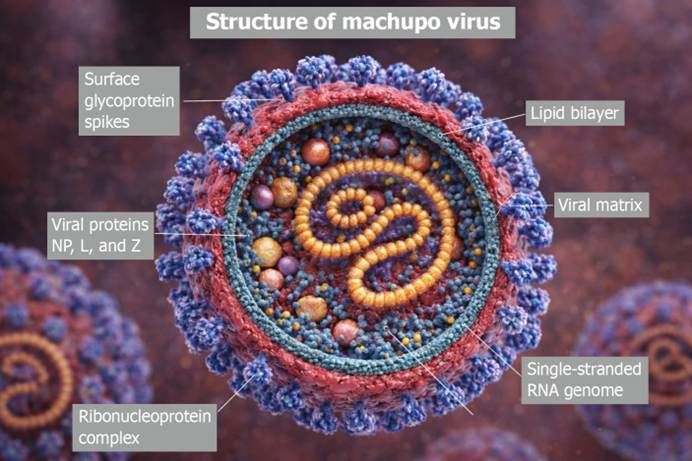
Structure of Machupo virus (PMID: 42395044)
2.2 Machupo Virus Genome & Classification
MACV belongs to the genus Mammarenavirus in the family Arenaviridae, clade B of the New World arenaviruses. The genome is bisegmented negative-sense RNA; the L segment (7.2 kb) encodes Z and L proteins, and the S segment (3.4 kb) encodes GPC and NP proteins. Both segments employ an ambisense coding strategy, with each segment containing two open reading frames at opposite ends separated by an intergenic region.
2.3 What Are Machupo Virus Structural Proteins?
MACV encodes four structural proteins: GPC and NP from the S segment, and Z and L from the L segment.
Protein | Encoded by | Main Function |
GPC (Glycoprotein precursor) | S segment | Cleaved by host proteases to produce GP1, GP2, and SSP, forming the surface spike trimer |
NP (Nucleoprotein) | S segment | Binds viral RNA to form ribonucleoprotein complexes (RNPs) |
Z (Matrix protein) | L segment | Zinc-binding matrix protein; regulates viral RNA synthesis, mediates assembly and budding, antagonises interferon |
L (Large protein) | L segment | RNA-dependent RNA polymerase (RdRp); catalyses genome replication and transcription |
2.4 Mechanism of Cell Entry and Replication
2.4.1 Viral Attachment and Receptor Recognition
MACV infection begins with the binding of the viral GP1 protein to human transferrin receptor 1 (hTfR1) on the host cell surface. hTfR1 is the principal entry receptor shared by pathogenic New World arenaviruses.
2.4.2 Viral Entry
The virus enters host cells via clathrin-mediated endocytosis. Endosomal acidification triggers pH-dependent conformational changes in the spike protein, exposing GP2 and mediating fusion of the viral envelope with the endosomal membrane, releasing the viral RNP into the cytoplasm.
2.4.3 Viral RNA Replication
After RNP release into the cytoplasm, the L protein (RdRp) initiates genome transcription and replication. The L protein employs a cap-snatching mechanism to cleave the 5′ cap structure from host mRNAs for use in viral mRNA capping. The Z protein regulates viral RNA synthesis as a switch via its interaction with the L protein. Replication occurs entirely in the host cell cytoplasm.
2.4.4 Viral Assembly and Release
The Z protein recruits RNPs to the cell membrane, and the virus acquires its envelope by budding from the host cell membrane, releasing new virions.
2.5 Symptoms and Treatment
2.5.1 Clinical Symptoms
The incubation period of BHF is typically 7–14 days. Initial symptoms are non-specific and include fever, headache, myalgia, anorexia, chills, and fatigue. The illness can progress to severe haemorrhagic manifestations including epistaxis and haematemesis, as well as neurological signs such as tremors and convulsions. The case fatality rate is approximately 5%–30%.
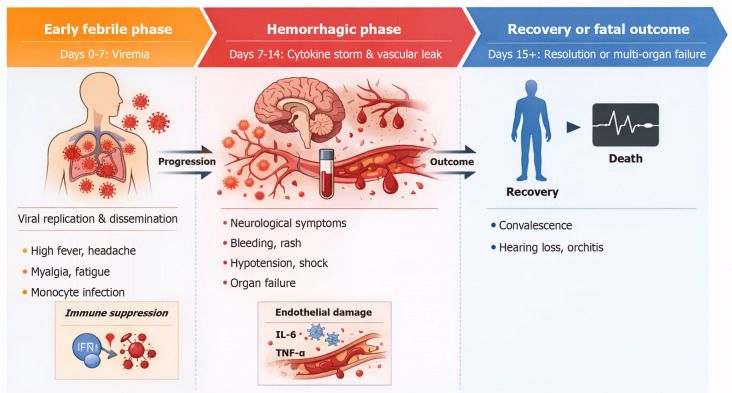
Pathogenesis and clinical progression of Machupo virus infection (PMID: 42395044)
2.5.2 Antiviral Treatment
Currently, no specific antiviral drug is approved for MACV. Treatment is primarily supportive. Ribavirin is the primary antiviral treatment for BHF, and early administration is most effective.
2.6 Targets for Intervention
2.6.1 Viral Targets
Target | Protein | Biological Role |
GPC | Glycoprotein precursor (GP1/GP2) | Receptor binding & membrane fusion |
L (RdRp) | RNA polymerase | RNA transcription & replication |
L (endonuclease) | Cap-dependent endonuclease | Cap-snatching, mRNA capping |
Z | Matrix protein | RNA synthesis regulation, assembly & budding |
2.6.2 Host Receptors & Entry Factors
Host Target | Type | Role in Infection |
hTfR1 (Human transferrin receptor 1) | Receptor | Primary receptor for MACV entry |
2.7 Vaccine Types and Development Progress
Currently, no MACV vaccine is licensed worldwide. Several vaccine candidates are in development.
2.7.1 Immunoinformatics-Driven Multi-Epitope Vaccine
A 2025 study published in Molecular Diversity used immunoinformatics approaches to design a MACV multi-epitope vaccine candidate that can be tested in the lab to evaluate its effectiveness as a preventative measure for BHF.
2.7.2 MOPEVAC Multivalent Vaccine Platform
Institut Pasteur has developed a multivalent immunogenic composition based on the MOPEVAC platform for vaccination against New World arenaviruses (including MACV, SABV, CHAPV, JUNV, and GTOV).
2.7.3 mRNA-LNP Vaccine
The mRNA-LNP vaccine platform has shown promise in MACV vaccine development; this is the first description of any mRNA-LNP vaccine for MACV.
2.8 Drugs
Currently, no specific small-molecule antiviral is approved for MACV.
2.8.1 Virus-Targeted Drugs
Target/mechanism | Drug/candidate | Mechanism | Stage |
L endonuclease | BW-148 | Metal chelation inhibiting endonuclease activity | In vitro |
GP1-hTfR1 interface | Compound 22f | Submicromolar inhibition of JUNV replication, pan-arenavirus activity | In vitro & mouse model |
Viral entry | 18N18 (VHH antibody) | Targets hTfR1 apical domain, blocks GP1 binding | In vitro |
2.8.2 Host-Targeted Drugs
Target | Drug/candidate | Mechanism | Stage |
hTfR1 | 18N18 (VHH antibody) | Blocks hTfR1-GP1 interaction | In vitro |
2.9 Epidemiology
l First identified: 1959, San Joaquin, Bolivia
l Geographic distribution: Beni Department plains, Bolivia
l Natural reservoir: Large vesper mouse (Calomys callosus)
l Transmission routes: primarily via contact with or inhalation of aerosols from the excreta of infected rodents
l Case fatality rate: 25%–35%
l 2025 surveillance data: CDC ArboNET lists MACV as a notifiable disease for surveillance in the United States
2.10 Diagnosis
Diagnosis of MACV infection relies on laboratory testing (requires BSL-4 containment):
l Virus isolation: isolation of MACV from clinical material
l Nucleic acid testing (NAT) : detection of MACV RNA in clinical material (RT-PCR)
l Serology: detection of seroconversion or four-fold or greater rise in MACV-specific IgM/IgG titres (antigen-capture ELISA or serological methods)
2.11 Prevention
l Vaccination: no licensed MACV vaccine is currently available
l Rodent control: reduce Calomys callosus habitats and prevent their entry into residential areas
l Food safety: store food safely to prevent rodent contamination
l Personal protective measures: use personal protective equipment (PPE) to prevent nosocomial transmission
l Surveillance and reporting: strengthen BHF case surveillance and reporting
3. Related Products & Services
l Recombinant Antigens & Receptors
l Antibodies
l Detection Kits
l Recombinant Protein Expression Services
l Antibody Development Services
4. Resources
5. References
1. Radoshitzky, S. R., Abraham, J., Spiropoulou, C. F., et al. (2007). Transferrin receptor 1 is a cellular receptor for New World haemorrhagic fever arenaviruses. Nature, 446(7131), 92–96.
2. Sarute, N., Ross, S. R. (2017). New World Arenavirus Biology. Annual review of virology, 4(1), 141–158.
3. Lendino, A., Castellanos, A. A., Pigott, D. M., et al. (2024). A review of emerging health threats from zoonotic New World mammarenaviruses. BMC microbiology, 24(1), 115.
4. Tapia-Ramírez, G., Lorenzo, C., Navarrete, D., et al. (2022). A Review of Mammarenaviruses and Rodent Reservoirs in the Americas. EcoHealth, 19(1), 22–39.
5. Mann, C. J., Yang, P., Olal, D., et al. (2025). Molecular organization of the New World arenavirus spike glycoprotein complex. Nature microbiology, 10(9), 2207–2220.
6. Pyle, J. D., Whelan, S. P. J. (2021). Isolation of Reconstructed Functional Ribonucleoprotein Complexes of Machupo Virus. Journal of virology, 95(22), e0105421.
7. Radoshitzky, S. R., Longobardi, L. E., Kuhn, J. H., et al. (2011). Machupo virus glycoprotein determinants for human transferrin receptor 1 binding and cell entry. PloS one, 6(7), e21398.
8. Kang, Q., Li, G., Wu, Y., et al. (2024). A hTfR1 Receptor-Specific VHH Antibody Neutralizes Pseudoviruses Expressing Glycoproteins from Junín and Machupo Viruses. Viruses, 16(12), 1951.
9. Radoshitzky, S. R., Kuhn, J. H., de Kok-Mercado, F., et al. (2012). Drug discovery technologies and strategies for Machupo virus and other New World arenaviruses. Expert opinion on drug discovery, 7(7), 613–632.
10. Wasson, S. R., Flude, B. M., Salerno, M., et al. (2026). Computer-Aided Discovery of Small-Molecule Inhibitors of Pathogenic New World Arenavirus Entry and Replication. ACS infectious diseases, 12(6), 2046–2059.
11. Peter, A. S., Hoffmann, D. S., Klier, J., et al. (2024). Strategies of rational and structure-driven vaccine design for Arenaviruses. Infection, genetics and evolution : journal of molecular epidemiology and evolutionary genetics in infectious diseases, 123, 105626.
12. Erickson, R., Muramatsu, H., Tiwari, S., et al. (2026). Comparison of Vaccine Platforms for Machupo Virus. Vaccines, 14(4), 315.
13. Uppala, P. K., Karanam, S. K., Kandra, N. V., et al. (2026). Understanding machupo virus: A neglected arenavirus with global health importance. World journal of virology, 15(2), 119515.