
info@mail.ucallm.com
1. Overview
Mojiang henipavirus (MojV) is a member of the genus Henipavirus within the family Paramyxoviridae and is a novel zoonotic virus discovered in 2012 in Mojiang Hani Autonomous County, Yunnan Province, China. It is an enveloped, negative-sense, single-stranded, non-segmented RNA virus with pleomorphic virions.
The discovery of MojV originated from a cluster of unexplained fatal pneumonia cases. In June 2012, three miners working in an abandoned copper mine died from severe pneumonia. Through virome analysis of bat, rat, and musk shrew samples from the mine cave, researchers detected a novel paramyxovirus closely related to henipaviruses in yellow-bellied rats (Rattus flavipectus) , named Mojiang virus. MojV is the first henipavirus identified in rodents, with its natural reservoir being Rattus flavipectus. MojV belongs to the genus Henipavirus along with Nipah virus (NiV) and Hendra virus (HeV) and is classified as a Biosafety Level 4 (BSL-4) virus. Currently, no specific vaccine or antiviral drug is approved for MojV.
2. Background Information
2.1 What is Mojiang Virus?
MojV is an enveloped, negative-sense, single-stranded, non-segmented RNA virus belonging to the family Paramyxoviridae and genus Henipavirus. Its genome is approximately 18 kb and follows the canonical henipavirus genome organization 3′-N-P/V/W/C-M-F-G-L-5′. The genome encodes six major structural proteins:
Protein | Full name | Main Function |
N | Nucleocapsid protein | Encapsidates the viral RNA genome, forming ribonucleoprotein complexes (RNPs) |
P/V/W/C | Phosphoprotein | Polymerase cofactor, involved in viral transcription and replication |
M | Matrix protein | Inner envelope protein, mediates viral assembly and budding |
F | Fusion protein | Class I fusion protein, mediates fusion of the viral envelope with the host cell membrane |
G | Attachment glycoprotein | Mediates viral binding to host cell receptors; primary target of neutralizing antibodies |
L | Large protein | RNA-dependent RNA polymerase (RdRp), catalyses viral genome replication and transcription |

Genomic organization of Mojiang paramyxovirus (PMID: 24865545)
2.2 Mojiang Virus Genome & Classification
The MojV genome is approximately 18 kb, encoding six structural proteins, with a genome organization highly similar to henipaviruses. MojV belongs to the genus Henipavirus within the family Paramyxoviridae. Phylogenetic analysis indicates that MojV forms a distinct lineage within the genus Henipavirus, more distantly related to NiV and HeV. The International Committee on Taxonomy of Viruses (ICTV) classifies MojV within the genus Henipavirus, with the scientific name Parahenipavirus mojiangense.
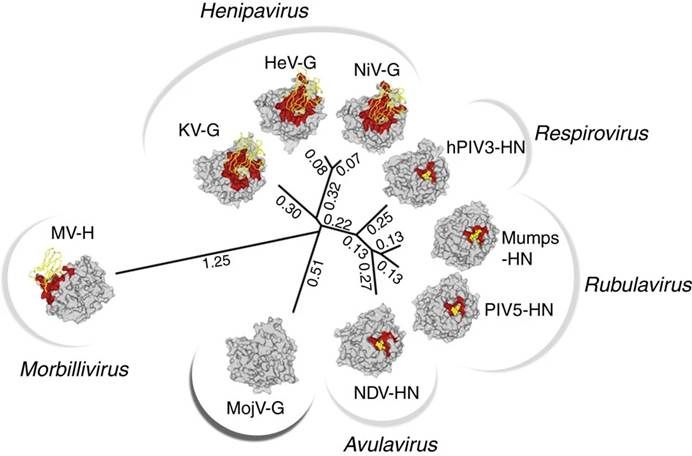
A structure-based phylogeny of paramyxoviral receptor binding proteins, produced using SHP software. (PMID: 28699636)
2.3 What Are Mojiang Virus Structural Proteins?
MojV encodes six major structural proteins, among which the G and F proteins play key roles in viral entry.
2.3.1 Attachment Glycoprotein G
MojV-G is the attachment glycoprotein on the viral surface, responsible for recognizing and binding host cell receptors. Unlike NiV and HeV, MojV-G lacks the conserved ephrin receptor-binding motif and cannot interact with known paramyxoviral receptors such as ephrin-B2/B3, sialic acid, or CD150. A 2017 study published in Nature Communications resolved the crystal structure of MojV-G, revealing a unique six-bladed β-propeller fold with limited similarity to known paramyxoviral attachment glycoproteins, particularly at host receptor-binding surfaces. MojV-G is also antigenically distinct from NiV and HeV, suggesting that MojV would less likely be detected in existing large-scale serological screening studies focused on well-established HNVs.
2.3.2 Fusion Protein F
MojV-F is a class I fusion protein that mediates fusion of the viral envelope with the host cell membrane. Its prefusion conformation structure has been resolved by cryo-EM at 2.66 Å resolution (EMD-29300). MojV-F shares some structural similarity with NiV-F and HeV-F but is antigenically distinct.
2.4 Mechanism of Cell Entry and Replication
2.4.1 Viral Attachment and Receptor Recognition
MojV cell entry is mediated by the cooperative action of the attachment glycoprotein G and the fusion protein F. MojV-G cannot bind the ephrin-B2/B3 receptors used by NiV and HeV, nor does it rely on sialic acid or CD150-mediated entry pathways. A 2026 computational study showed that MojV-G exhibits the strongest binding affinity for ephrin-A5 (binding free energy approximately −93.81 kcal/mol), suggesting that class A ephrins may serve as alternative receptors for MojV, potentially expanding its host range and pathogenic capabilities. The unique six-bladed β-propeller structure of MojV-G sterically hinders interaction with ephrin-B2/B3.
2.4.2 Viral Entry
MojV utilizes a host-cell entry pathway distinct from genetically related henipaviruses. Receptor binding by the G protein triggers conformational changes in the F protein, mediating fusion of the viral envelope with the host cell membrane. Due to the antigenic uniqueness of MojV-G and F proteins, NiV/HeV-elicited antibodies do not cross-react with them.
2.4.3 Viral RNA Replication
After release of the viral RNP into the cytoplasm, the L protein (RdRp) and its cofactor P protein initiate genome transcription and replication. MojV has a pattern of replication similar to other henipaviruses, with a 6-gene RNA genome. Replication occurs entirely in the host cell cytoplasm.
2.4.4 Viral Assembly and Release
Newly synthesized N protein associates with progeny genomic RNA to form RNPs. The M protein recruits RNPs to the cell membrane, and the virus acquires its envelope by budding from the host cell membrane, releasing new virions.
2.5 Symptoms and Treatment
2.5.1 Clinical Symptoms
The clinical characteristics of MojV are not fully defined. In the initial cluster, three miners presented with severe pneumonia and all died. Since human infection with MojV has not been formally confirmed, the full clinical spectrum is still under investigation. Based on its genetic relationship with NiV and HeV, MojV may cause respiratory and neurological symptoms.
2.5.2 Antiviral Treatment
Currently, no specific antiviral therapy is approved for MojV. Treatment is primarily supportive, including rest, hydration, and medication to alleviate symptoms such as fever and pain. Ribavirin has been utilized as a compassionate-use medication, but its efficacy has not been established. Due to significant antigenic differences between MojV and NiV/HeV, vaccines or antibody therapies developed against NiV/HeV may be ineffective against MojV. Therefore, tailored antiviral research is urgently needed.
2.6 Targets for Intervention
2.6.1 Viral Targets
Target | Protein | Biological Role |
G | Attachment glycoprotein | Receptor binding |
F | Fusion protein | Membrane fusion |
N | Nucleoprotein | RNP formation, genome packaging |
L | RNA polymerase | RNA replication |
2.6.2 Host Receptors & Entry Factors
Host Target | Type | Role in Infection |
ephrin-A5 (putative) | Receptor | Computational study suggests alternative receptor for MojV with strongest binding affinity (~−93.81 kcal/mol) |
Unknown receptor | Receptor | MojV uses a different unknown receptor from NiV/HeV for host cell entry |
2.6.3 Host Signaling Pathways
Pathway | Key Targets | Biological Role |
Innate immune pathway | — | potentially suppresses host innate immune responses |
2.7 Vaccine Types and Development Progress
Currently, no MojV vaccine is licensed worldwide. Vaccine development faces significant challenges, as MojV-G and F proteins are antigenically distinct from NiV/HeV, and existing candidate vaccines targeting NiV/HeV are unlikely to provide cross-protection.
2.7.1 mRNA Vaccine (Heterologous Sequential Vaccination)
A 2026 study published in Viruses evaluated a heterologous sequential mRNA vaccination strategy using mRNA vaccines encoding the G proteins of multiple henipaviruses (including NiV, HeV, Ghana virus, LayV, and MojV). This strategy induced broad binding and neutralizing antibody responses against diverse henipaviruses in Indian rhesus macaques. The study emphasized the need for broadly protective countermeasures.
2.7.2 Multi-Epitope Vaccine (Immunoinformatics Design)
A 2026 study used immunoinformatics approaches to analyze epitopes of the MojV-G protein, identifying four high-scoring epitopes as promising candidates for multi-epitope vaccines, improved diagnostics, and cross-henipavirus research.
2.7.3 Other Vaccine Directions
Given the high sequence identity between MojV-G and LayV-G (approximately 86%), vaccine strategies targeting LayV may provide a reference for MojV vaccine development. However, existing evidence indicates that the G proteins of both MojV and LayV are antigenically distinct from NiV/HeV, suggesting the need for vaccines specifically targeting parahenipaviruses.
2.8 Drugs
Currently, no specific small-molecule antiviral is approved for MojV.
2.8.1 Virus-Targeted Drugs
Target/mechanism | Drug/candidate | Mechanism | Stage |
Broad-spectrum antiviral | Remdesivir | RdRp inhibition | Mentioned in reviews as a potential therapeutic strategy |
Ribavirin | Broad-spectrum antiviral | Compassionate use |
2.8.2 Host-Targeted Drugs
No host-targeted drugs for MojV have entered clinical research.
2.8.3 Drugs with Unclear or Non-Specific Targets
No drugs with unclear or non-specific mechanisms have entered clinical research for MojV.
2.9 Epidemiology
l First identified: 2012, Mojiang Hani Autonomous County, Yunnan Province, China
l Discovery context: Three miners died from unexplained severe pneumonia; the virus was detected in Rattus flavipectus rats in the mine cave
l Natural reservoir: Yellow-bellied rat (Rattus flavipectus)
l Geographic distribution: Mojiang Hani Autonomous County, Yunnan Province, China; in 2025, a putative henipavirus closely related to MojV and LayV was detected in shrews (Crocidura mariquensis) in South Africa, with amino acid sequence identity of 83%–86%, suggesting a potentially wider host and geographic distribution
l Human infection: Not formally confirmed; the three miners in the initial cluster died, but whether MojV was the direct causative agent remains unclear
l Public health risk: MojV currently poses a low risk to public health, but due to its structural similarities to LayV and insufficient data on its potential host range, the degree of uncertainty remains high
l 2025 research: A study on insectivore viromes in southwestern China observed host jumping in 11 viruses, including potential pathogenic viruses related to Mojiang paramyxovirus
l European surveillance project: A project named "Henipa-ECO" (2025) is underway in France to investigate the circulation of parahenipaviruses in shrews and their zoonotic potential
2.10 Diagnosis
Diagnosis of MojV infection relies on laboratory testing. Currently, no specific diagnostic tools exist for MojV.
2.10.1 Nucleic Acid Testing
l Quadruple real-time fluorescence-based quantitative RT-PCR: A quadruple real-time fluorescence-based quantitative RT-PCR assay has been developed for simultaneous detection of LayV, MojV, NiV, and CedV
l RT-RPA/RAA: A dual real-time fluorescence reverse transcription-recombinase polymerase amplification/recombinase-aided amplification assay has been established for rapid and accurate discrimination of NiV, LayV, MojV, and CedV; it is simple, rapid, and does not require complex equipment, making it especially suitable for point-of-care diagnosis
2.10.2 Serology
Indirect ELISA methods based on NiV and LayV proteins can be used to detect antibodies in animals, but the antigenic uniqueness of MojV-G may result in low serological cross-reactivity, and existing large-scale serological screening methods may fail to detect MojV.
2.11 Prevention
l Vaccination: no licensed MojV vaccine is currently available
l Avoid contact: avoid unnecessary contact or interaction with wild animals, especially wild rodents (Rattus flavipectus); wash hands often with soap and water after being around animals
l Personal protective measures: wear appropriate personal protective equipment (PPE) and face masks when potential contact with wildlife may occur
l One Health strategy: strengthen animal-human interface surveillance based on the One Health framework for early detection of novel zoonotic viruses
l Surveillance and reporting: strengthen surveillance and reporting of MojV and related parahenipaviruses, and conduct active surveillance worldwide in an open and collaborative manner to reduce the likelihood of this new virus causing a health crisis
3. Related Products & Services
l Recombinant Antigens & Receptors
l Antibodies
l Detection Kits
l Recombinant Protein Expression Services
l Antibody Development Services
4. Resources
5. References
1. Wu, Z., Yang, L., Yang, F., et al. (2014). Novel Henipa-like virus, Mojiang Paramyxovirus, in rats, China, 2012. Emerging infectious diseases, 20(6), 1064–1066.
2. Rissanen, I., Ahmed, A. A., Azarm, K.,et al. (2017). Idiosyncratic Mòjiāng virus attachment glycoprotein directs a host-cell entry pathway distinct from genetically related henipaviruses. Nature communications, 8, 16060.
3. McLinton, E. C., Wagstaff, K. M., Lee, A., et al. (2017). Nuclear localization and secretion competence are conserved among henipavirus matrix proteins. The Journal of general virology, 98(4), 563–576.
4. Cheliout Da Silva, S., Yan, L., Dang, H. V., et al. (2021). Functional Analysis of the Fusion and Attachment Glycoproteins of Mojiang Henipavirus. Viruses, 13(3), 517.
5. Kaza, B., Aguilar, H. C. (2023). Pathogenicity and virulence of henipaviruses. Virulence, 14(1), 2273684.
6. Isaacs, A., Low, Y. S., Macauslane, K. L., et al. (2023). Structure and antigenicity of divergent Henipavirus fusion glycoproteins. Nature communications, 14(1), 3577.
7. Meier, K., Olejnik, J., Hume, A. J., et al. (2024). A Comparative Assessment of the Pathogenic Potential of Newly Discovered Henipaviruses. Pathogens (Basel, Switzerland), 13(7), 587.
8. Spengler, J. R., Lo, M. K., Welch, S. R., et al. (2025). Henipaviruses: epidemiology, ecology, disease, and the development of vaccines and therapeutics. Clinical microbiology reviews, 38(1), e0012823.
9. He, W., Ma, T., Wang, Y., et al. (2024). Development and evaluation of a quadruple real-time fluorescence-based quantitative reverse transcription polymerase chain reaction assay for detecting Langya, Mojiang, Nipah, and Cedar viruses. Biosafety and health, 6(2), 80–87.
10. Yang, J. H., Luo, C. F., Xiang, R., et al. (2025). Host taxonomy and environment shapes insectivore viromes and viral spillover risks in Southwestern China. Microbiome, 13(1), 122.
11. Tripp, M. N., Rawlinson, S. M., Edwards, S. J., et al. (2025). The intracellular virus-host interface of henipaviruses. Journal of virology, 99(8), e0077025.
12. Navaratnarajah, C. K., Cattaneo, R. (2025). Trafficking and Activation of Henipavirus, Parahenipavirus, and Henipa-like Virus Fusion Proteins. Viruses, 17(6), 866.
13. Voigt, T. B., Ghosh, N., Rosen, B. C., et al. (2026). Heterologous Sequential mRNA Vaccination of Indian Rhesus Macaques Elicits Broad Binding and Neutralizing Antibody Responses Against Diverse Henipaviruses. Viruses, 18(5), 487.
14. Samia, P. T., Norine, D. (2026). An in silico exploration of class A ephrins as alternative receptors for Mojiang and Langya viruses: Insights into emerging Henipavirus entry mechanisms. In Silico Research in Biomedicine, 2, 100317.
15. International Committee on Taxonomy of Viruses (ICTV). Genus: Parahenipavirus / Paramyxoviridae taxonomy.