
info@mail.ucallm.com
1. Overview
Monkeypox virus (MPXV) is a significant member of the genus Orthopoxvirus within the family Poxviridae and is the causative agent of mpox (formerly known as monkeypox). It is an enveloped, linear double-stranded DNA virus with a brick-shaped or ovoid virion, approximately 200–250 nm in size.
MPXV was first isolated in 1958 from cynomolgus macaques shipped from Singapore to Copenhagen, Denmark. The first human case was reported in 1970 in the Democratic Republic of the Congo (DRC). For decades thereafter, mpox remained largely confined to sporadic outbreaks in Central and West African countries. In 2022, MPXV triggered an unprecedented global outbreak, prompting the World Health Organization (WHO) to declare a Public Health Emergency of International Concern (PHEIC) on 23 July 2022. In August 2024, a surge in clade I infections in Central Africa and the emergence of a new clade Ib prompted a second PHEIC declaration. In September 2025, following sustained declines in reported cases across affected countries in Central and East Africa, the WHO announced that mpox no longer constituted a PHEIC. As of 2025, mpox transmission remains a public health concern, particularly in the African Region.
MPXV shares close virological and genetic similarities with other orthopoxviruses, including variola virus (smallpox), vaccinia virus, and cowpox virus.
2. Background Information
2.1 What is Monkeypox Virus?
Monkeypox virus is an enveloped, linear double-stranded DNA virus belonging to the family Poxviridae and genus Orthopoxvirus. The virion is brick-shaped or ovoid, approximately 200–250 nm in size, with a complex internal structure including a core, lateral bodies, and an envelope.
The MPXV genome is a linear double-stranded DNA of approximately 197 kb, one of the largest viral genomes known. The central genomic region encodes conserved enzymes and structural proteins essential for viral replication and assembly, while the terminal regions contain genes involved in host range, virulence, and immune modulation. The MPXV genome exhibits clade-specific plasticity, with variations in genes such as OPG065 and MOPICE driving differences in virulence, immune evasion, and host adaptation. Phylogenomic analysis has identified 24 MPXV proteins that are particularly mutation-prone.
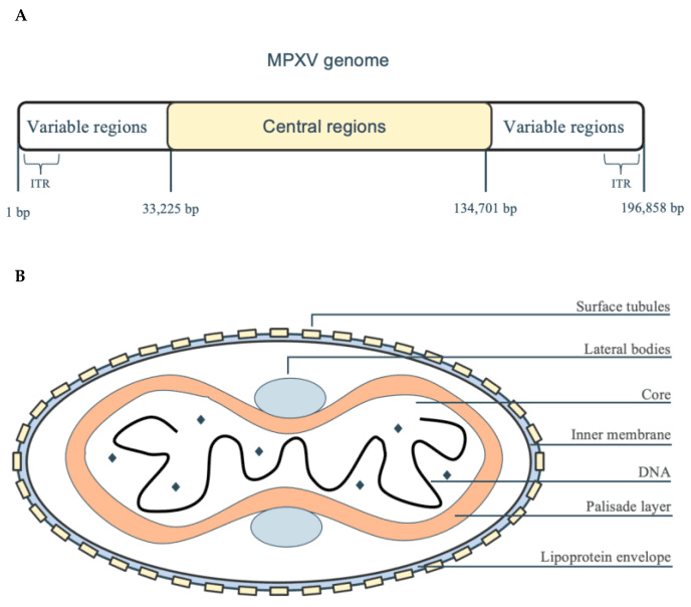
Monkeypox Virus genome and structure (PMID: 41012622)
2.2 Monkeypox Virus Genome & Classification
The MPXV genome is a linear double-stranded DNA of approximately 197 kb, one of the largest viral genomes known. The central genomic region encodes conserved enzymes and structural proteins essential for viral replication and assembly, while the terminal regions contain genes involved in host range, virulence, and immune modulation. The MPXV genome exhibits clade-specific plasticity, with variations in genes such as OPG065 and MOPICE driving differences in virulence, immune evasion, and host adaptation. Phylogenomic analysis has identified 24 MPXV proteins that are particularly mutation-prone.
MPXV exists in two major genetic clades:
l Clade I (Central African clade): historically associated with more severe disease, predominantly detected in Central and East Africa
l Clade II (West African clade): historically associated with milder disease, with clade IIb driving the 2022 global outbreak
In 2024, a novel clade Ib emerged in Central Africa, triggering a renewed public health emergency.
2.3 What Are Monkeypox Virus Structural Proteins?
MPXV encodes over 200 proteins, including numerous structural and immune-modulatory proteins that play critical roles in viral infection, replication, and pathogenesis.
2.3.1 Entry-Associated Proteins
l A27L and L1R: entry facilitators that mediate viral attachment to host cells
l Envelope protein F13L (VP37): involved in viral envelopment and egress; the target of the antiviral drug tecovirimat
2.3.2 Immune Modulators
l B19R and C12L: immune modulators involved in host immune evasion
l A35R: a key protein expressed on extracellular enveloped virions (EV), essential for cell-to-cell spread in the host; an important target for antiviral antibodies
l M1R and B6R: key immunogens that induce protective antibody responses
2.3.3 Replication-Associated Proteins
l E9L: DNA polymerase; the target of cidofovir and brincidofovir
l E5: involved in DNA unwinding and replication initiation
l D5: helicase-primase that plays a critical role in viral DNA replication
2.4 Mechanism of Cell Entry and Replication
2.4.1 Viral Attachment and Receptor Recognition
MPXV initiates infection through the binding of its surface proteins to molecules on the host cell surface. While the specific receptors for MPXV are not fully characterized, it shares similar entry mechanisms with other orthopoxviruses such as vaccinia virus.
2.4.2 Viral Entry
MPXV enters host cells via endocytosis. After the viral particle is engulfed by the cell membrane and internalized, the viral core is released into the cytoplasm. The released viral core travels at an average speed of 52 μm/min along microtubule structures to a "viral factory" near the cell nucleus. Viral particles can be observed adhering to cytoskeletal filaments, and progeny virus is extruded via exocytosis.
2.4.3 Viral DNA Replication
MPXV replication occurs entirely within the host cell cytoplasm, independent of the nucleus. The virus carries its own transcriptional machinery, enabling rapid early gene expression upon entry. Conserved enzymes and structural proteins encoded in the central region drive viral genome replication and progeny virion assembly. The virus forms a "viral factory" in the cytoplasm—a granular and fibrous matrix surrounded by mitochondria and rough endoplasmic reticulum cisternae.
2.4.4 Viral Assembly and Release
Newly synthesized viral DNA and structural proteins assemble into immature virions (IV) within the viral factory, which then mature into brick-shaped intracellular mature virions (IMV). Some IMVs acquire a double membrane to become intracellular enveloped virions (IEV), which are subsequently released as extracellular enveloped virions (EEV) upon fusion with the plasma membrane. EEVs are responsible for long-range dissemination and cell-to-cell spread within the host.
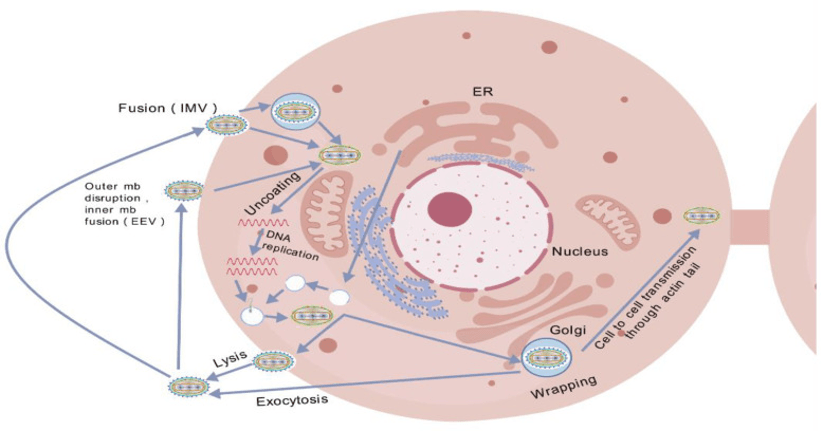
The life cycle of MPXV. (PMID: 41012622)
2.5 Symptoms and Treatment
2.5.1 Clinical Symptoms
The incubation period for mpox is typically 5–21 days. Common clinical manifestations include:
l Skin rash or mucosal lesions (lasting 2–4 weeks)
l Fever
l Headache
l Muscle aches
l Back pain
l Low energy
l Lymphadenopathy (a distinguishing feature from smallpox)
Clinical features have shifted in recent outbreaks, with lesions becoming more localized, predominantly in the anogenital area. Mpox is generally self-limiting in immunocompetent individuals, but severe cases may occur in pregnant women, young children, and immunocompromised individuals (particularly those with HIV).
2.5.2 Antiviral Treatment
Mpox management primarily relies on supportive care:
l Pain management
l Skin lesion care
l Management of complications
2.6 Targets for Intervention
2.6.1 Viral Targets
Target | Protein | Biological Role |
VP37/F13L | Envelope protein | Viral envelopment and egress |
E9L | DNA polymerase | Viral DNA replication |
A35R/A33 | Envelope protein | Cell-to-cell spread |
M1R, B6R | Immunogens | Induce protective immunity |
A27L, L1R | Entry facilitators | Attachment and entry |
D5 | Helicase-primase | DNA replication |
2.6.2 Host Targets
Host Target | Type | Role in Infection |
cGAS-STING pathway | Innate immune pathway | Activated by virus to upregulate IFN-I expression |
Type I interferon (IFN-I) | Cytokine | Antiviral response; significantly inhibits MPXV replication |
Clathrin-mediated endocytosis | Endocytic pathway | Viral entry |
2.7 Vaccine Types and Development Progress
Several mpox vaccines are currently licensed or in clinical trials.
2.7.1 MVA-BN (JYNNEOS/Imvanex/Imvamune, Third-Generation Attenuated Vaccinia Vaccine)
MVA-BN is a third-generation live attenuated vaccine based on Modified Vaccinia Ankara (MVA) and is the most widely used mpox vaccine.
l Approvals: licensed in the EU (Imvanex), US (Jynneos), and Canada (Imvamune); WHO-prequalified in 2024
l Regimen: two-dose schedule (28 days apart), subcutaneous administration
l Efficacy: favorable safety profile and promising efficacy data in preventing clade IIb mpox, including in immunocompromised individuals
l Children and adolescents: multiple clinical trials ongoing, including evaluation of two doses of MVA-BN in adolescents aged 12–17
l People living with HIV: immunogenicity and safety trial of MVA-BN in adults living with HIV in Kinshasa, DRC
2.7.2 LC16m8 (Second-Generation Live Attenuated Vaccine)
LC16m8 is a live attenuated vaccine derived from the Japanese Kagoshima strain.
l Clinical trial: a trial evaluating the effectiveness and safety of the LC16m8 mpox vaccine was initiated in the DRC in 2025
2.7.3 MVA-SIBP (Chinese MVA Vaccine)
MVA-SIBP is a Chinese MVA-based mpox vaccine.
l Phase 2 trial: a double-blind, randomized, controlled, age de-escalation Phase 2 study was initiated in the DRC in 2025 to evaluate the safety and immunogenicity of MVA-SIBP in individuals aged 2–45 years
2.7.4 BNT166a (mRNA Vaccine, BioNTech)
BNT166a is a lipid nanoparticle (LNP)-encapsulated quadrivalent mRNA vaccine encoding MPXV antigens A35, B6, M1, and H3.
l Preclinical studies: demonstrated immunogenicity and protective efficacy against MPXV clades I and II and vaccinia virus in murine and non-human primate models
l Phase 1 trial (NCT05988203) : 48 vaccinia-naïve participants (median age 35) and 16 vaccinia-experienced participants (median age 58) were enrolled. Local and systemic reactogenicity events were mostly mild-to-moderate. No related serious adverse events were observed. BNT166a induced binding antibodies against all four antigens
2.7.5 mRNA-1769 (mRNA Vaccine, Moderna)
Moderna's quadrivalent mRNA mpox vaccine has entered clinical trials.
2.7.6 Other Vaccine Candidates
Approximately 20 mpox vaccine candidates are currently in development using mRNA, DNA, and live-attenuated platforms, most targeting conserved MPXV intracellular mature virion (IMV) and extracellular enveloped virion (EEV) antigens.
2.8 Drugs
2.8.1 Virus-Targeted Drugs
Target | Drug/candidate | Mechanism | Stage |
VP37/F13L | Tecovirimat (TPOXX) | Inhibits viral envelopment and egress | Expanded access |
E9L DNA polymerase | Cidofovir | DNA polymerase inhibition | Research/expanded access |
Brincidofovir | DNA polymerase inhibition | Research | |
Viral replication | Interferon (IFN-α/β) | Antiviral immune modulation | Preclinical |
2.8.2 Emerging Antiviral Candidates
G243-1720: In 2025, the Zhang Rong team at Fudan University reported in Nature Communications the discovery of a novel anti-poxvirus lead compound G243-1720 through high-throughput screening using a replication-defective MPXV (rdMPXV) platform. Although structurally distinct from tecovirimat, this compound shares the same target (OPG57/F13L) and exerts its inhibitory effect by inducing target protein dimerization.
2.8.3 Monoclonal Antibodies
l Human anti-A35R monoclonal antibodies: A 2025 study published in Cell identified two human monoclonal antibodies (mAb 975 and mAb 981) that cross-recognize vaccinia virus A33 and MPXV A35 proteins. In a CAST/EiJ mouse infection model, either antibody alone significantly reduced viral loads in plasma and tissues and alleviated splenic pathology. In rhesus macaque models, the antibodies also showed protective effects, reducing viral loads in plasma, throat swabs, anal swabs, and tissues, with significant suppression of skin lesion development.
l Bispecific antibody: The team of Gao Fu/Wang Qihui at the Institute of Microbiology, Chinese Academy of Sciences, characterized the molecular features of antibodies induced by MPXV key immunogens M1R and B6R, and designed a bispecific antibody that demonstrated significant protective efficacy in animal models.
2.9 Epidemiology
l First identified: 1958, Copenhagen, Denmark (in monkeys)
l First human case: 1970, Democratic Republic of the Congo
l 2022 global outbreak: 94,274 confirmed cases; US 32,125 cases (58 deaths), Brazil 10,967 cases (16 deaths)
l 2024–2025 outbreaks (Africa) :
Ø 1 January 2024 to 7 December 2025: 60,997 confirmed cases and 244 deaths across 34 African countries
Ø 2025 (as of June): 20,936 confirmed cases, already surpassing the total for 2024 by 6%
Ø 2025 (as of September): 44,299 confirmed cases and 180 deaths across 93 countries
Ø 2025 (as of October): 39,799 confirmed cases and 178 deaths across 27 countries (CFR ≈0.4%)
l May 2025: 6,823 confirmed cases and 16 deaths (CFR 0.2%) reported from 49 countries across all WHO regions
l 2025: Africa accounted for >90% of global cases, with nearly 32,000 cases and 137 deaths, predominantly from DRC, Sierra Leone, and Uganda
l Major circulating clades:
Ø Clade IIb: drove the 2022 global outbreak, primarily through sustained human-to-human transmission among men who have sex with men (MSM)
Ø Clade Ib: emerged in Central Africa in 2024, primarily transmitted through sexual contact within heterosexual networks
Ø Clade Ia: recent outbreaks with sexual contact transmission
l Transmission routes:
Ø Animal → human: contact with blood, bodily fluids, or skin/mucosal lesions of infected animals (zoonotic spillover)
Ø Human → human: direct contact with skin lesions, bodily fluids, respiratory droplets, or contaminated surfaces/objects
Ø Sexual contact: has become a predominant transmission route in recent outbreaks
l 2025 Sierra Leone outbreak: caused by Clade IIb, involving 5,442 confirmed cases with a CFR of 1.1%
2.10 Diagnosis
Diagnosis of mpox relies on laboratory testing
l PCR (Polymerase Chain Reaction) : detection of viral DNA from skin lesion specimens; the gold standard for diagnosis
l Serological tests: detection of anti-MPXV antibodies
l CRISPR-based point-of-care diagnostics: novel rapid diagnostic technologies
2.11 Prevention
l Vaccination: MVA-BN (JYNNEOS/Imvanex) is the primary means of mpox prevention
l Avoid contact: avoid contact with potentially infected animals (particularly rodents and primates) and skin lesions/bodily fluids of infected individuals
l Personal hygiene: practice good handwashing, especially after contact with animals or patients
l Healthcare settings: healthcare providers should wear appropriate personal protective equipment (PPE)
l Safe sexual practices: adopt safe sexual practices in outbreak areas
l Surveillance and contact tracing: rapid surveillance and contact tracing are critical for outbreak control
3. Related Products & Services
l Recombinant Antigens & Receptors
l Antibodies
l Detection Kits
l Recombinant Protein Expression Services
l Antibody Development Services
4. Resources
5. References
1. Ogoina, D., Dunning, J., Damon, I., et al. (2026). Mpox emergence, epidemiology, biology, clinical features and control. Nature Reviews Microbiology, 24(7), 463–477.
2. Moss, B. (2024). Understanding the biology of monkeypox virus to prevent future outbreaks. Nature Microbiology, 9, 1408–1416.
3. Lum, F. M., Torres-Ruesta, A., Tay, M. Z., et al. (2022). Monkeypox: disease epidemiology, host immunity and clinical interventions. Nature Reviews Microbiology, 20(10), 597–613.
4. Gessain, A., Nakoune, E., & Yazdanpanah, Y. (2022). Monkeypox. New England Journal of Medicine, 387(19), 1783–1793.
5. Likos, A. M., Sammons, S. A., Olson, V. A., et al. (2005). A tale of two clades: monkeypox viruses. Journal of General Virology, 86(10), 2661–2672.
6. Chen, N., Li, G., Liszewski, M. K., et al. (2005). Virulence differences between monkeypox virus isolates from West Africa and the Congo basin. Virology, 340(1), 46–63.
7. Deputy, N. P., Deckert, J., Chard, A. N., et al. (2023). Vaccine effectiveness of JYNNEOS against mpox disease in the United States. New England Journal of Medicine, 388(26), 2434–2443.
8. Cotter, C. A., Ignacio, M. A., Americo, J. L., et al. (2024). Mpox mRNA-1769 vaccine inhibits orthopoxvirus replication at intranasal, intrarectal, and cutaneous sites of inoculation. npj Vaccines, 9, 256.
9. Bähner, F., Faust, S. N., Davies, L. R. L., et al. (2026). Safety and immunogenicity of mRNA-based mpox vaccine candidate BNT166a: an open-label, dose-escalation, first-in-human trial. The Lancet Infectious Diseases.
10. Zucker, J., Fischer, W. A., Zheng, L., et al. (2026). Tecovirimat for the Treatment of Mpox. New England Journal of Medicine, 394(9), 884–895.
11. PALM007 Writing Group. (2025). Tecovirimat for Clade I MPXV Infection in the Democratic Republic of Congo. New England Journal of Medicine, 392(15), 1484–1496.
12. Grosenbach, D. W., Honeychurch, K. M., Rose, E. A., et al. (2011). Oral tecovirimat for the treatment of smallpox. New England Journal of Medicine, 365(10), 903–912.
13. Chen, J., Hu, L., Vernuccio, R., et al. (2025). Development of a replication-defective mpox virus platform for fundamental and therapeutic research. Nature communications, 17(1), 798.
14. Okumura, N., Morino, E., Nomoto, H., et al. (2026). LC16m8 for Pre-exposure Prophylaxis Against Mpox in a High-Risk Population: An Open-Label Randomized Trial. Clinical infectious diseases : an official publication of the Infectious Diseases Society of America, 82(4), 665–672.
15. Bai, S., Song, S., Wang, X., et al. (2026). Discovery and Structural Characterization of a Highly Protective Neutralizing Antibody Targeting the Mpox Virus A35R Protein. MedComm, 7(7), e70804.
16. Wang, Y., Hai, M., Guo, Z., et al. (2025). Evolving Threats: Adaptive Mechanisms of Monkeypox Virus (MPXV) in the 2022 Global Outbreak and Their Implications for Vaccine Strategies. Viruses, 17(9), 1194.