
info@ucallmlabs.com
Astrocytes are the most abundant type of glial cells in the central nervous system (CNS) and play essential roles in maintaining neuronal homeostasis, regulating synaptic function, contributing to blood–brain barrier formation, and promoting neural injury repair. Neural Stem Cells (NSCs), as multipotent neural progenitor cells during nervous system development, can be induced to differentiate into mature astrocytes with functional characteristics by mimicking the in vivo process of astrogliogenesis under defined culture conditions.
In vitro astrocyte differentiation systems typically maintain NSC expansion using EGF and FGF2, followed by the application of glial-inducing factors such as CNTF, LIF, and BMP2/4 to activate JAK/STAT and BMP signaling pathways. These signals promote the transition of NSCs from a neurogenic state toward glial lineage commitment, progressing through glial progenitors, immature astrocytes, and ultimately mature astrocytes. During differentiation, cells gradually acquire the expression of key glial lineage-determining factors, including SOX9, NFIA, and NFIB, and further express mature astrocyte markers such as GFAP, S100β, ALDH1L1, AQP4, and EAAT1/EAAT2.
NSC-derived astrocyte models effectively recapitulate aspects of human astrocyte development and gliogenesis, providing valuable platforms for studying mechanisms underlying neurodevelopmental disorders, Alzheimer’s disease, Parkinson’s disease, brain injury, and neuroinflammation. These models also serve as reliable cellular resources for neurotoxicity assessment, drug screening, cell therapy research, and the development of neurological disease models.
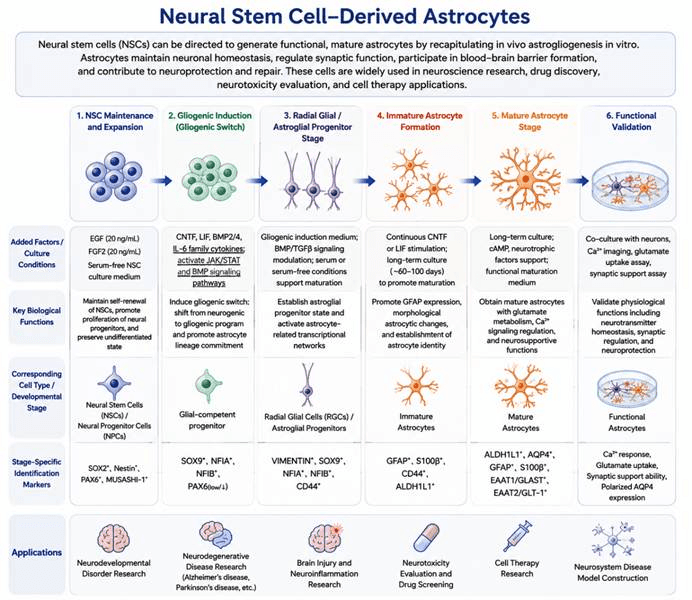
Schematic diagram of the in vitro differentiation process of Neural Stem Cell–Derived Astrocytes. Neural Stem Cells undergo expansion and maintenance, followed by glial lineage induction, and progressively differentiate through glial progenitor cells, immature astrocytes, and mature astrocytes. Under the regulation of signaling factors such as CNTF, LIF, and BMP, NSCs undergo astrocytic fate specification and functional maturation. Different differentiation stages can be characterized by stage-specific markers, including SOX2, Nestin, SOX9, NFIA, GFAP, S100β, ALDH1L1, AQP4, and EAAT1/2, and further validated through functional assays such as neuronal co-culture, calcium signaling analysis, and glutamate uptake evaluation. This model provides a valuable platform for studying neural development, neurodegenerative diseases, brain injury, neuroinflammation, drug screening, and cell therapy research.
Differentiation Stage | Added Factors / Culture Conditions | Core Biological Function | Corresponding Cell Type / Developmental Stage | Stage-specific Identification Markers |
NSC Maintenance and Expansion Stage | EGF (20 ng/mL), FGF2 (20 ng/mL), serum-free neural stem cell culture system | Maintains neural stem cell self-renewal capacity, promotes neural progenitor cell expansion, and preserves an undifferentiated state | Neural Stem Cells (NSCs) / Neural Progenitor Cells (NPCs) | SOX2⁺, Nestin⁺, PAX6⁺, MUSASHI-1⁺ |
Neural Glial Lineage Initiation Stage | CNTF, LIF, BMP2/BMP4, IL-6 family cytokines; activation of JAK/STAT and BMP signaling pathways | Induces the transition of NSCs from a neurogenic state to a gliogenic state (gliogenic switch), promoting astrocytic fate specification | Glial-competent Progenitors | SOX9⁺, NFIA⁺, NFIB⁺, reduced PAX6 expression |
Radial Glial / Astroglial Progenitor Stage | Glial induction medium; BMP/TGFβ-related signaling regulation; serum or serum-substitute conditions to promote maturation | Establishes astroglial progenitor identity and activates astrocyte-specific transcriptional networks | Radial Glial Cells (RGCs) / Astroglial Progenitors | VIMENTIN⁺, SOX9⁺, NFIA⁺, NFIB⁺, CD44⁺ |
Immature Astrocyte Formation Stage | Continuous CNTF or LIF stimulation; long-term culture (approximately 60–100 days) to promote maturation | Promotes GFAP expression, astrocyte-like morphology, and establishment of astrocytic identity | Immature Astrocytes | GFAP⁺, S100β⁺, CD44⁺, ALDH1L1⁺ |
Mature Astrocyte Stage | Long-term culture; cAMP and neurotrophic factor support; functional maturation culture system | Establishes mature astrocytes with glutamate metabolism, calcium signaling regulation, and neuronal support functions | Mature Astrocytes | ALDH1L1⁺, AQP4⁺, GFAP⁺, S100β⁺, EAAT1/GLAST⁺, EAAT2/GLT-1⁺ |
Functional Validation Stage | Neuronal co-culture, Ca²⁺ imaging, glutamate uptake assay, synaptic support assay | Validates physiological functions of astrocytes, including neurotransmitter homeostasis, synaptic regulation, and neuroprotective effects | Functional Astrocytes | Ca²⁺ responses, glutamate uptake capacity, synaptic support ability, AQP4 polarization expression |