info@ucallmlabs.com
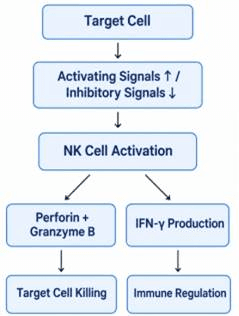
Natural killer (NK) cells are important cytotoxic lymphocytes of the innate immune system, and their activation mechanisms differ from those of T cells and B cells. Unlike T and B cells, NK cells do not rely on a single antigen-specific receptor. Instead, they determine whether target cells are in an abnormal state by integrating signals from multiple activating receptors and inhibitory receptors.
Normal cells typically express MHC class I molecules, which provide “self” signals through inhibitory receptors on NK cells, thereby preventing inappropriate NK-cell activation. In contrast, virus-infected cells or tumor cells may exhibit reduced MHC I expression and increased expression of stress-induced ligands, causing activating signals to dominate and triggering NK-cell-mediated cytotoxicity.
In addition, NK cells can recognize IgG-coated target cells through CD16 (FcγRIII) and eliminate these cells through antibody-dependent cellular cytotoxicity (ADCC). Upon activation, NK cells release Perforin and Granzyme B to disrupt target cells and induce apoptosis. They can also produce large amounts of cytokines such as IFN-γ, contributing to macrophage activation and regulation of immune responses.
Core Process of NK Cell Activation